


S&T Clusters Annual Report 2024-2025” highlighted various initiatives launched under the programme, including Kalaanubhav.in which is an AR/VR-enabled artisan marketplace
About the S&T Clusters initiative
- Genesis: Launched in 2020 based on the recommendations of the Prime Minister’s Science, Technology, and Innovation Advisory Council (PM-STIAC).
- Aims: To bring together stakeholders, like academic institutions, R&D organisations, industry, local governments, to deliver demand-driven solutions through innovative ideas.
- Working Model:
- Operates through a consortium-based approach.
- Focuses on science and tech-based regional problem-solving.
- Nodal Implementing Agency: Office of the Principal Scientific Adviser (PSA)
- PSA works under the Cabinet Secretariat.
Article Sources
1 sourceCritical and Emerging Technologies Index has been launched to assess how 25 countries perform across five technology sectors: AI, biotechnology, semiconductors, space, and quantum.
- Published by the Harvard Kennedy School.
- It identifies six criteria that define each technology sector: geopolitical significance, systemic leverage, GDP contribution, dual-use potential, supply chain risk, and time to maturity.
Key Findings
- India lags significantly behind the top three — U.S., China, and Europe — across most technology sectors.
- India trails in critical tech, particularly semiconductor tech.
DRDO & IIT Delhi achieved quantum entanglement based free space communication.
- The free-space quantum secure communication was demonstrated over a distance of ~1 km via a free-space optical link.
- ISRO demonstrated 1st free-space QKD over 300m in 2021.
About the experiment
- It was part of the ‘Design and development of photonic technologies for free space Quantum Key Distribution (QKD)’ of DRDO.
- The experiment exhibited a very low Quantum Bit Error Rate (QBER) of less than 7%.
- QBER is the error between the information sent and received and an indicator of the probability of eavesdropping.
- It paves the way for real-time applications in quantum cybersecurity, long-distance QKD, and the future quantum internet.
What is QKD?
- Communication Technology: It is a Quantum Communication technology based on quantum mechanics, that is, quantum entanglement and cryptography.
- Quantum mechanics explains how extremely small objects simultaneously the characteristics of both particles and waves have (a disturbance or variation that transfers energy).
- Physicists call this the “wave-particle duality.”
- Quantum mechanics explains how extremely small objects simultaneously the characteristics of both particles and waves have (a disturbance or variation that transfers energy).
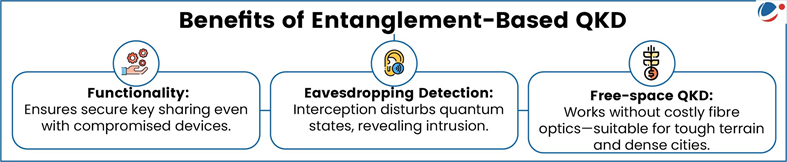
- Key Principles:
- Quantum entanglement: Particles of the same origin, which were once connected, always stay connected, even when separated by vast distances.
- Quantum cryptography: encryption to secure and transmit data in a way that cannot be hacked.
Article Sources
1 sourceRecently used in the Russia-Ukraine conflict, fiber optic drones are seen as a a game-changer in drone warfare due to their resistance to electronic warfare (EW).
About Fiber Optic Drones

- These drones are tethered to the operator using long fiber optic cables (up to 20 km) instead of radio links.
- Fiber optic cable is made up of a collection of glass tubes spun as thin as hairs.
- They can support faster speeds, longer distances, and simultaneous communications.
- Unlike wired cable, fiber only supports a single communication on a single frequency at one time.
- No radio link means they cannot be jammed or intercepted by electronic warfare (EW) systems.
Article Sources
1 sourceThe Department of Posts (DoP) has released a comprehensive policy document outlining the framework for DHRUVA, a national-level Digital Address Digital Public Infrastructure (DPI).
About DHRUVA
- DHRUVA is a DPI being developed by DoP to provide a unique digital address for every home in India.
- It creates a secure digital environment through which users can share accurate address information by leveraging a geo-coded framework.
- Aim: To recognize address information management as a foundational public infrastructure vital for effective governance, inclusive service delivery, and enhanced user experience.
- It will also enable Address-as-a-Service (AaaS), the array of services associated with address data management.
- Consists of 2 key Layers:
- Digital Postal Index Number (DIGIPIN): It is a 10- digit alpha-numeric code representing geographic coordinates (latitude-longitude), developed by creating uniform approximately 4x4 meter grids on India’s territory.
- DIGIPIN uniquely identifies locations using geospatial data.
- Digital Address Layer: It is a user-centric, consent-based system built on DIGIPIN, allowing users to create customized labels to represent their DIGIPIN and descriptive addresses.
- Digital Postal Index Number (DIGIPIN): It is a 10- digit alpha-numeric code representing geographic coordinates (latitude-longitude), developed by creating uniform approximately 4x4 meter grids on India’s territory.
- Key Features: Privacy & Security; Interoperability and Openness; Scalability; Transparency & Accountability; Innovation Friendly etc.
Benefits | ||
Citizens | Private Sector | Governance |
|
|
|
Article Sources
1 sourceChina launched Tianwen-2 probe to return samples from an asteroid near Mars.
- Earlier, Tianwen-1 probe consisting of an orbiter, a lander and a rover (Zhurong) landed on mars’ surface in 2021.
- Tianwen-3, scheduled for (launch) around 2028, aims to collect and bring samples back to Earth from Mars while Tianwen-4 aims to explore Jupiter around 2030.
About Tianwen-2 probe
- Launch Vehicle: Long March 3-B rocket.
- Aim: Collect samples from the Asteroid 2016HO3 and explore the main-belt comet 311P, which lies even further from the Earth than Mars.
India’s first gene-edited sheep has been produced by researchers from Kashmir University in collaboration with ICAR using CRISPR-Cas9 technology.
- This follows the release of India’s first gene-edited rice variety recently.
About CRISPR-Cas9 Technology
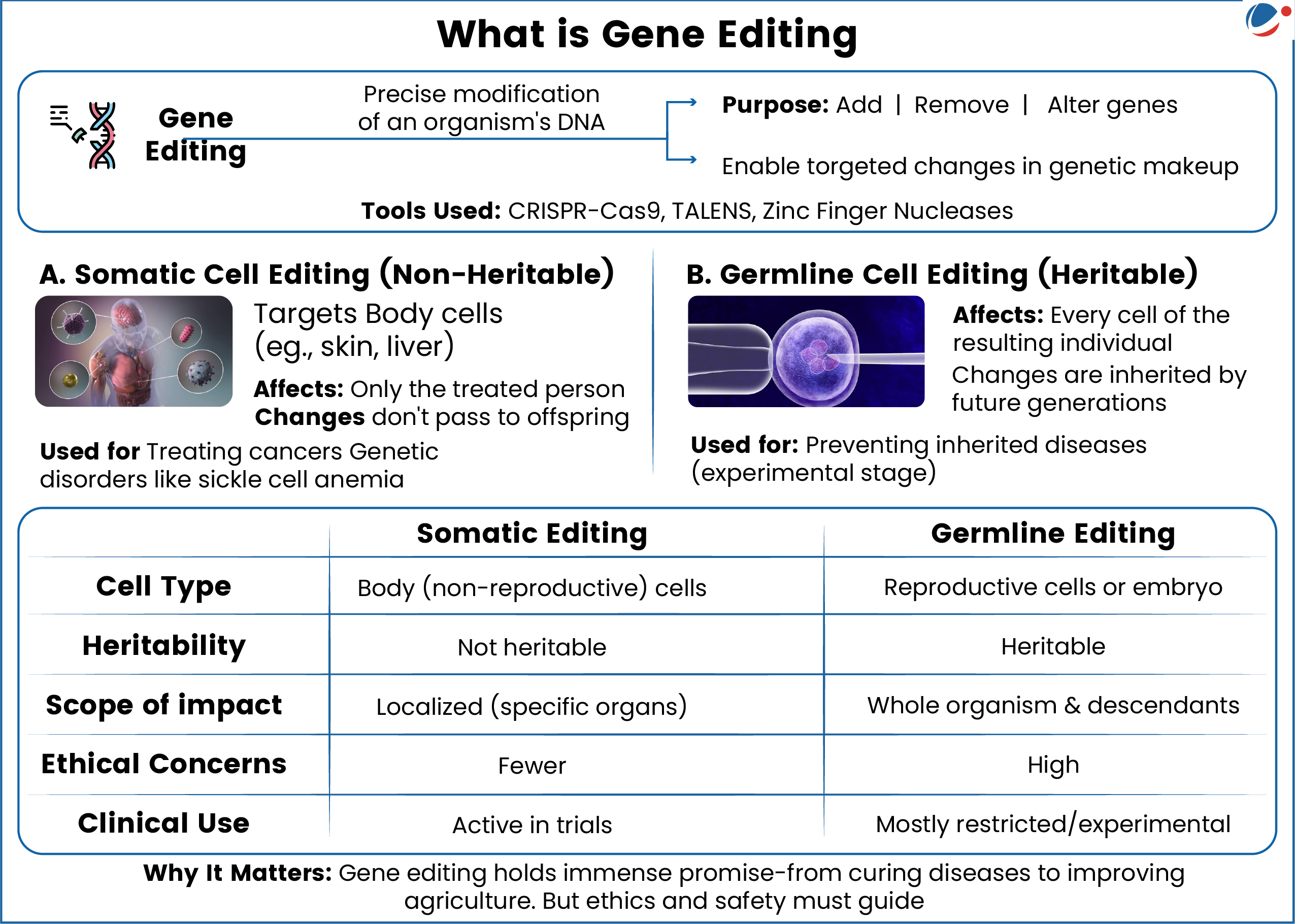
- CRISPR-Cas9 works on a cut-and-paste mechanism for DNA Strands.
- The 2020 Nobel Prize for Chemistry was awarded for their discovery.
About the Research
- Myostatin gene in a lamb was edited boosting muscle growth by 30% (a trait found in some European breeds, such as the Texel, but absent in Indian breeds).
- No foreign DNA was added, making it different from transgenic animals.
- Thus, this technique makes the process efficient, safe, and potentially acceptable to both regulators and consumers.
- Earlier the National Dairy Research Institute (NDRI) had developed a gene-edited buffalo embryo.
Ethical Concerns in Gene Editing Animals
- Editing traits like intelligence, sex, or appearance may lead to the creation of designer babies, potentially creating a divide between the wealthy and others.
- It risks eugenics, promoting the idea of "improving" humans and increasing discrimination.
- Gene editing may cause off-target effects and mosaicism, which refers to mixed changes in cells.
- There are unknown risks, such as new diseases or ecosystem damage.
- Animal welfare is a concern, as creating genetically edited animals often involves sacrificing some animals and performing surgical procedures.
- The International Bioethics Committee of UNESCO explores the ethical implications of genome editing.
US Food and Drug Administration (FDA) approves new HIV prevention drug Lenacapavir.
- FDA approval also paves the way for WHO prequalification, which can accelerate national regulatory approvals.
- WHO Prequalification of Medicines Programme (PQP) helps ensure that medicines supplied by procurement agencies meet acceptable standards of quality, safety and efficacy.
About Lenacapavir
- Lenacapavir is an antiretroviral medicine that is used for HIV prevention as a Pre-Exposure Prophylaxis or PrEP.
- PrEP is a medication that can reduce the risk of HIV infection for individuals who are HIV-negative but are at risk of contracting the virus.
- WHO currently recommends oral PrEP, the dapivirine vaginal ring, and long-acting injectable cabotegravir (CAB-LA) as options for HIV PrEP.
About HIV
- Human Immunodeficiency Virus (HIV) is a virus that attacks the body’s immune system.
- Mechanism: HIV damages the immune system by infecting and destroying CD4 cells (CD4 T Lymphocytes), a type of white blood cells.
- Transmission: HIV is spread from the body fluids of an infected person, including blood, breast milk, semen and vaginal fluids.
- It can also spread from a mother to her baby.
- Treatment: HIV can be prevented and treated with antiretroviral therapy (ART).
- Untreated HIV can progress to acquired immunodeficiency syndrome (AIDS).
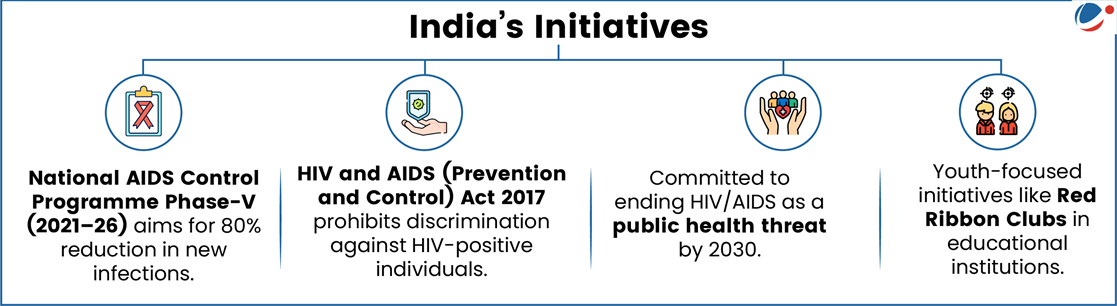
- According to HIV Estimations 2023 report, over 2.5 million people are living with HIV in India.
Danish pharma company Novo Nordisk launched its weight loss drug Wegovy in India.
- The drug Semaglutide, marketed under the brand name Wegovy, will be available in the form of injections to be administered once a week.
- Semaglutide, works as an appetite suppressant by imitating a hormone called glucagon-like peptide-1 (GLP-1).
- GLP-1 is an intestinal hormone released after eating, and usually makes people feel fuller.
- Semaglutide, works as an appetite suppressant by imitating a hormone called glucagon-like peptide-1 (GLP-1).
- Other weight loss drugs include Mounjaro, which is made up of tirzepatide (mimics function of GLP-1 and GIP).


