


Why in the News?
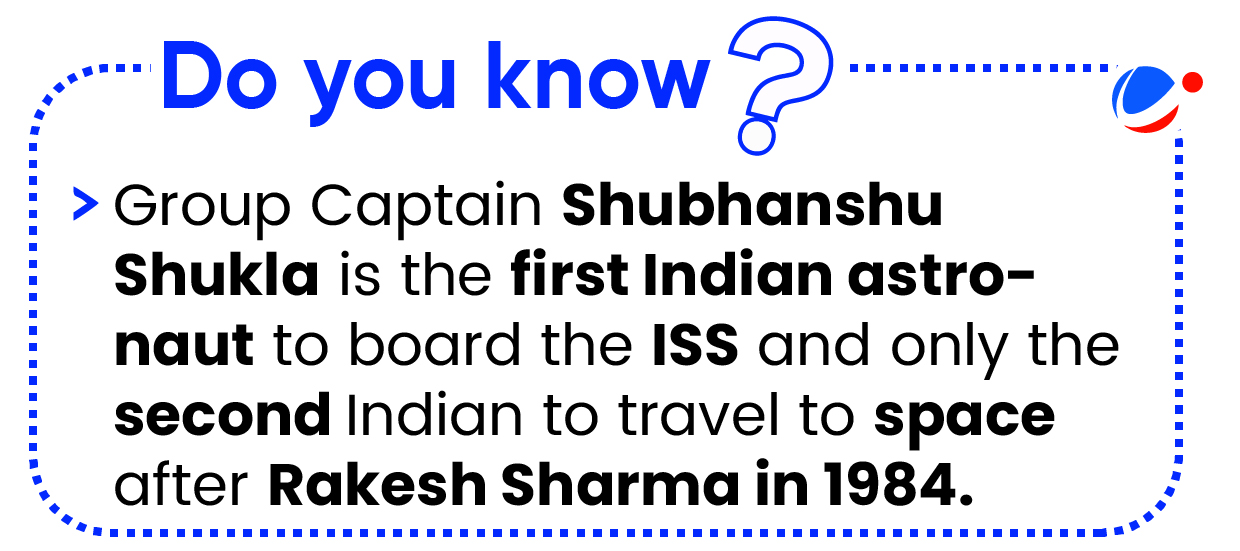
The Axiom-4 Mission carrying Indian astronaut Group Captain Shubhanshu Shukla and 3 other astronauts successfully returned on July 15, 2025.
About Axiom-4 (Ax-4) Mission
- It is the 4th private astronaut mission, to the International Space Station (ISS), of private US Company Axiom Space in collaboration with NASA and SpaceX.
- It was a 14-day mission launched aboard a SpaceX Dragon Spacecraft by the Falcon 9 launch vehicle from NASA's Kennedy Space Centre, Florida.
- Falcon 9 is a two-stage reuseable launch vehicle and Dragon spacecraft is a reusable crew module for carrying astronauts into space.
- Astronauts: Shubhanshu Shukla (India), Peggy Whitson (USA), Sławosz Uznański (Poland), and Tibor Kapu (Hungary).
- Key Features:
- Aim: To "realize the return" to human spaceflight for India, Poland, and Hungary.
- Ax-4 marks each nation's first mission to the ISS in history and with each nation's first government-sponsored flight in more than 40 years.
- Research: 60+ scientific studies representing 31 countries, including microgravity experiments, human physiology research, Earth observation imaging, among others.
- Following research and activities have been executed by ISRO:
- Crop growth: Study impact of microgravity on 6 crop seed varieties for future space farming.
- Cyanobacteria: Observe growth and activity for use in spacecraft life support systems.
- Cyanobacteria are aquatic bacteria that can photosynthesize.
- Space Microalgae: Compare metabolic and genetic activity in space vs Earth; potential use as food, fuel, or for life support.
- Myogenesis: Study muscle loss, identify pathways responsible for skeletal muscle dysfunction in microgravity and explore therapeutic targeting strategies.
- Tardigrades: Investigate the revival, survival, and reproduction of tardigrades to identify molecular mechanisms of resilience.
- Others: Investigate how the physical and cognitive impact of utilizing computer screens in microgravity; STEM outreach activities for Indian students.
Axiom Mission's Significance for India
- Development of Gaganyaan Mission: Offers valuable inputs for medical training, psychological prep, and crew–ground coordination.
- Group Captain Shubhanshu Shukla is one of the 4 astronauts selected for the Gaganyaan Mission.
- Space diplomacy: Highlights ISRO's global collaborations with NASA, ESA, and private firms.
- Development of India's Space Ecosystem: Encourages growth of India's space industry; aligns with plans for Bharatiya Antariksh Station.
- National Pride and inspiration: Indian astronauts in space will inspire Indian youth to pursue careers in science, technology, engineering, and mathematics (STEM).
Major Obstacles for India in launching a Manned Space Mission
- Technological
- Life support system: Must ensure air regeneration, temperature control, waste recycling, and food storage.
- Radiation protection: Beyond Low Earth Orbit, cosmic radiation and solar particle events pose serious health risks.
- Spacecraft re-entry and thermal protection: For re-entry into Earth's atmosphere, spacecraft must withstand temperatures up to 7,000 degrees Fahrenheit, caused by the compression of gas and air particles against the surface of the spacecraft.
- Launch vehicle reliability: Human-rated rockets must meet stricter safety standards to address complexities including controlled ascent, abort systems, and reusability.
- Logistical
- Higher cost: Manned space missions incur higher costs due to requirement of robust ecosystems including launchpads, testing facilities, tracking stations, etc.
- Training and selection of astronauts: Astronauts need rigorous physical, psychological, and technical training.
- Additionally, long-term missions also raise concerns of space-induced psychological issues.
About International Space Station (ISS)
About Gaganyaan Programme
About Bharatiya Antariksh Station (BAS)
|
Conclusion
For India, the collaborations under Axiom-4 Mission, not only accelerates technological learning ahead of its proposed Gaganyaan mission but also build critical human capital and infrastructure for future long-duration spaceflight.




