


Why in the News?
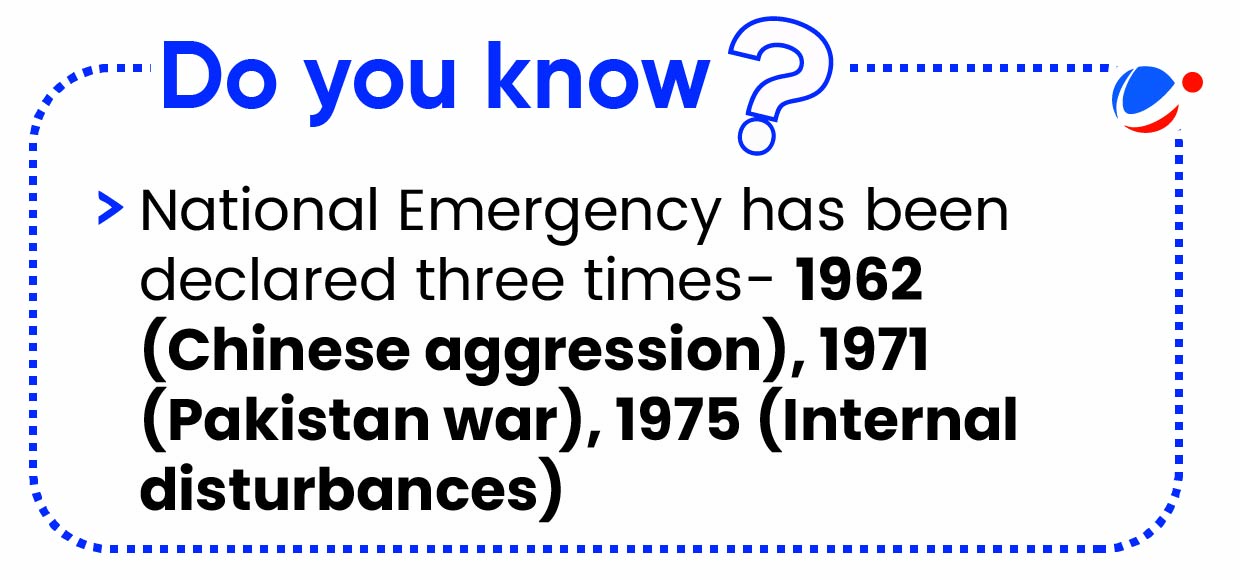
2025 marked 50 years since the imposition of the National Emergency, declared on June 25, 1975, and lasting until March 21, 1977.
Why Emergency in 1975 was imposed?
- Social Unrest: Large-scale protests, strikes, and demonstrations, notably JP Movement led by Jayaprakash Narayan, questioned the legitimacy of Indira Gandhi's rule. This unrest created an environment conducive to the declaration of Emergency, which the government claimed was necessary to restore order.
- Economic crises post 1971 war: Country was grappling with severe economic distres s, including inflation, unemployment, and economic stagnation, exacerbated by global oil crisis.
- Political Factors: Allahabad High Court had invalidated Indira Gandhi's election in the case of State of UP vs. Raj Narain, accusing her of electoral malpractice. Her response to this judgment and growing political unrest led to a desire to centralize power.
Major Constitutional Amendments during Emergency:
- 38th Amendment (1975): Barred judicial review of Emergency declaration by making President's satisfaction to be 'final and conclusive' under Articles 352, 356 and 360.
- 39th Amendment (1975): It introduced changes in the method of deciding election disputes relating to President, Vice President, Prime Minister and Speaker.
- To be decided by such authority as may be determined by Parliament. Thus, effectively keeping these offices beyond scope of judiciary.
- 42nd Amendment (1976):
- Gave primacy to Directive Principles over Fundamental Rights under article 31C.
- Curtailment of powers of Supreme Court and High Court by various measures, like
- Article 32A was inserted to deny SC power to consider the constitutional validity of State laws. (omitted by 43rd amendment act)
- Deny HC power to check constitutional validity of Central laws (Article 131A & 226A).
- Extended Lok Sabha term from 5 to 6 years.
- Gave Parliament power to amend the Constitution virtually unchecked by adding clauses 4 & 5 to Article 368.
- Apart from this during emergency civil liberties and fundamental rights were suspended (as noted in the ADM Jabalpur case), media was censored, and mass arrests occurred under laws like MISA.
Post-Emergency Reforms
- Shah Commission established in May 1977 to probe abuses like sterilisations, government employees forcibly retired, Censorship of courts & Parliament, etc.
- Changes brought after Internal Emergency through 44th Amendment Act (1978):
- Changes under Article 352:
- Changed ground for imposing emergency to "armed rebellion" to prevent further misuse on ground of "internal disturbance" which has wider connotation.
- Added safeguards like 'Union Cabinet to communicate to President in writing' to prevent hasty decisions in future.
- Mandatory Parliamentary approval within a month by special majority for Emergency Proclamations.
- Fundamental Rights: Restricted scope of Article 359 i.e. Right to protection in respect of conviction for offences (Article 20) and right to life and personal liberty (Article 21) remain enforceable during emergency.
- It omitted right to property as a fundamental right and made it a constitutional right under Article 300A.
- Removal of Article 257A: It allowed Government of India to deploy any armed force of Union or any other force to deal with any grave situation of law and order in any State.
- Term of Lok Sabha: Back to 5 years from 6 years by amending Articles 83 and 172.
- Restored judicial review: Amendment restored the power of the judiciary to review election disputes concerning President and Vice-President.
- Changed ground for imposing emergency to "armed rebellion" to prevent further misuse on ground of "internal disturbance" which has wider connotation.
Conclusion
Lessons of the Emergency are still very relevant today. There is always a risk that power may be misused in the name of national interest or stability, leading to suppression of dissent and violation of constitutional rights. It underscores the need for constant vigilance by democratic forces to protect constitutional safeguards and civil liberties.
About National Emergency (Article 352)
Effect of Proclamation of National Emergency
|


