


Why in the News?
India is celebrated 10th years of the Digital India Mission launched in 2015.
About Digital India Mission
- Nodal Implementing Ministry: Ministry of Electronics and Information Technology (MeitY).
- Purpose: To transform India into a digitally empowered society and knowledge economy.
- Nature: Umbrella programme that clubs together various e-governance initiatives across Ministries and Departments.
- Leveraging private sector: Public Private Partnerships (PPP) are preferred wherever feasible to implement e-Governance projects.
- Objectives
- To transform India into a digitally empowered society and knowledge economy.
- To ensure digital access, digital inclusion, digital empowerment and bridge the digital divide.
- To ensure that Government services are available to citizens electronically.
- Vision is centred on three key areas:
- Digital Infrastructure as a Utility to Every Citizen
- Governance & Services on Demand
- Digital Empowerment of Citizens
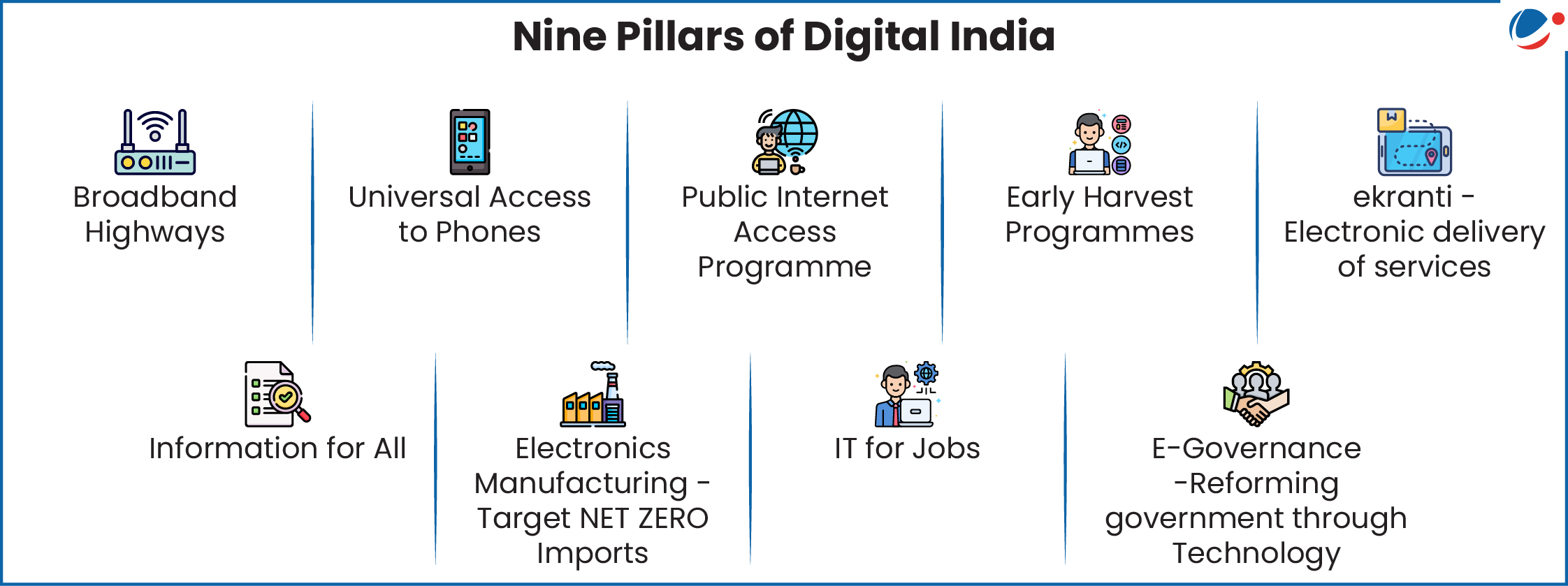
Key Achievements of Digital India Mission
- Digital Economy: India now ranks third globally in terms of digital economy size (State of India's Digital Economy Report 2024) and is expected to contribute nearly 20% of GDP by 2030.
- Rising internet penetration: Internet connections grew 285% (2014–2024) while data costs dropped from ₹308/GB to ₹9.34/GB, making it more affordable.
- Financial Inclusion: India leads globally in real-time payments (49% of global transactions in 2023). DBT transferred ₹44 lakh crore till May 2025, removing ineligible beneficiaries for targeted delivery.
- Inclusivity & Language Access: Initiatives like BHASHINI are breaking language barriers by supporting over 30 Indian languages with different AI models.
- It is integrated into platforms like IRCTC ticketing, NPCI payment systems, and police documentation.
Challenges that Hinder Harnessing Full Potential of Digital India Mission
- Digital Literacy Gap: Only 38% of households are digitally literate.
- Internet usage is uneven, 31% in rural areas compared to 67% in urban areas (Oxfam 2022).
- Poor Connectivity & Broadband Quality: Access is often unreliable due to outages, call drops, and weak signals.
- Outdated broadband definition (2 Mbps) compared to the global standard (25 Mbps+).
- Cybersecurity Risks: India's cyber regulatory framework is inadequate, leaving systems vulnerable to hacking and DDoS attacks.
- Average data breach cost rose 13% to ₹220 million in 2025 (IBM).
- Healthcare Digitization Gaps: Projects like NDHM and e-Sanjeevani are hampered by weak infrastructure and low literacy.
- CoWIN vaccination drive excluded many without smartphones or digital skills.
Way Ahead to Reap the Full Potential of Digital India Mission
- Universal Broadband & Connectivity: The BharatNet Phase-II project should be fast-tracked through state-led, private sector, and CPSU models.
- Radio and satellite technologies can bridge gaps in remote Gram Panchayats.
- Improve Quality of Service: Adequate contiguous spectrum must be allocated, with a push towards advanced technologies.
- Encourage private investment in network upgrades. Keep devices and data affordable to ensure inclusivity.
- Expand & Standardize e-Services: The National e-Governance Division of MeitY must periodically audit state compliance to improve delivery standards.
- Strengthen Cybersecurity: Develop a comprehensive framework for data security and complaint redressal. Strengthen national and cross-border cybercrime response teams.
- Increase research and development for secure IT networks.
- Boost Digital Literacy & Skills: Digital literacy should be integrated into school and college curricula, with the National Digital Literacy Mission training students to pass on knowledge within their communities.
- Include cybersecurity awareness in all training programs.


