


Why in the News?
In 2025, the Convention on International Trade in Endangered Species of Wild Fauna and Flora (CITES) is celebrating its 50th anniversary.
About CITES
- Genesis: Originally conceived in 1963 at the International Union for Conservation of Nature (IUCN) meeting, it entered into force in 1975.
- Aim: Voluntary international agreement between governments ensuring international trade in specimens of wild animals and plants does not threaten their survival.
- It subjects international trade to certain controls covering all import, export, re-export, through a licensing system.
- Secretariat: The CITES Secretariat is administered by UNEP and is located at Geneva, Switzerland.
- IUCN provides scientific and technical services to the CITES Secretariat.
- Parties: 185 parties (States or regional economic organizations). India ratified in 1976.
- Although CITES is legally binding on the Parties, it does not take the place of national laws, rather each party implements it through its own domestic legislation.
- Conference of Parties (CoP): Highest Decision making body. CoP3 was held in New Delhi in 1981.
- CITES Trade Database: Managed by the UN Environment Programme World Conservation Monitoring Centre (UNEP-WCMC) on behalf of the CITES Secretariat.
Key Initiatives of CITES
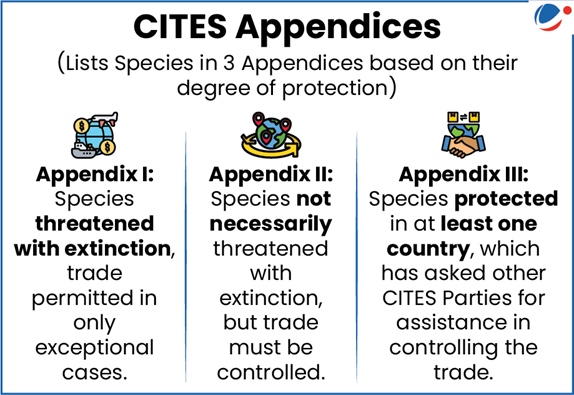
- Protects more than 40,000 animal and plant species through its Appendices. (see infographic)
- MIKE Programme helps range States make appropriate management and enforcement decisions by monitoring trends in levels of illegal killing of elephants.
- E.g. of MIKE sites in India- Chirang-Ripu Elephant Reserve; Dihing Patkai Elephant Reserve.
- Strategic Vision 2021–2030: Guides CITES' efforts to ensure wildlife trade supports global biodiversity goals and sustainable development Goals.
- CITES Tree Species Programme (CTSP): To support the sustainable and legal trade of CITES-listed tree species.
- International Consortium on Combating Wildlife Crime (ICCWC), 2010: To strengthen criminal justice systems and provide coordinated support at national, regional and international level to combat wildlife and forest crime.
Conclusion
Through its evolving strategies, collaborative mechanisms like the MIKE Programme and ICCWC, and a strong legal framework implemented by member countries, CITES continues to play a crucial role in safeguarding biodiversity.


