
Quantum Cyber Readiness | Current Affairs | Vision IAS
MENU
Home

Periodically curated articles and updates on national and international developments relevant for UPSC Civil Services Examination.

Quick Links

High-quality MCQs and Mains Answer Writing to sharpen skills and reinforce learning every day.

Watch explainer and thematic concept-building videos under initiatives like Deep Dive, Master Classes, etc., on important UPSC topics.

ESC

Quantum Cyber Readiness

19 Aug 2025
3 min

Why in the News?

MeitY, CERT-In, and cybersecurity firm SISA jointly launched a whitepaper titled "Transitioning to Quantum Cyber Readiness" to prepare for disruptive potential of quantum technologies, especially in cybersecurity.

More on the news

  • The whitepaper warned that Quantum computers pose a serious threat to current encryption algorithms by breaking asymmetric cryptographic protocols such as Rivest-Shamir-Adleman (RSA).
    • Quantum computers can solve complex, intractable mathematical problems - and perform tasks in machine learning, optimization, and logistics - orders of magnitude faster than conventional computers. 
  • As per the paper, any data requiring protection beyond 2030 should be considered at immediate risk.
  • Harvest Now, Decrypt Later (HNDL) Attacks: These attacks involve adversaries collecting and storing encrypted data today with the intention of decrypting it once quantum computers become capable of breaking current cryptographic systems.
  • Secure channel decryption: Quantum computing can break encrypted network communications and "listen in" on sensitive conversations like defence communications. 
  • Signature impersonation: Quantum computing can enable attackers to forge digital certificates, enabling malware distribution and targeted phishing.
  • New "Zero-Day" vulnerabilities: This includes the potential for yet unknown quantum algorithms to break existing cryptographic systems and challenges associated with transitioning to quantum-resistant cryptography.
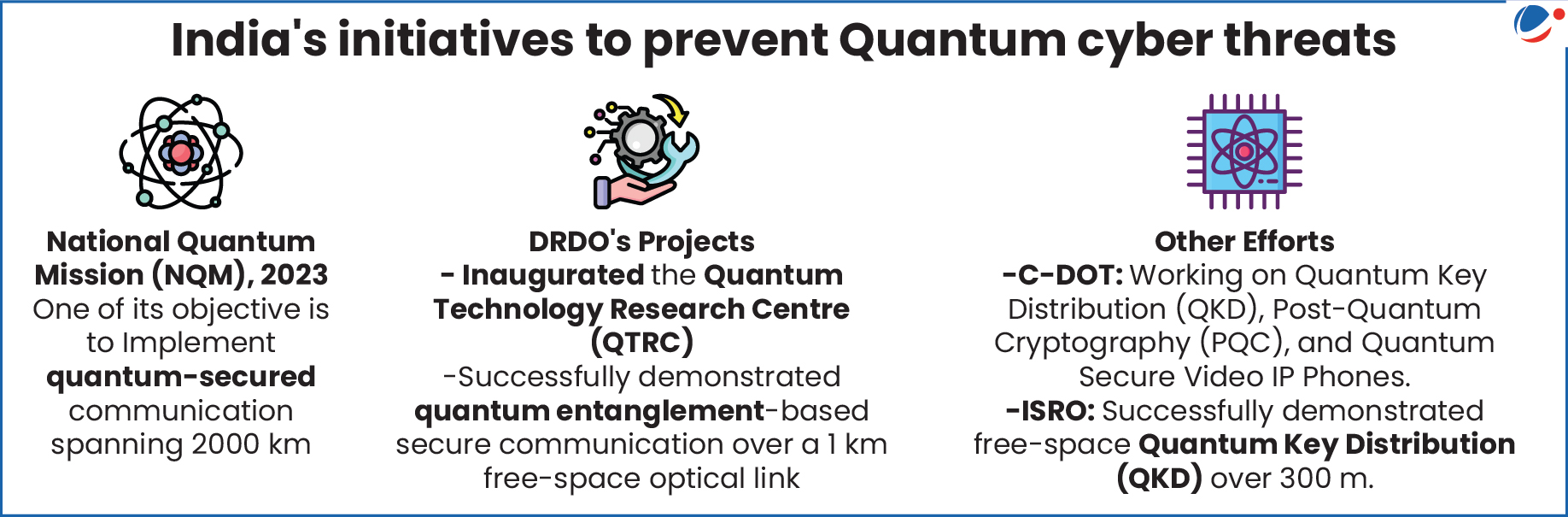
India's initiatives to prepare for quantum cyber threats: National Quantum Mission (2023) – aims to implement quantum-secured communication over 2000 km. DRDO – Quantum Technology Research Centre and 1 km quantum entanglement-based secure communication. Other efforts: C-DOT – Quantum Key Distribution, Post-Quantum Cryptography, Quantum Secure Video IP Phones; ISRO – free-space Quantum Key Distribution over 300 m

Area

Recommendations

Foundational Assessment & Strategic Planning

  • Quantum Bill of Materials (QBOM): To support key initiatives including risk prioritization, procurement decisions that demand post-quantum compatibility, upgrade planning and compliance audits
  • Al-Enhanced Risk Assessment: Machine learning algorithms for pattern recognition in cryptographic usage.

Technology Readiness & Capability Building


  • Organizations must rigorously test and validate Post-Quantum Cryptography (PQC) implementations before deploying them into production environments.
  • Hybrid Cryptography Adoption approach to provide a strategic pathway for organizations transitioning to quantum-safe security by integrating both classical and quantum-resistant algorithms during the migration phase.

Phased Organizational Rollout 


  • PQC should also be embedded into workflows, ensuring secure software development, automated key management and signing processes.
  • Key actions include updating security and ICT policies to mandate standards bodies approved PQC algorithms, define approved toolsets and enforce standards across internal and vendor systems.

Resilience, Monitoring & Futureproofing


  • QKD Exploration: For a complementary, physics-based security model grounded in the principles of quantum mechanics. 
  • Use both ML-DSA (Module Lattice-based Digital Signature Algorithm) and SLH-DSA (Stateless Hash-based Digital Signature Algorithm):  These introduce larger cryptographic payloads and significantly increased computational demands- for critical document signing in government applications, financial transactions, and legal document.

Conclusion

The quantum revolution is inevitable, but organizations that act decisively and strategically will not only protect their data from quantum risks but also lead the way in shaping a quantum-resilient future.

Explore Related Content

Discover more articles, videos, and terms related to this topic

RELATED VIDEOS

1
Simplified | The Quantum Revolution Is Here

Simplified | The Quantum Revolution Is Here

YouTube HD
Title is required. Maximum 500 characters.

Search Notes

Filter Notes

Loading your notes...
Searching your notes...
Loading more notes...
You've reached the end of your notes

No notes yet

Create your first note to get started.

No notes found

Try adjusting your search criteria or clear the search.

Saving...
Saved

Please select a subject.

Referenced Articles

linked

No references added yet