


Why in News?
The NISAR satellite was successfully launched from Satish Dhawan Space Centre, Sriharikota.
About NISAR satellite
- NISAR is an L and S-band, global, microwave imaging mission, with capability to acquire fully polarimetric and interferometric data.
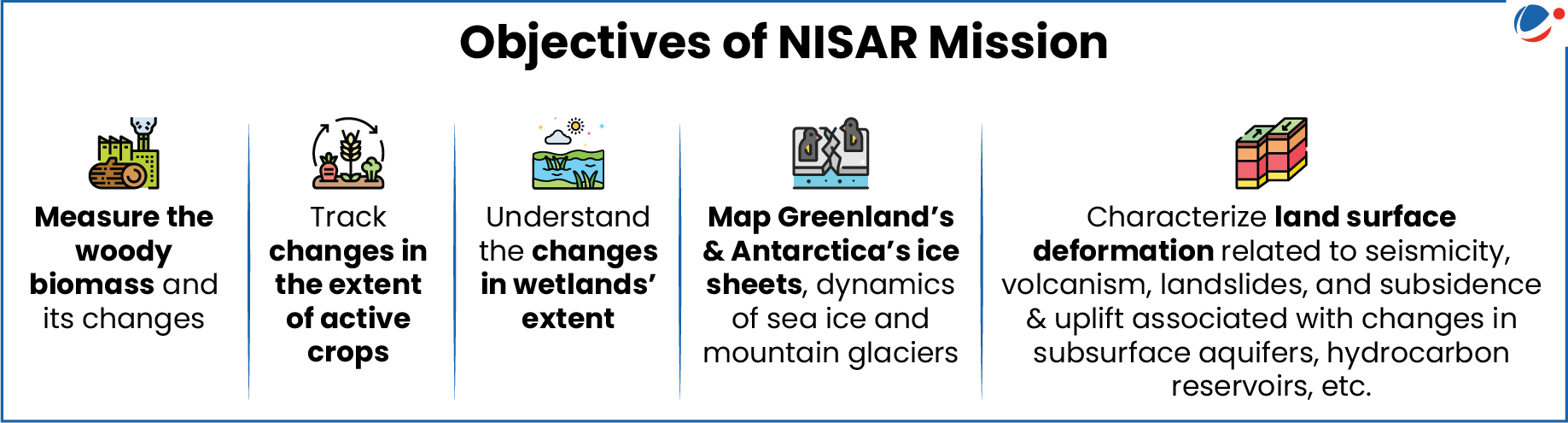
- Developed jointly by ISRO and the American space agency NASA
- NASA provided the L-band radar, GPS receiver, high-rate telecom system, Solid-State Recorder, and the 12-meter deployable antenna.
- ISRO contributed the S-band radar, the spacecraft bus, the GSLV-F16 launch vehicle, and associated systems and services.
- In terms of total investment, NASA has contributed about $1.16 billion, while ISRO has pitched in with $90 million.
- Weight: 2,392 kg
- Launch Vehicle: ISRO's Geosynchronous Satellite Launch Vehicle (GSLV)-F16.
- Orbit: Sun Synchronous Polar Orbit
- It is the first time a GSLV rocket was used to place a satellite into a 743 km Sun-Synchronous orbit (SSO).
- GSLV is typically used for placement in Geosynchronous Transfer Orbit/GTO (35 786 km).
- SSO is a polar orbit where satellites are in sync with Sun, matching earth's rotation around sun and appearing to be in the same position relative to sun.
- Mission Life: 5 years
Technical Features
- SweepSAR (Swept Synthetic Aperture Radar): It is a technique used in radar imaging to produce high-resolution, wide-swath images across a broad range of terrain.
- Repeat Cycle: The NISAR mission will provide high-resolution data every 12 days to monitor land changes across Earth.
- Dual-band Synthetic Aperture Radar (SAR):
- L-band SAR operates at 24 cm wavelength and can penetrate forest canopy, ice, and soil, useful for biomass and deformation studies.
- S-band SAR operates at 12 cm wavelength and will excel at quantifying changes such as tree canopy height and melting snowpack.
- It is world's first Earth observation satellite to integrate both L-band and S-band SAR on a single platform.
- Antenna and Resolution The satellite features a large, 12-metre diameter common unfurlable reflector antenna.
- This antenna system is capable of producing images with a resolution comparable to those from a simple ground-based antenna 20 km in diameter.
- Open-Data Policy: Information collected will be freely available to global scientific community benefiting developing countries.
About SAR
Why is it Synthetic?
|
Conclusion
NISAR is a powerful tool for sustainable development, disaster preparedness, and climate resilience. For India, it marks a leap in Earth observation capability, ensuring better planning, policy-making, and fulfilment of developmental goals.
