


Why in the News?
The Prime Minister's recently visited Trinidad and Tobago, Argentina and Brazil, and participation in the 17th BRICS Summit in Rio de Janeiro.
More on the News
- Highest Civilian Honours: The Prime Minister was conferred Order of the Republic of Trinidad & Tobago.
- Trinidad & Tobago: India announced the extension of OCI cards to the sixth-generation diaspora.
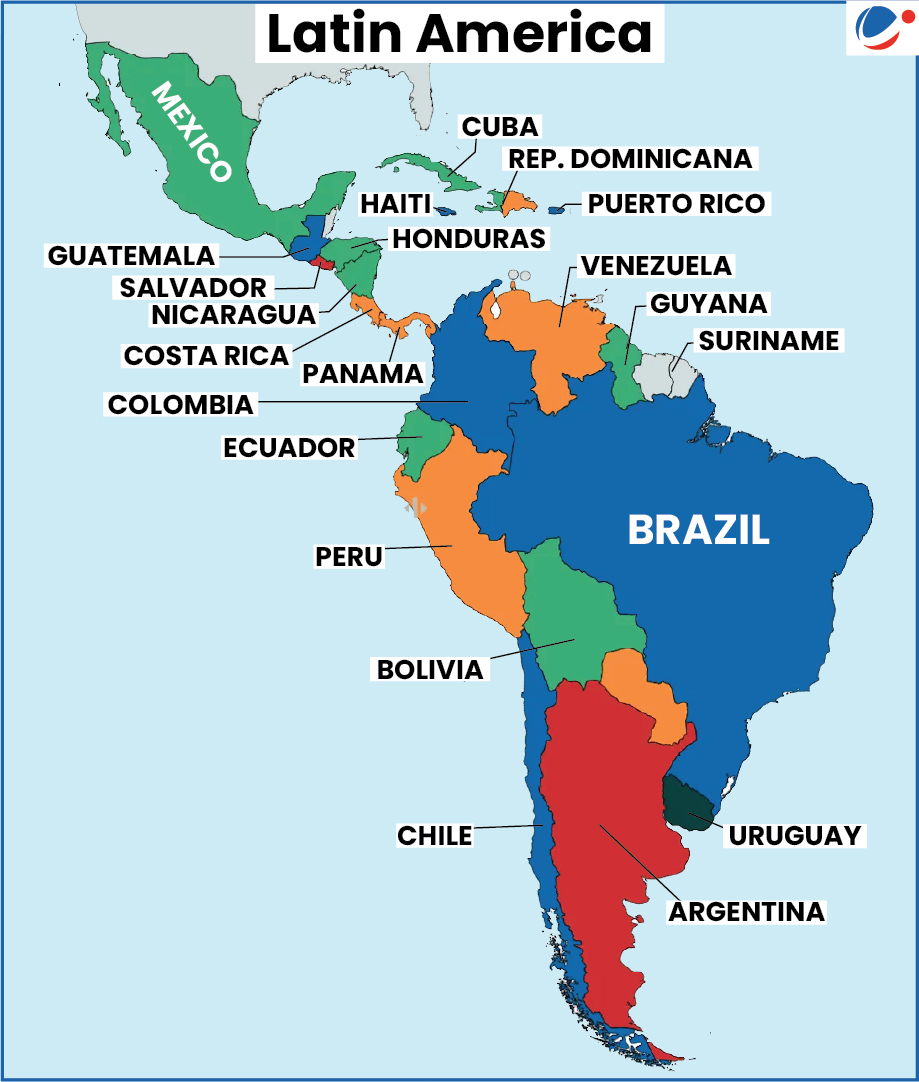
Significance of Latin America and Caribbean (LAC)-India Relations
- Strategic:
- Defense Cooperation: India and Brazil have deepened defence cooperation with Joint Defence Committee meetings and established a 2+2 Political-Military dialogue.
- Critical Minerals Security: KABIL signed an agreement with CAMYEN to acquire five lithium blocks in Argentina, marking the first lithium exploration and mining project by an Indian state-owned company.
- Chile, Argentina and Bolivia, called the Lithium Triangle, hold over 75% of global reserves.
- Food Security: Latin America has become a key supplier of food commodities to India such as edible oils and pulses.
- Argentina is one of the primary suppliers of edible oils, especially soybean oil, to India.
- Economic & Trade Relations:
- Trade and Investments:
- Total trade with the region reached USD 35.73 billion in 2023-24.
- Investments: Indian companies have invested USD 12 billion in the past 15 years in IT, pharmaceuticals, energy, mining, manufacturing and agro-chemicals.
- India has a Preferential Trade Agreement with MERCOSUR.
- Energy Security: Crude oil imports from Venezuela, Mexico, and Brazil, accounted for 30% of India's total import from the region.
- Climate Change and Renewable Energy: India extended a US$ 140 million Line of Credit to CARICOM for solar, renewable energy and climate-change related projects. CARICOM is a regional organization to promote economic integration and cooperation in the Caribbean Region.
- India is partnering with Brazil to promote biofuel research and production through the Biofuture Platform.
- Trade and Investments:
- Cooperation at Regional and Multilateral Fora:
- Significant cooperation in groups like G20 (With Argentina and Brazil) and Groups like BRICS, IBSA and G4 (with Brazil).
- Regional Groupings: India has an active participation and meetings with Community of Latin American and Caribbean States (CELAC), CARICOM, and Central American Integration System (SICA).
About MERCOSUR
|
Challenges
- China Factor: China has established robust ties with Latin America and trade has registered a thirty-five-fold increase since 2000.
- Regional Integration Weaknesses: MERCOSUR faces internal divisions. (e.g., Brazil and Uruguay seeking bilateral deals, Argentina's threat to leave).
- High Transport Costs: Physical distance is a perceived reason for limited engagement, as direct air and shipping links are considered uneconomical.
- Last Frontier in Foreign Policy: Latin America is often relegated to the far end of the three concentric circles that drive India's foreign policy, signifying its de-prioritization.
- Others: Language disadvantage, lack of influential Diaspora, etc.
Way Forward
- Prioritize Political Engagement: Institutionalize high-level dialogues and integrate Latin America into foreign policy priorities.
- Strengthen Economic Linkages: Reduce tariffs, streamline regulations, and pursue free trade agreements to enhance reciprocal investment.
- Enhance Connectivity: Establish direct shipping routes, air links, and air freight corridors to lower costs and improve trade flow.
- Expand Technological Collaboration: Leverage Latin America's resources and India's technology strengths in renewable energy, agriculture, IT, and climate resilience.
- Mobilize the Private Sector: Encourage cross-investments through trade missions, networking platforms, and investment incentives.
Conclusion
India can transform its ties with Latin America by pursuing a proactive, multi-pronged strategy that deepens trade, investment, and cultural links while addressing logistical hurdles. Leveraging democratic values, it can build a durable partnership that advances shared development goals and strengthens both regions' positions in the evolving global order.



