
Employability and Skilling in India | Current Affairs | Vision IAS
MENU
Home

Periodically curated articles and updates on national and international developments relevant for UPSC Civil Services Examination.

Quick Links

High-quality MCQs and Mains Answer Writing to sharpen skills and reinforce learning every day.

Watch explainer and thematic concept-building videos under initiatives like Deep Dive, Master Classes, etc., on important UPSC topics.

ESC

Employability and Skilling in India

19 Aug 2025
3 min

Why in the News?

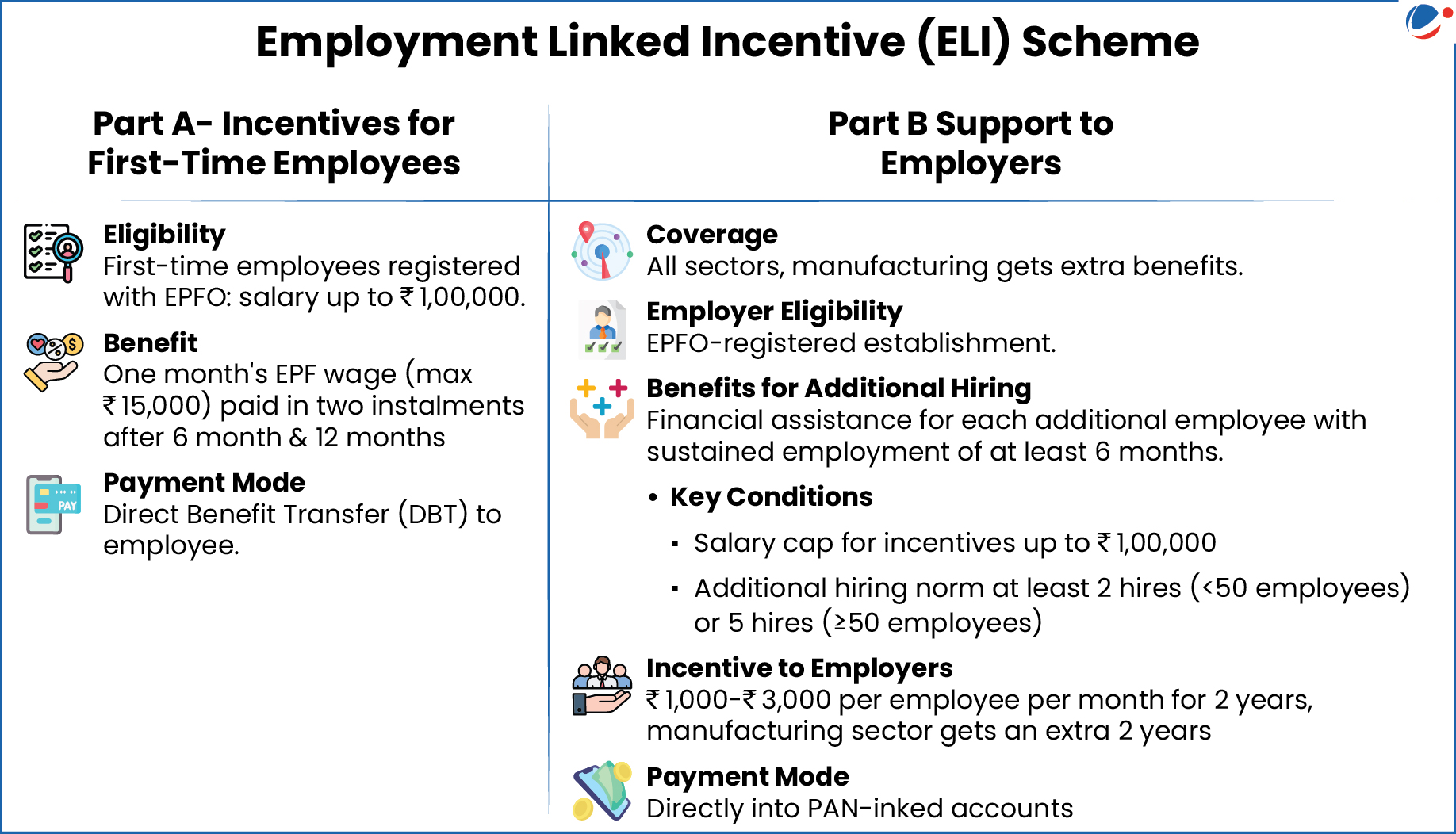
Recently, the Union Cabinet approved the Employment Linked Incentive (ELI) Scheme which is expected to enhance youth employability, nurture skills and facilitate job retention in private sector. 

About Employment Linked Incentive (ELI) Scheme 

  • Background: Announced in the Union Budget 2024-25 as part of PM's package of five schemes to facilitate employment, and skilling opportunities for youth.
  • Nodal Ministry: Ministry of Labour & Employment
  • Purpose: Promote job creation, enhance employability, and expand social security across sectors, specifically manufacturing
  • Target: 3.5 crore jobs (including first-time employees)
About Employability and Skilling In India 

According to the India Skills Report 2025:

  • Employability: Over 50% of graduates (53.47% for Male and 46.53% for Female) are employable in 2024, up from 33% a decade ago (17% rise).
  • Drivers: Growth driven by focus on emerging technologies like AI, cloud computing, and automation.

Challenges Existing In India's Employability and Skilling Landscape

India is expected to add 10 million workers annually over the next decade. However, in FY 2023-24 only, 4.67 crore jobs were created. To fully reap the benefits of the demographic dividend, the key challenges are as follows

  • Mismatch Between Education and Industry Needs: Universities focus more on theory than practical skills. Graduates often lack hands-on experience and technical competencies leading to lower employability in technical fields.
  • Threat from Automation: Graduates are significantly less prepared for technical roles, even in high-demand fields like AI and data science. 69% of jobs in India face automation risk (World Bank)
  • Limited Emphasis on Soft Skills Development: The growing importance of soft skills such as communication, teamwork, and critical thinking remains undervalued in many university programs. 
    • This oversight contributes to graduates who are not only technically unprepared but also lack the interpersonal skills necessary for success in the workplace. 

Key Initiatives Taken for Employability And Skilling

  • Skill India Mission (SIM): Launched by Ministry of Skill Development and Entrepreneurship. The restructured Scheme constitute PM Kaushal Vikas Yojana (PMKVY) 4.0, National Apprenticeship Promotion Scheme (NAPS), and Jan Shikshan Sansthan (JSS).
  • PMKVY 4.0: the focus is to empower trained candidates to choose their varied career path and they are suitably oriented for the same.
  • NAPS: Promotes apprenticeship by offering financial support for apprentice stipends. Training includes both basic and on-the-job/practical training in industries.
  • JSS: Vocational training for non-literates, dropouts, and disadvantaged groups (ages 15–45). Trained 26+ lakh people since 2018–19.
  • Skill India Digital Hub (SIDH) platform: Launched to integrate skilling, education, employment, and entrepreneurship ecosystems.
  • India Skills Accelerator: A public-private collaboration platform launched by Ministry of Skill Development and Entrepreneurship (MSDE), in collaboration with the World Economic Forum (WEF)
  • Skill Impact Bond: Ld by the National Skill Development Corporation (NSDC) it first development impact bond in India dedicated to skills training and job placement.


Conclusion

Harnessing the demographic dividend needs strong skills. Immediate investment in education, training, healthcare, and social protection is key. Strengthening human capital, fixing labour market gaps, and matching technology with workforce needs will drive inclusive and sustainable growth.

Explore Related Content

Discover more articles, videos, and terms related to this topic

RELATED VIDEOS

3
News Today (Jul 16, 2025)

News Today (Jul 16, 2025)

YouTube HD
Circularity in Textile Structure

Circularity in Textile Structure

YouTube HD
Growth of Tier 2 and Tier 3 Cities in India

Growth of Tier 2 and Tier 3 Cities in India

YouTube HD
Title is required. Maximum 500 characters.

Search Notes

Filter Notes

Loading your notes...
Searching your notes...
Loading more notes...
You've reached the end of your notes

No notes yet

Create your first note to get started.

No notes found

Try adjusting your search criteria or clear the search.

Saving...
Saved

Please select a subject.

Referenced Articles

linked

No references added yet

Subscribe for Premium Features