


Why in the News?
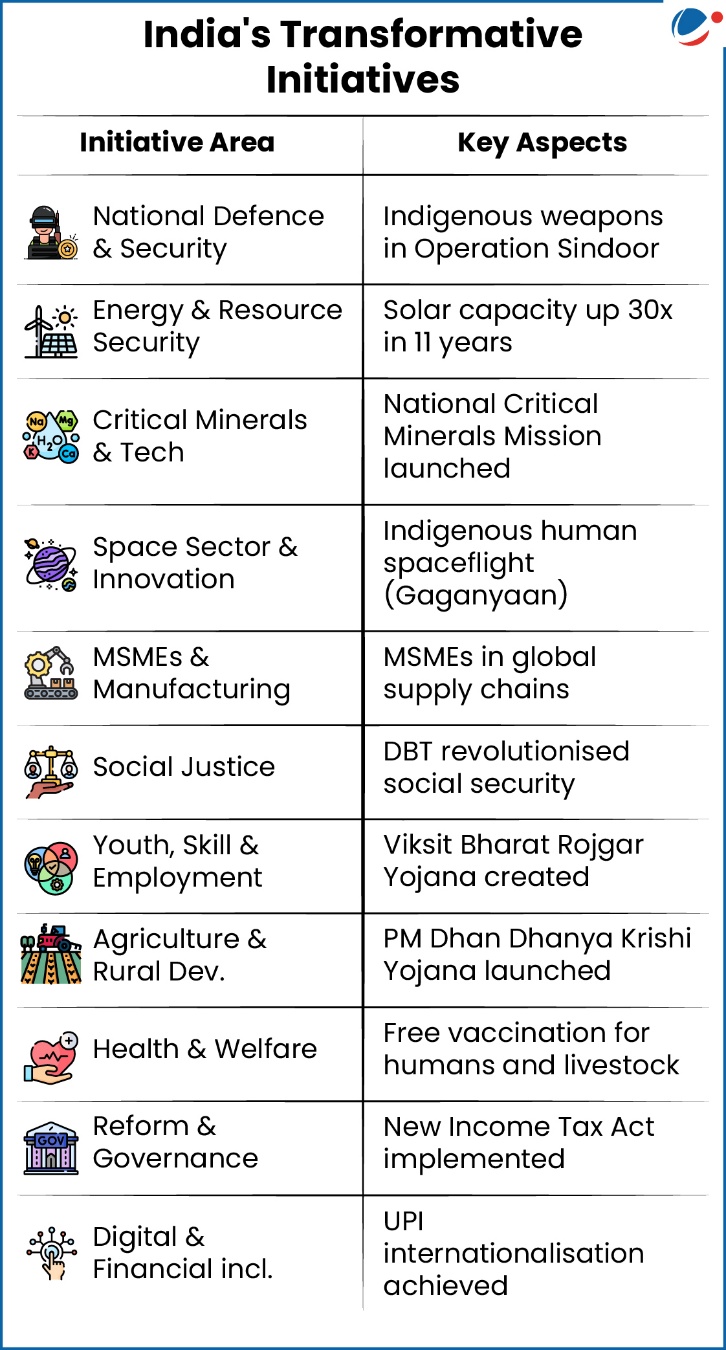
In its recent report, the Standing Committee on Finance suggested ways for India to navigate rising global trade uncertainties and growing protectionism.
More on the News
- Conflicts like the Russia–Ukraine war and the West Asia crisis have disturbed energy markets and supply chains, making India's trade more vulnerable.
- Recently, the United States' move to impose a 50 percent tariff on Indian products has also underlined the same.
- Experts believe that this is India's opportunity to evolve from a service-oriented economy into a true product nation.
- This has also been signaled in the recent reforms announced by the government like GST rationalization.
What is a Product Nation?
- Definition: A product nation is a country that produces and exports a substantial volume of high-value goods, becoming a net producer rather than a net importer.
- Purpose: At its core, a product nation shifts from being only a consumer or assembler to becoming a creator of globally competitive goods, boosting both its economic strength and its strategic standing in the world
- Smile Curve Insight—Stan Shih's Smile Curve shows that higher value lies in R&D, design, branding, and distribution rather than pure manufacturing. E.g.,: Apple ($3T market cap) vs. Foxconn ($85B).
- This curve makes the case for investing in entire life cycle of a product, rather than just assembly. E.g., Apple ($3T market cap) vs. Foxconn that assembles for Apple ($85B).
- South Korea, Japan, and several Southeast Asian nations have risen as manufacturing hubs over the last three decades.
Challenges in Becoming a Product Nation
- Innovation & R&D Gaps: Lack of innovation in manufacturing and high-tech lags. For instance, India spends 0.65% of its GDP on R&D.
- Import Dependence: Heavy reliance on energy, fertilizers, metals, Active Pharmaceutical Ingredients, and technology imports makes India vulnerable to supply disruptions.
- India imports 65-70% of its semiconductor needs.
- Low Private Investment: Despite reforms, private sector capital formation remains subdued.
- Regulatory and Policy Bottleneck: Delays in approvals, complex compliance, and a lack of ease in doing business affect growth.
- Structural Constraints: Weak infrastructure and a shortage of skilled labor limit India's capacity to scale manufacturing rapidly.
- Make in India risks being reduced to assembly work rather than genuine value addition.
- Employment Generation: Mismatch between job creation and the growing young workforce, especially in manufacturing.
- Climate & Sustainability Risks: Exposure to climate change impacts, energy transition challenges, and lack of green finance readiness.
- Coal generates more than 70% of India's total electricity.
Way Forward
- Strengthen Manufacturing: Scale up Production Linked Incentive (PLI) and incentivise indigenous innovation in electronics, semiconductors, and EVs.
- Infrastructure & Connectivity Push: Invest in logistics parks, multimodal transport, and digital connectivity, and integrate MSMEs into global value chains through cluster-based development, e.g., National Logistics Policy (2022).
- Invest in Human Capital: Reform education and skill development to align with product-driven economy needs (AI, robotics, advanced manufacturing).
- For example, Skill India & Gati Shakti initiatives as building blocks.
- Foster Product Development Platforms: Create intelligent product platforms that startups and companies can use to accelerate development, like Atal Incubation Centers.
Conclusion
By strengthening indigenous innovation and advanced manufacturing that integrates human creativity with intelligent technologies in line with the principles of Industry 5.0 (human-centric, sustainable, and resilient industrial model, where advanced technologies such as AI, robotics, IoT, etc., work with humans rather than replacing them), India can reduce external vulnerabilities and enhance value capture. In an era of trade wars and geopolitical flux, this shift becomes vital for safeguarding the nation's geostrategic and economic autonomy.


