


Why in the news?
Cloudbursts have recently impacted several regions in India including states like Uttarakhand, Himachal Pradesh, and Jammu & Kashmir.
About Cloudburst
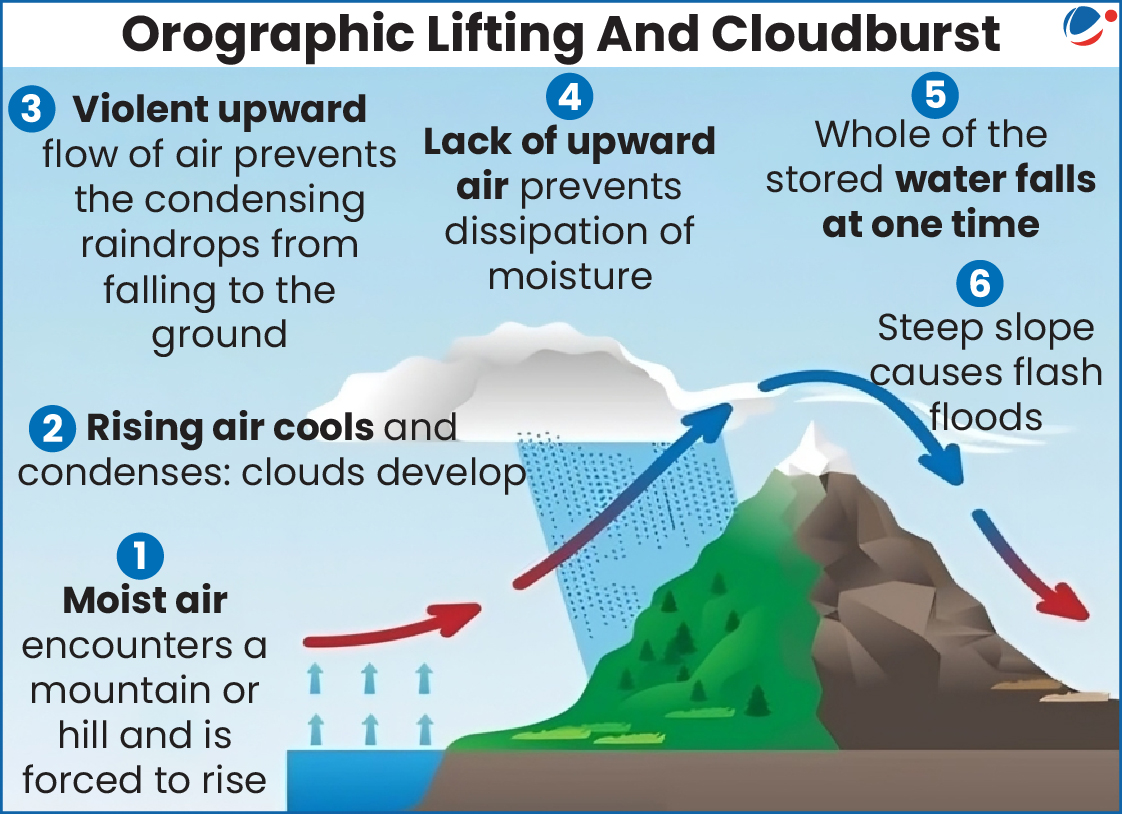
- It is an extreme amount of precipitation in a short period, sometimes accompanied by hail and thunder, that can create flood conditions.
- India Meteorological Department (IMD) terms a rain event as cloud burst if 10 cm rainfall is received at a station in one hour.
- Recent Examples: Kishtwar district, Jammu and Kashmir and Chamoli Cloudburst, Uttarakhand (2025) and Himachal Pradesh (2020).
- Cloudbursts happen in plains as well, but are more common in mountainous zones, as they occur via orographic lift. (see infographic)
- Consequences of Cloudburst: Triggers Flash floods, Dam breaks, mudslides/Landslides etc. leading to loss of life; destruction of Homes, roads, and public facilities; biodiversity loss etc.
Challenges associated with tackling cloudbursts
- Climate Change: Global warming has disrupted precipitation patterns, triggering more frequent, intense rainfall.
- E.g., every 1°C rise lets air hold ~7% more moisture.
- Forecasting Challenges: Cloudbursts are highly local and short-lived and difficult to predict; Satellites lack precision; Doppler radars give around 3 hours' warning but are costly and limited etc.
- Anthropogenic Factors: Deforestation, wetland loss, and unplanned development reduce natural absorption, worsening flash floods and damage.
Way Forward: Cloudburst Disaster Risk Reduction (DRR) Strategy – National Disaster Management Plan (2019)
- Landslide Hazard Zonation (LHZ): Using remote sensing and different kinds of spatial data (aerial photographs, satellite imagery) along with local knowledge for accurate mapping of landslide-prone areas.
- Inter-agency Coordination: Coordination between central and state agencies for updating rules, adopting new standards, amending laws, and reviewing policies.
- Ensure effective early warning dissemination down to the last mile.
- Structural Measures:
- Slope stabilization through bioengineering (plantation, vegetation), and protective structures.
- Maintenance and improvement of stormwater drainage, rivulets, and natural water systems to reduce flooding risks.
- Non-Structural Measures:
- Expansion of multi-hazard insurance for life and property.
- Integration of risk-sensitive urban planning: amending building by-laws to reduce vulnerability.
- Application of multi-level safety planning in expanding and high-risk settlements.
- Capacity Development: Strengthen ULBs/PRIs to prepare and respond effectively and encourage use of insurance and risk transfer tools.
- Climate Change Risk Management: Support and promote state-specific and local adaptation efforts.
Conclusion:
The recent cloudburst shows the urgent need for disaster risk reduction, especially in the Himalayas. The focus must shift from reactive relief to proactive resilience by strengthening early warning systems, promoting community-based adaptation, linking disaster management with sustainable development, and using technology, local knowledge, and good governance to reduce risks




