


Why in the News?
The President of India has given her assent to the Indian Ports Act, 2025 which replaces the Indian Ports Act, 1908.
Indian Ports Act 2025
It seeks to consolidate the law relating to ports, promote integrated port development, facilitate ease of doing business and ensure optimum utilisation of India's coastline.
Key features of the Act
- Statutory recognition to Maritime State Development Council (MSDC): It is established by the Central Government to make recommendations on the legal framework, port sector growth, competition, efficiency, and port connectivity.
- Composition
- Union Minister of Ports, Shipping and Waterways shall be the ex-officio Chairman.
- Ministers-in-charge of each coastal state,
- Secretaries in the Indian Navy and Coast Guard dealing with coastal security, and
- Secretary of the Union Ministry for Ports, Shipping and Waterways.
- Composition
- Statutory recognition to State Maritime Boards (SMB): SMB administer non-major ports within their respective states.
- Adjudicatory Mechanisms: Each State Government must constitute a Dispute Resolution Committee to adjudicate disputes between ports (other than major ports)
- Civil courts are barred from having jurisdiction over matters.
MARPOL and BWM Convention
|
- Appeals from the Committee's orders can be made to the High Court within sixty days.
- Port Tariff and Charges: For major ports, tariffs are fixed by the Board of Major Port Authority or board of directors (if a company).
- For ports other than major ports, the respective SMB or authorized concessionaires fix the tariffs.
- Port officer: The Act specifies the conservator as a port officer appointed by the state government for each port or a group of ports.
- It possesses powers to issue directions regarding vessel berthing, mooring, anchoring, movement, and removal of obstructions.
- Mega Ports: Central Government, in consultation with State Governments, can notify criteria for classifying ports as "mega ports." A mega port retains its original status (major or non-major) and shall continue to be governed by the respective laws applicable to such port.
- Emergency preparedness and response plan: For safety, security, disaster management, and pollution incidents, subject to Central Government approval and audit.
- Environmental and Pollution Control: Mandates compliance with International Convention for the Prevention of Pollution from Ships (MARPOL) Convention and Ballast Water Management (BWM) Convention.
- Penalty: Certain offences from the 1908 Act are decriminalized and made punishable with monetary penalties.
- Digital Integration and Data Management: Introduces provisions for electronic integration of port-related data with a port community system or centralized system.
- Prior Clearance for Ownership Changes: Introduces a new requirement for any port undergoing a change in substantial ownership or effective control to obtain prior clearance from the Central Government.
- Exclusions: Act does not apply to specified ports, navigable rivers, aircrafts exclusively servicing military, non-commercial government, Indian Navy, Coast Guard, foreign vessels of war etc.
Conclusion
The Indian Ports Act, 2025 is a landmark reform aiming to modernise port governance, promote efficiency, and align India with global maritime standards. However, concerns over need for classification of mega ports and absence of appeal against penalties levied by the conservator must be addressed. With proper checks, the Act can drive India's ambition of emerging as a top maritime nation by 2047.
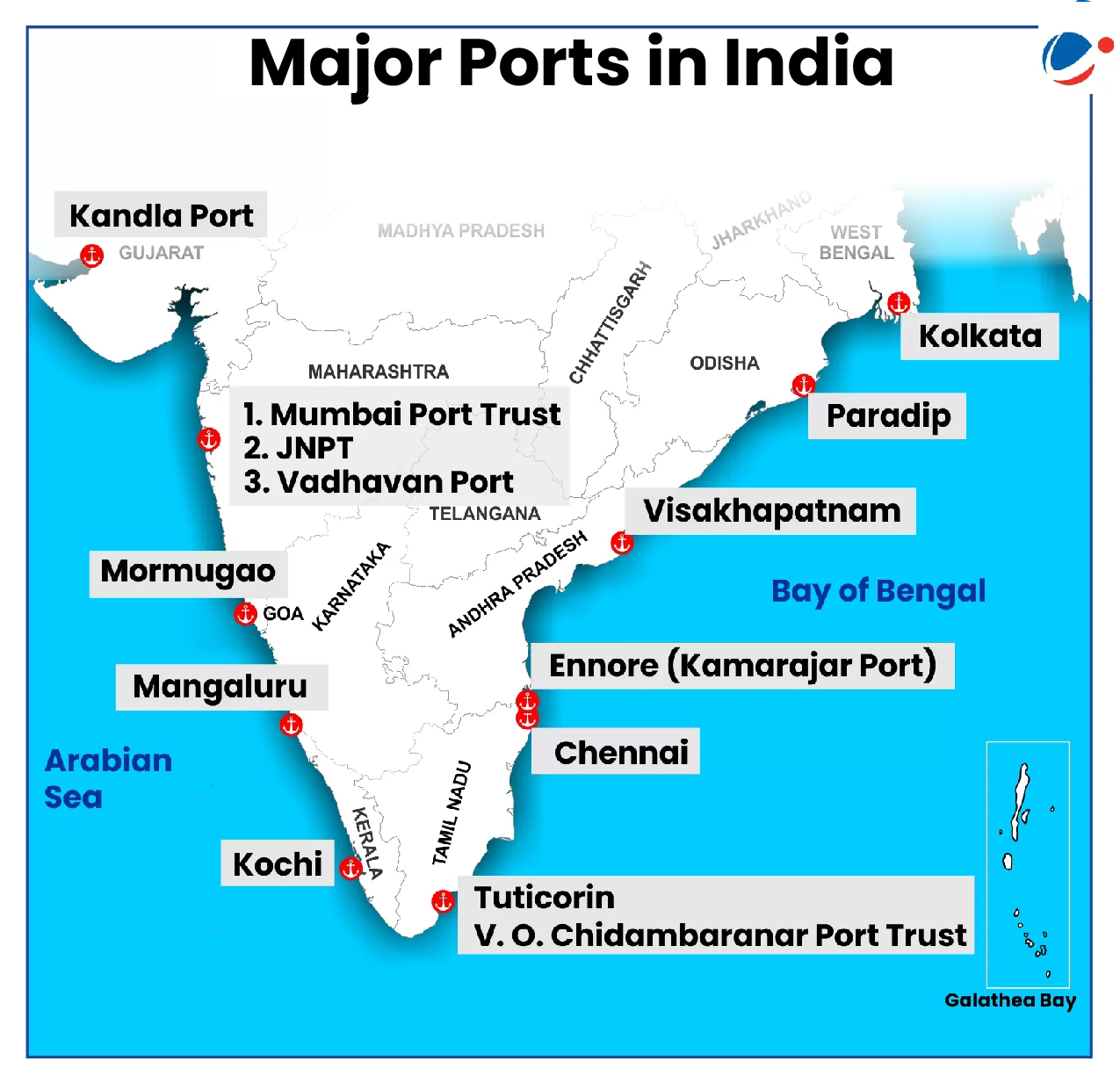 Ports in India
Initiatives for port development
|


