
Centre Notifies ‘Telecommunications (Procedures and Safeguards for Lawful Interception of Messages) Rules, 2024’ | Current Affairs | Vision IAS
MENU
Home

Periodically curated articles and updates on national and international developments relevant for UPSC Civil Services Examination.

Quick Links

High-quality MCQs and Mains Answer Writing to sharpen skills and reinforce learning every day.

Watch explainer and thematic concept-building videos under initiatives like Deep Dive, Master Classes, etc., on important UPSC topics.

ESC

Centre has notified new rules under Telecommunications Act, 2023, replacing Rules 419 and 419A of the Indian Telegraph Rules, 1951.

Key Highlights of the Rules 

  • Power to issue order: 
    • Competent Authority: Union Home Secretary (or Home Secretary at state government level) or an officer, not below the rank Joint Secretary with proper authorization.
    • Authorised Agency: Any other agency as authorised by Central Government.
    • For remote areas or operational needs:  Orders could be issued by the Head or second senior most officer of the authorised agency (at Central or State level)
  • Interception Duration: Orders are valid for 60 days and extendable up to 180 days.
  • Obligations relating to Interception: Authorized agencies must appoint two nodal officers to communicate interception orders to the DoT nodal officer or the telecom entity’s nodal officer.
  • Safeguard Mechanisms: 
    • Review committee: A Central Review Committee (led by the Cabinet Secretary) and State Review Committees ensure bi-monthly reviews of interception orders to ensure compliance.
    • Destruction of records:  Interception records must be destroyed every six months, unless required for functional requirements or court directions.

Key concerns 

  • Increased discretionary powers with limited supervision. 
  • No judicial or parliamentary oversight, relying solely on executive review. 
  • Exemption for testing interception systems by the government may enable unchecked surveillance.
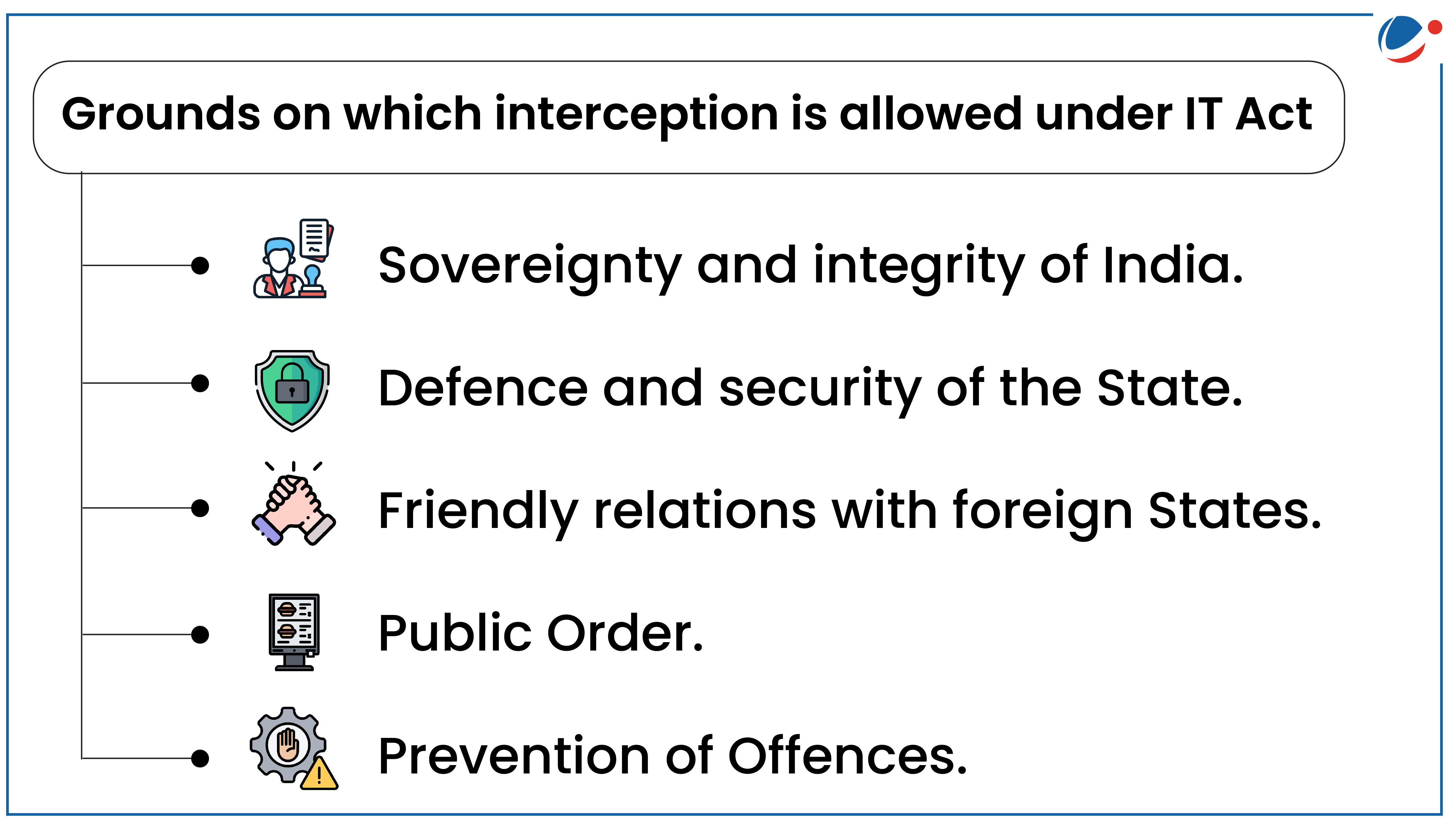
 

An image explaining grounds on which interception of messages is allowed.

Judicial Pronouncement on Power of interception

  • Telecommunications Act, 2023: During ‘public emergency’ or in the ‘interest of public safety’, Government may intercept messages on certain grounds (Refer infographics).
  • People‘S Union For Civilliberties (PUCL) Vs. Union of India And Another (1996): Supreme Court held that expression "public safety" means the state or condition of freedom from danger or risk for the people at large, when either of these two conditions are not in existence, telephone tapping cannot be resorted. 


Watch Video News Today

Explore Related Content

Discover more articles, videos, and terms related to this topic

Title is required. Maximum 500 characters.

Search Notes

Filter Notes

Loading your notes...
Searching your notes...
Loading more notes...
You've reached the end of your notes

No notes yet

Create your first note to get started.

No notes found

Try adjusting your search criteria or clear the search.

Saving...
Saved

Please select a subject.

Referenced Articles

linked

No references added yet

Subscribe for Premium Features