


Why in the News?
The Union Budget 2026-27 has reinforced Ease of Doing Business (EoDB) as a foundational pillar for economic growth and development. (see infographic)
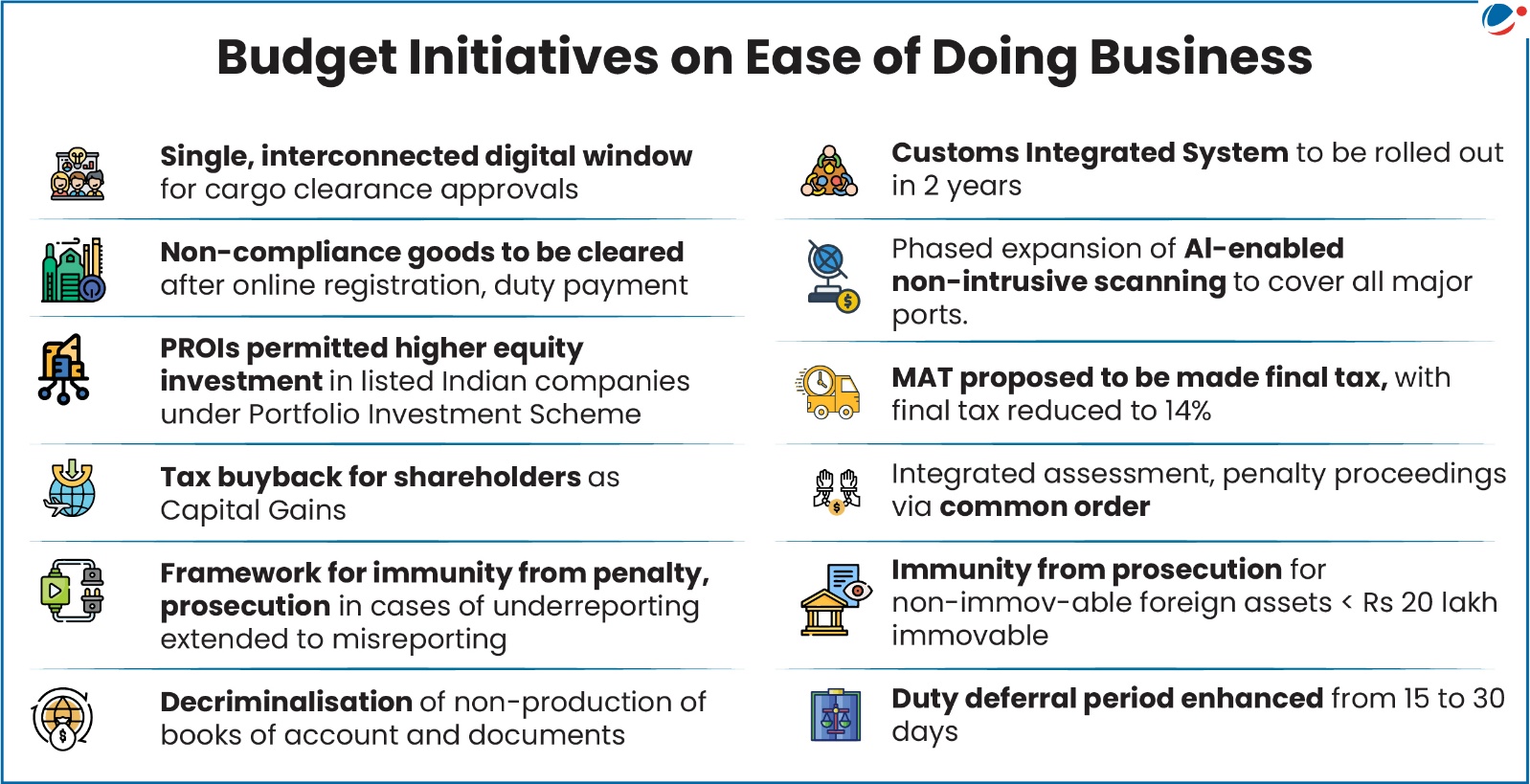
About Ease of Doing Business (EoDB)
- It refers to the quality of a nation's regulatory and institutional framework that determines how effortlessly businesses can start, operate, comply, and exit within an economy.
- Status of EoDB in India:
- Global ranking: As per World Bank Group's as Doing Business Report 2019, India ranked at 63 (improvement of 79 ranks in the 5 years).
- Growth in Business registrations: ~27% growth in 5 years (2020–21 to 2025–26).
Significance of EoDB
- Attracting Investment and Global Trade: Clear and stable rules such as Production Linked Incentives (PLI) have helped India join global supply chains, turning the country into a major exporter of goods like electronics.
- Helping Small Businesses (MSMEs): Simplifying rules removes unnecessary hurdles for MSMEs.
- Platforms like Udyam Registration and TReDS help them get officially recognized and give them quicker access to cash flow.
- Good Governance: Faceless Tax Assessments and the National Single Window System eliminate discretionary human interface, curbing corruption.
- Creating Jobs: Lowering the barriers to starting a business encourages new entrepreneurs (like through Start-up India) and helps creating jobs for India's large, young population.
- Boosting Efficiency and Innovation: By lowering logistics and transaction costs via master plans like PM Gati Shakti, firms can redirect capital from compliance management toward Research and Development (R&D).
Challenges Associated with EoDB
- Slow Legal System: With over 4.6 crore pending cases, a massive amount of money (~ ₹25 lakh crore) is stuck in commercial disputes, which makes long-term investors nervous.
- Disproportionated towards large corporations: The recent improvements in doing business have mostly helped large corporations due to their capability to adapt new systems like GST compliance, e-invoicing etc.
- Implementation Divergence: While states like Uttar Pradesh and Haryana have fully adopted business reforms, others are falling behind leading to foreign investment mostly going to a few top-performing states.
- Land and Labor Bottlenecks: Land remains a complex State subject plagued by a lack of clear, digitized titles.
- Furthermore, a severe formal skill gap in the workforce creates a mismatch between capital-intensive growth and the needs of labor-intensive manufacturing.
Other reforms Supporting Ease of Doing Business
|
Way Ahead
- Judicial Efficiency & ADR Mainstreaming: Establish specialized commercial courts at the district level to bring dispute resolution times from the current ~1,400 days closer to the global average of 400 days.
- Mandating ADR as a pre-litigation step can reduce case pendency and lower the cost of contract enforcement.
- Localization via D-BRAP: Shift the focus of reforms from State capitals to Municipalities through the District Business Reform Action Plan (D-BRAP).
- Urban Local Bodies (ULBs) must be equipped with the digital infrastructure to handle construction permits and utility connections seamlessly.
- Land Reform via U-PIN: Expedite the nationwide rollout of the Unique Land Parcel Identification Number (U-PIN), acting as an "Aadhaar for Land," to create dispute-free digital titles and de-risk industrial land acquisition.
- Trust-Based Governance: Implement universal decriminalization of minor administrative lapses so that businesses do not operate under the threat of imprisonment.
- Move micro-enterprises to a self-certification model with randomized, risk-based audits.
- Aligning with ESG & B-READY Standards: To secure top rankings in the World Bank's upcoming B-READY index, India must deeply integrate Environmental, Social, and Governance (ESG) standardized reporting and leverage its Digital Public Infrastructure (DPI) for a truly paperless compliance journey.
Conclusion
Ease of Doing Business should be seen as a wider state-capacity reform that shapes investment, enterprise growth, export competitiveness, and employment generation.
In India's context, better EoDB can deepen formalisation, improve MSME survival, reduce friction between citizen and state, and make growth more geographically broad-based. It's true success lies not merely in improving rankings, but in creating a predictable, transparent and locally efficient ecosystem where entrepreneurship becomes easier without diluting labour welfare or environmental responsibility..


