


Why in the news?
Union Budget 2026-2027 announced various steps to create "Champion MSMEs" through a three-pronged approach to accelerate and sustain economic growth for Viksit Bharat.
More on the news
The three-pronged approach includes
- Equity Support
- SME Growth Fund: Dedicated ₹10,000 crore specialized SME Growth Fund for incentivizing enterprises based on select criteria.
- Self-Reliant India Fund: Proposed to top up the Self-Reliant India Fund set up in 2021, with ₹2,000 crore to micro enterprises.
- Liquidity Support
- TReDS: Maximising the potential of the TReDS (Trade Receivables Discounting System) platform through four specific measures:
- Mandatory TReDS Use: All CPSE purchases from MSMEs to be settled via TReDS.
- Credit Guarantee Support: Introduce a credit guarantee support mechanism through Credit Guarantee Fund Trust for Micro and Small Enterprises (CGTMSE) to provide guarantees for invoice discounting on TReDS, reducing lender risk.
- CGTMSE aims to provide credit guarantees for the credit facilities extended to MSEs by the Member Lending Institutions (MLIs), without collateral security or third-party guarantees.
- TReDS: Maximising the potential of the TReDS (Trade Receivables Discounting System) platform through four specific measures:
- SME Growth Fund: Dedicated ₹10,000 crore specialized SME Growth Fund for incentivizing enterprises based on select criteria.
- Self-Reliant India Fund: Proposed to top up the Self-Reliant India Fund set up in 2021, with ₹2,000 crore to micro enterprises.
- GeM–TReDS Integration: Linking GeM with TReDS to share government purchase data with financiers, enabling faster and cheaper MSME credit.
- Secondary Market Development: Introduction of TReDS receivables as asset-backed securities to boost liquidity.
- Professional Support
- Corporate Mitras: Accredited para-professionals who will help MSMEs meet compliance requirements at affordable costs.
- Professional institutions: Like ICAI, ICSI, and ICMAI will be facilitated to design short-term, modular courses to train corporate Mitras especially in Tier-II and Tier-III towns.
- Corporate Mitras: Accredited para-professionals who will help MSMEs meet compliance requirements at affordable costs.
Trade Receivables Discounting System (TReDS)
|
What are MSMEs?
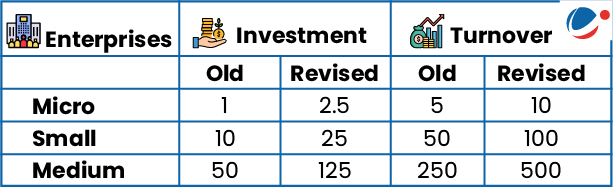
- Criteria: The Micro, Small and Medium Enterprises is based on the Investment in Plant, Machinery or Equipment values (excluding land and building) and Annual Turnover.
- The classification of Micro, Small and Medium Enterprises is defined under the Micro Small and Medium Enterprise Development Act 2006 (amendment 2020).
- Union Budget 2025-26 has increased the investment and turnover limits for classification by 2.5 times and 2 times, respectively, effective from 01.04.2025.
Significance of MSMEs
- Employment Generation: MSMEs are the second-largest employer in India, trailing only behind agriculture.
- There are over 7.47 crore MSME enterprises in the country, employing more than 32.82 crore individuals (Economic Survey 2025-26).
- Instrument of inclusive growth: These industries require low capital costs, which heavily contributes to alleviating poverty in rural areas and among the working poor, women, youth, and vulnerable communities.
- Economic Output: The sector is a massive driver of the national economy, accounting for 31.1% of India's GDP (Economic Survey 2025-26).
- Backbone of industrial sector: As per the Economic Survey 2025-26, MSMEs represent approximately 35.4% of the nation's total manufacturing.
- Driving Exports: MSMEs play a pivotal role in meeting both domestic and global market demands, contributing to 48.58% of India's total exports.
- Rural Development: Distribution of MSMEs is marginally in favour of rural areas, which account for 51% of the total.
Issues faced by MSMEs
- Access to financial sources: It is identified as the biggest obstacle by 21.5% of MSMEs in India. (World Bank)
- Banks are often hesitant to lend due to high risk perception, lack of collateral, high transaction costs, and difficulties in verifying the creditworthiness of small applicants.
- "Missing Middle" Phenomenon: Stringent business regulations and compliance costs disproportionately affect smaller firms, leading to a tendency to remain small and informal to stay "under the regulatory radar".
- As of November 2023, 97.92% of registered MSMEs were micro-enterprises, while only 0.01% reached "medium" status.
- Low Innovation Rates: Only 5.8% of Indian MSMEs introduce new products or services, compared to 24.9% in South Asia and 36% globally.
- Infrastructure Bottlenecks: Poor roads, unreliable power supply, and inadequate digital critical infrastructure hinder business operations.
- Market Access: Although MSMEs account for nearly 45% of total exports, only about 1.1% of registered MSMEs on the Udyam portal are actually engaged in export activities.
Various initiatives by India for promotion of MSMEs
- The Udyam Registration Portal: It was launched in 2020 to facilitate ease of registration for MSMEs and access to all the Schemes and benefits. The registration process is free of cost, paperless and digital.
- Udyam Assist Platform (UAP) Portal (2023): For bringing Informal Micro Enterprises (IMEs) into the formal ambit, and for availing Priority Sector Lending (PSL) benefits.
- More than 7.30 crore enterprises have registered on Udyam Registration Portal and Udyam Assist Platform till December 2025.
- Prime Minister's Employment Generation Programme (PMEGP): Supports micro-entrepreneurs by offering margin money subsidies on bank loans.
- PM VISHWAKARMA (2023): To provide end-to-end support to artisans and craftspeople of 18 trades who work with their hands and tools.
- Raising and Accelerating MSME Performance (RAMP) Scheme: World Bank-supported Central Sector Scheme aimed at improving access of MSMEs to market, finance and technology upgradation.
- Public Procurement Policy for Micro and Small Enterprises: It mandates 25% annual procurement from MSEs by Central Ministries/Departments/Central Public Sector Enterprises (CPSEs).
- MSME Champion Scheme: To identify and nurture select enterprises by upgrading their processes, minimizing inefficiencies, improving competitiveness, and supporting their growth to achieve excellence in both domestic and international markets.
- The Scheme has three components, namely, 'MSME-Sustainable (ZED)', 'MSME Competitive (LEAN)' and 'MSME-Innovative (Incubation, Design & IPR)'.
Way forward
A holistic strategy is needed to strengthen MSMEs, expanding credit through the Small Industries Development Bank of India, integrating them into global value chains, and building skilled human capital. Alongside, digital platforms, shared research infrastructure, and better market access can drive innovation, efficiency, and global competitiveness





