


India’s rank improved from 96th to 91st out of 182 countries and territories (with score of 39) on CPI 2025.
About Corruption Perceptions Index (CPI)
- Released By: Transparency International annually.
- Methodology: Ranks 180 countries and territories by their perceived levels of public sector corruption on a scale of 0 (highly corrupt) to 100 (very clean).
- It is a composite index, a combination of at least 3 and up to 13 surveys and assessments of corruption, collected by a variety of reputable institutions.
- CPI Excludes: Citizens’ direct perceptions or experience of corruption; Tax fraud; Illicit financial flows; Enablers of corruption (lawyers, accountants, financial advisors etc.); Money-laundering; Private sector corruption; Informal economies and markets.
- Key Highlights of CPI 2025
- Top Position: Denmark (score 89) was ranked first for eighth consecutive time.
- Bottom Ranks: Mostly conflict-affected and highly repressive countries are amongst lowest scorers like Venezuela (score 10) and Somalia and South Sudan (Both scoring 9).
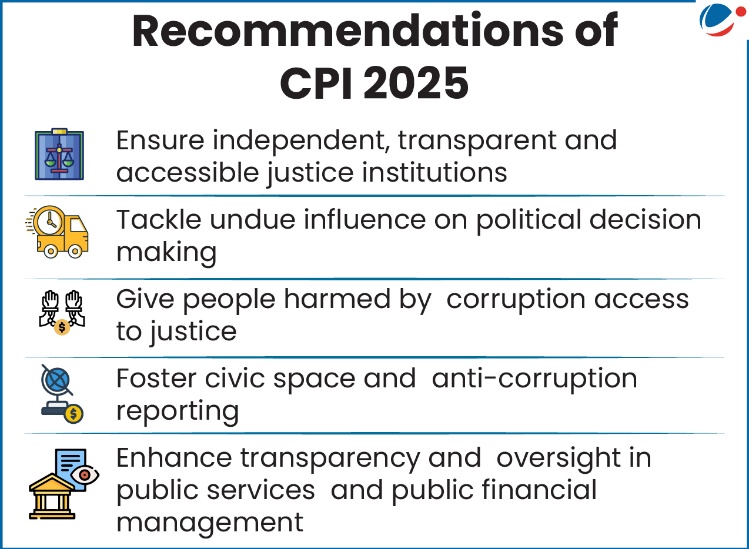
- Key drivers of Corruption: Limited or eroding democratic checks and balances; politicisation of justice systems; undue influence over political processes; and a failure to safeguard civic space.
Article Sources
1 sourceOf late, systematic "watering down" of environmental protections have been observed , characterized by the judicial recall of progressive judgments, the adoption of reductionist definitions for protected areas (such as the Aravalli hills), etc.
Systematic Dilution of Environmental Regulation
- EIA Process Undermined: Since December 18, 2025, for non-coal mining projects, land acquisition can occur before an Environmental Impact Assessment (EIA), and EIAs can be conducted without specific details regarding location and area.
- Judicial recalls: The recall of Vanashakti vs Union of India (2025) diluted the ban on retrospective clearances, signalling a retreat from pro-environment jurisprudence.
- Aravalli Hills Controversy: The Court accepted a 100-metre height-based definition, excluding large ecologically vital areas from protection impacting violation of Article 21, weakens article 48A.
- Mangroves & Coastal Ecology: Judicial approval for destruction of mangroves (e.g., Raigarh, Maharashtra for Adani Cementation Ltd.) reflects reliance on compensatory afforestation, which ignores ecological science.
- Strategic Defense vs. Ecology: Court allowed wider roads based on strategic defense needs despite recognizing the area's ecological importance. (Citizens for Green Doon vs Union of India, 2021).
- This "balancing act" has been linked to subsequent flash floods and ecological disturbances in Uttarakhand.
Constitutional and Jurisprudential Implications
- Constitutional provisions at risk: Article 14 (principle of non-arbitrariness and equality before law), Article 21 (right to clean and healthy environment), Article 51A(g) (fundamental duty of citizens to safeguard the environment), etc.
- Erosion of Public Trust doctrine: Established in M.C. Mehta vs. Kamal Nath (1996), the Public Trust Doctrine asserts that natural resources belong to the state in trust for the people and cannot be sold for private exploitation.
- Current judicial trends that approve environmental degradation appear to contradict this foundational jurisprudence.
Article Sources
1 sourceShare of Gender Budget in total Union Budget increased to 9.37% with total 53 Ministries/Departments and five UTs reporting allocations this year.
Gender Budget (GB) in India
- Meaning: Mechanism for establishing whether government's gender equality commitments translate into budgetary commitments.
- It does not seek to create separate budgets for gender concerns, rather views the Government Budget from a gender perspective.
- Adoption in India: India formally adopted GB in 2004-05.
- India has institutionalized GB at both national and state levels, with Gender Budget Cells established across ministries and departments.
- Gender Budgeting Scheme: Under ‘Samarthya’ sub-scheme of Mission Shakti scheme of Ministry of Women and Child Development (MWCD).
- It aims for 100% coverage of GB in all central and state Ministries/Departments, rural and urban local bodies.
- States like Odisha and Karnataka have also adopted Gender Budgeting.
- Parts of GB:
- Part A: Schemes with 100% provision for women.
- Part B: Schemes where allocations for women constitute at least 30%. .
Article Sources
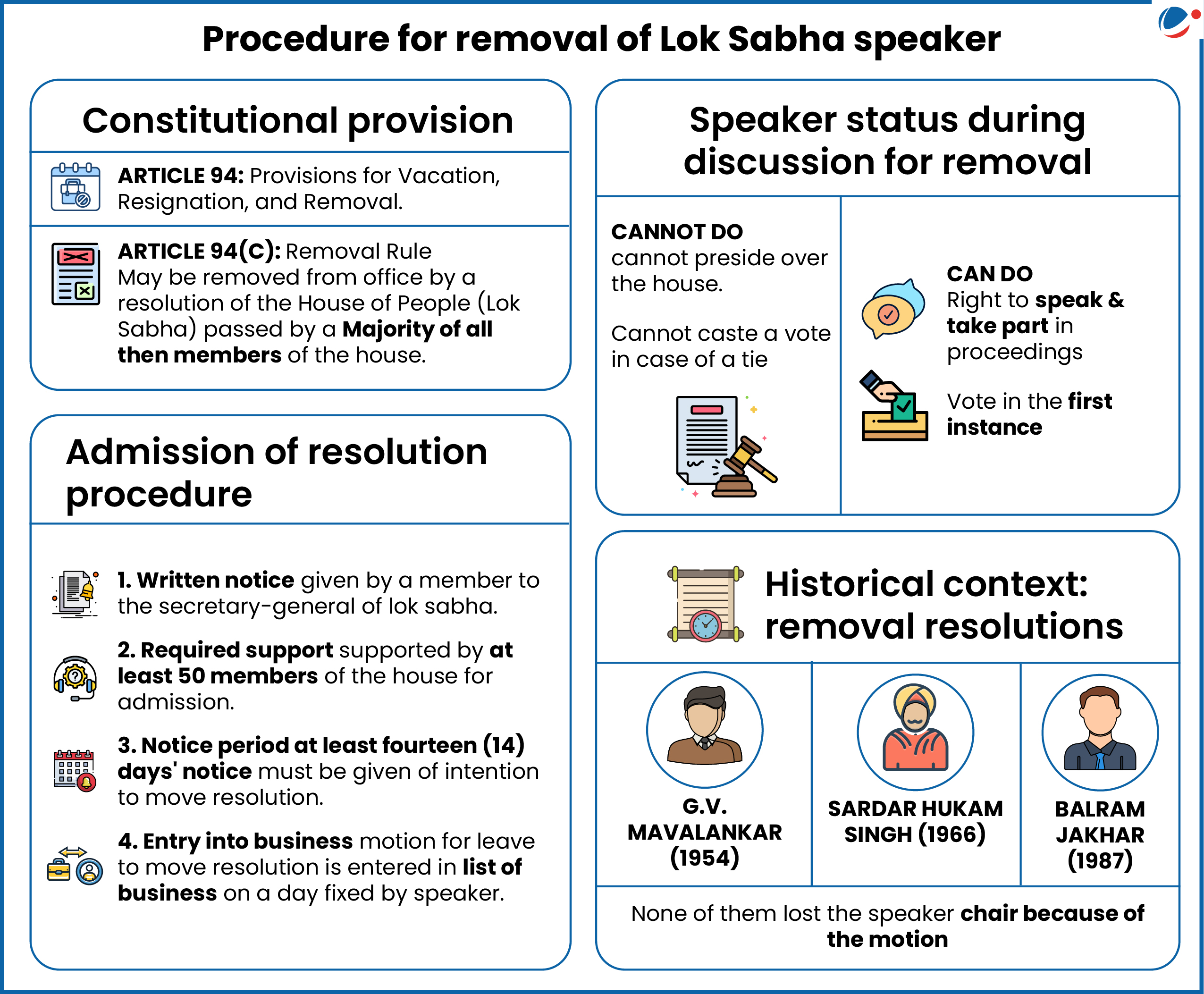
1 sourceRecently opposition moved a Resolution for removal against Lok Sabha Speaker Om Birla.
Protests in Lok Sabha prevent Prime Minister’s reply to the Motion of Thanks.
About Motion of Thanks
- Article 87 (1) provides that at the commencement of the first session after each general election to the Lok Sabha and at the commencement of the first session of each year the President shall address both Houses of Parliament assembled together and inform Parliament of the causes of its summons.
- Under Rule 17 of the Rules of Procedure and Conduct of Business in Lok Sabha, discussion on matters referred to in the President’s Address takes place on a Motion of Thanks moved by a member and seconded by another member.
- Amendments allowed: Opposition members may move amendments expressing regret that the Address omitted or inadequately covered certain issues.
The Supreme Court noted that more than a decade after its introduction, NOTA has had little impact on the choice of candidates fielded by political parties.
- In NOTA, citizens choose to vote by not giving a vote to any political candidate.
- In 2013 in PUCL vs Union of India, Supreme Court directed the ECI to include a NOTA option on Electronic Voting Machines (EVMs).
- First Implementation: NOTA was first implemented in the 2013 legislative assembly elections in Chhattisgarh, Mizoram, Rajasthan, Madhya Pradesh, and Delhi.
Challenges with NOTA
- Uncontested Elections: Voters cannot exercise the NOTA option in constituencies where a candidate is elected unopposed.
- No Impact on Election Results: Even if NOTA gets the highest votes, the candidate with the next highest votes is declared the winner.
- Ineffectiveness Against Criminality: As political parties continue to select candidates based on electability rather than moral considerations.
Way Forward
- The 50%+1 Rule and Candidate Bans: Under this rule, re-elections happen if NOTA gets 51% of valid votes, with the previous candidates barred from contesting again.
- This is done in Columbia.
- State-Level Initiatives: The State Election Commissions of Maharashtra and Haryana have taken positive steps by treating NOTA as a fictional candidate and ordering re-elections when NOTA secures a majority.
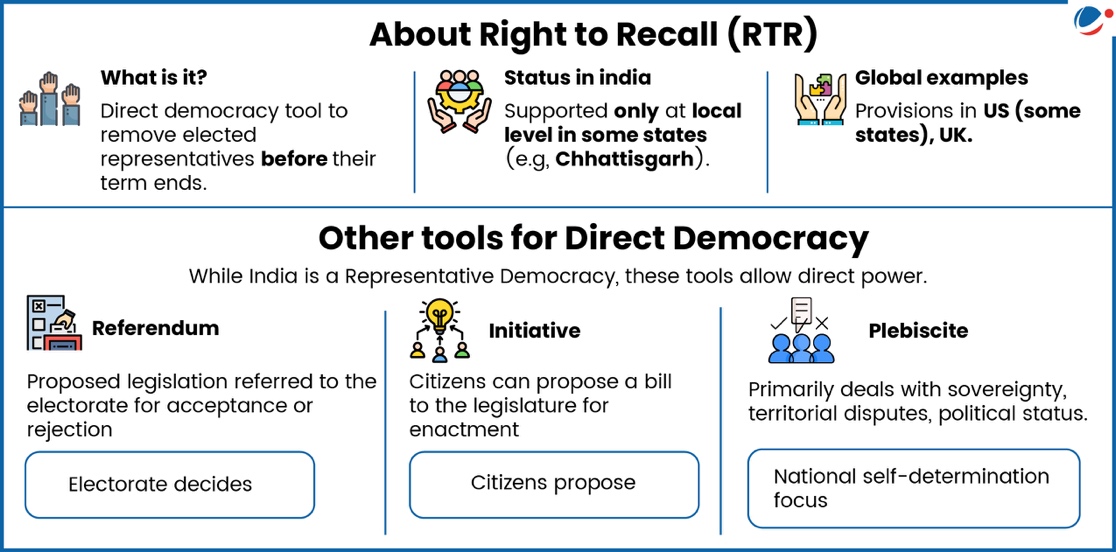
Recently a Member of Parliament in Rajya Sabha floated the idea of introducing ‘Right to Recall’ in India's parliamentary democracy.
Union Cabinet has approved the change of name from Kerala to Keralam.
About Article 3
- It empowers the Parliament to:
- Form a new State
- Increase, diminish or alter the boundary of a State
- Change the name of a State
- Process:
- President Recommendation: Such bill requires prior recommendation of the President.
- View of State Legislature: The President has to refer the concerned State Legislature for its view within a specified period
- The President (or Parliament) is not bound by the view of the State Legislature.
- The bill is passed by the Parliament by Simple Majority to change the name.
- A constitutional amendment under Article 368 is not needed for change of name.

