


Why in the News?
Union Budget 2026-27 has announced an allocation of Rs 20,000 crore over next 5 years to support the development and deployment of Carbon Capture, Utilisation and Storage (CCUS).
About CCUS
- IEA defines CCUS as technologies that capture CO2 from large stationary sources like power plants and industries.
- Goal: Prevent captured CO2 from re-entering the atmosphere via storage or utilisation.
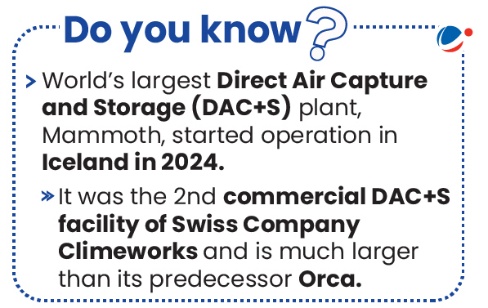
- Capture techniques: Separating CO2 from industrial gas streams through Direct Air Capture (DAC), solvents (chemical or physical), Adsorption, Cryogenic separation etc.
- Captured CO2 is then dehydrated, compressed, and transported to designated sites via pipelines, though shipping, rail, or trucks.
- Storage: Unutilized CO2 is permanently trapped in geological storage which includes EOR (Enhanced Oil Recovery), ECBMR (Enhanced Coal Bed Methane Recovery) and permanent storage options like saline aquifers and basalt storage.
- India's Target: 750 mtpa (Million Tonne Per Annum) of CO2 capture, utilization, and storage in NITI Aayog's report titled 'Carbon Capture, Utilisation, and Storage Policy Framework and its Deployment Mechanism in India'.
Significance of CCUS for India
- Decarbonization of hard to abate sectors: CCUS is only known technology for decarbonizing hard-to-electrify and CO2 intensive sectors such as steel, cement, oil & gas, petrochemicals & chemicals, and fertilizers.
- Enabling the sunrise sectors (coal gasification/low-carbon hydrogen): It can enable cost-competitive production of blue hydrogen (i.e. coal gasification-based hydrogen production coupled with CCUS) based on utilisation of India's rich endowments of coal.
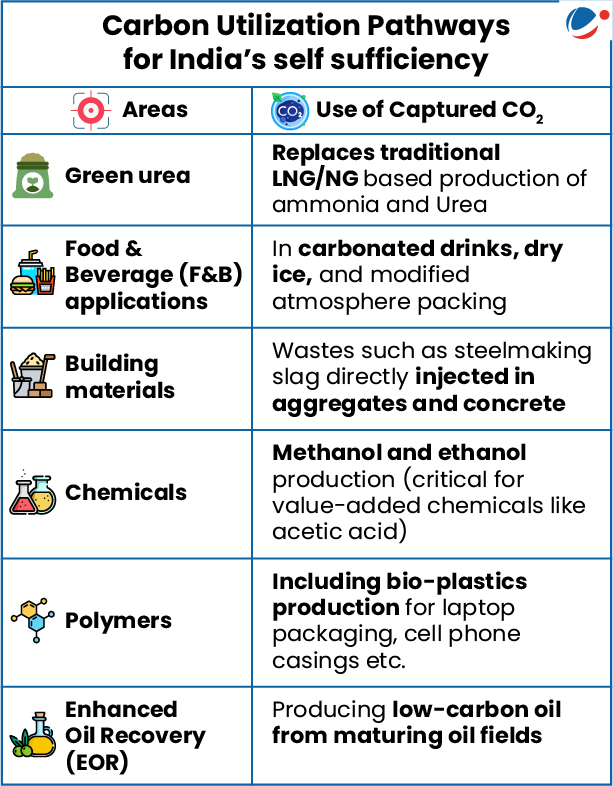
- Energy, materials & food security: CCUS can enable 'Circular Carbon Economy' in India through conversion of captured carbon into value-added products and help in reducing India's import bill. (see infographic)
- Sustenance of existing emitters by retrofitting: E.g., Nearly two-thirds of India's crude steel capacity have an age of less than 15 years, which can be saved by retrofitting with CCUS infrastructure.
- Achieving Net-Zero Emissions Targets: India's net zero target would require sequestering 11.4 GtCO2e (gigatonnes of carbon dioxide equivalent per year) cumulatively till 2070.
- CCUS can reduce emissions from India's power and industrial sectors (contributed around 60% of total emissions in 2020).
Challenges associated with implementing CCUS
- High Costs: CCUS projects will require upfront capital investments of US$ 100-150 billion for 750 mtpa of CO2 capture, utilization, and storage.
- Technological limitations:
- CO2 utilization technologies are relatively less developed: Compared to capture technologies.
- DAC in early stages: Its economics (present cost estimated at- US$ 400-800/tonne of CO2) and scale of operations are yet to be established.
- Retrofitting Difficulties: Retrofitting older plants (coal/cement) with CCUS is technically complex and cost-intensive.
- Geological Storage Risks: E.g., if CO2 is injected too forcefully it can fracture the rock and potentially induce seismicity (micro-earthquakes).
- Regulatory: Lack of clear legal frameworks defining who is responsible for safety, maintenance, and potential leaks creates immense financial risk for private investors.
- Limited data on storage: geological data on the pore space availability in India for the storage of CO2 is limited, especially for saline aquifers and basaltic storage.
Way forward to implement CCUS in India
- Incentivize & de-risk CCUS projects to enhance Private sector participation:
- Public/government funding: Through financing mechanisms like 'Clean Energy Cess', low-cost sovereign or International Green Funds, Carbon Bonds or Climate Funds
- Support to Low carbon or carbon-abated products: Through preferential procurement in Government tenders and Production Linked Incentive (PLI) schemes.
- Targeted Policy Interventions: Like financial framework such as a Carbon Capture Finance Corporation (CCFC) to support CCUS projects, carbon credits, capital and operational subsidies for capture plants, tax holidays for CCUS projects etc.
- Promote R&D in novel CO2 utilization technologies: Foster and incubate innovation-based ecosystems through national centres of excellence like National Centre of Excellence in Carbon Capture and Utilization at IIT Bombay.
- Technology transfer: E.g., Knowledge sharing through Mission Innovation which has Carbon Dioxide Removal as one of its missions.
- Draft national CCS regulations and legal framework: To cover the entire CCUS value chain focusing on CO2 ownership, liability for transport and post-injection, and carbon accounting.
- Mapping storage site: Government can map CO2 source-sink corridors and characterise geological storage potential across priority basins.
- Hub and cluster model: Hub-cluster models in KG Basin and Rajasthan can unlock CCUS economies of scale.
- Machine Learning for Geological Data Analysis: E.g., the CarbFix project in Iceland uses machine learning models to predict CO2 injection impacts and optimize site selection based on geological data.
Conclusion
India is the 3rd largest emitter of CO2 in the world after China and the US. CCUS is a key technology for decarbonizing hard-to-abate sectors and supporting India's NDC commitments like reducing CO2 emissions by 50% by 2050. However, high costs, technological gaps, and regulatory issues must be addressed through strong policy support, innovation, and private participation to enable its effective deployment.



