


Why in the news?
The Union Finance Minister announces plans to boost the Orange Economy (Creative Economy) in the Union Budget 2026-27, recognizing its role in employment generation, innovation, exports, and soft power.
Various announcements in the budget
- AVGC Content Creator Labs: The government proposed supporting the Indian Institute of Creative Technologies (IICT), Mumbai, to set up AVGC content creator labs in 15,000 secondary schools and 500 colleges.
- Growth projection: The budget stated that India's Animation, Visual Effects, Gaming, and Comics (AVGC) sector is projected to require 2 million professionals by 2030.
- New National Institute of Design: To address the shortage of Indian designers, the Budget proposed establishing a new National Institute of Design in the eastern region of India.
- India currently has seven NIDs, all recognized as institutes of national importance.
What is the Orange economy?
- Origin: The term was coined by former Colombian President Iván Duque Márquez and former culture minister Felipe Buitrago in their 2013 book, "The Orange Economy: An Infinite Opportunity".
- They chose the color orange because it has historically and religiously been associated with culture, creativity, and identity.
- Definition: The "Orange Economy" (creative economy) is defined as a group of linked activities through which ideas are transformed into cultural goods and services, with their value determined primarily by intellectual property.
- Concept: Orange Economy centers on industries that use creativity and intellectual capital as their primary inputs. It encompasses a wide array of activities including:
- Animation, Visual Effects, Gaming, and Comics (AVGC)
- Audiovisual media, filmmaking, television, and radio
- Music, performing arts, and visual arts
- Architecture, design, fashion, and crafts
- Software, research and development, and digital expressions of communication, etc.
Importance of the Orange economy for India
- Export Potential: It is a significant driver of foreign exchange; creative exports surged by 20% in 2023-24 to earn more than $11 billion.
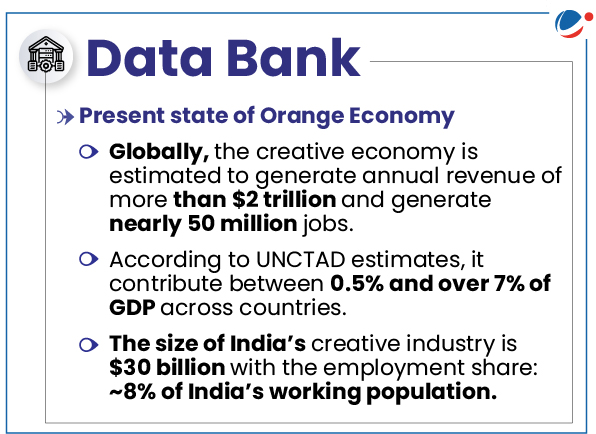
- Job Creation: The creative sector is fundamentally talent-driven. It currently supports over 10 million livelihoods, both directly and indirectly.
- Leveraging Cultural Heritage: It is a mechanism to turn the country's rich cultural heritage and diversity into tangible economic opportunity.
- Five days of the Jaipur Literature Festival contribute over ₹100 crore to the local economy.
- Building "Smart Power": Nearly 25% of the total viewership for Indian OTT content originates from overseas, successfully building emotional and cultural connections across continents.
- Youth and Women-Driven: Globally, 23% of its workforce is between 15 and 29 years old (more than any other sector), and women hold 45% of creative occupations.
- Cost Competitiveness India offers a 40 to 60 % cost advantage in animation and VFX services, supported by a large, skilled workforce.
- This comparative edge has transformed India from an outsourcing destination into a sought-after hub for high-value creative collaboration, such as productions like Avatar and Game of Thrones.
Impediments in growth of the Orange economy
- Breach of Intellectual Property (IP): Protecting intellectual property in a digital environment where content is easily copied and redistributed is a major obstacle resulting in revenue losses for the film and television industries.
- Market Concentration and Monopoly Power The digital creative economy is highly concentrated, with a few large tech companies and "gatekeeper" platforms dominating areas like publishing, streaming, and social media.
- For example, in the publishing industry, an estimated 90% of revenues are absorbed by publishers, distributors, and retailers, leaving only 10% for the actual creators.
- Artificial intelligence: It raises concerns regarding the unauthorized appropriation of artists' work without compensation.
- Labor Conditions: Creative industry workers frequently face high job insecurity. Work is often project-based and self-employment that strips workers of standard social security protections, like paid sick or maternity leave.
- Systemic inequalities: Women remain heavily underrepresented in leadership and decision-making roles (such as film directing), and creative employment is often heavily concentrated in urban centres, leaving rural talent behind.
Initiatives taken to promote Orange/creative economy
- Global Initiatives
- International Year of Creative Economy: UN General Assembly declared 2021 as the "International Year of Creative Economy for Sustainable Development".
- Bali Agenda on Creative Economy (2018): Established at the World Conferences on Creative Economy.
- Bridgetown Covenant: By the UNCTAD has explicitly mandated placing culture and creativity at the center of trade, technological innovation, and economic diversification.
- Indian Initiatives
- Indian Institute of Creative Technologies (IICT): It was unveiled in Mumbai, Maharashtra, in 2024 as the National Centre of Excellence for AVGC-XR.
- Film Facilitation and Anti-Piracy: The Cinematograph (Amendment) Act, 2023 introduced stringent anti-piracy provisions, including jail time and heavy fines, to protect digital IP.
- India Cine Hub (ICH): As a single-window digital platform to streamline film shooting permissions and centralize production incentives.
- National Broadcasting Policy: Developed to create a modern, inclusive, and growth-oriented framework for India's broadcasting ecosystem. It will focus on promoting content diversity, fair competition, and investment.
- World Audio Visual and Entertainment Summit (WAVES): The platform serves as a convergence point for policymakers, industry leaders, creators, and investors across the film, television, OTT, animation, VFX, gaming, and XR sectors.
Conclusion
Harnessing the creative potential of the Orange Economy can boost jobs and growth in India. Strengthening IP protection, digital infrastructure, skill development, cultural exports, and startup support can unlock its full economic and soft power potential.




