


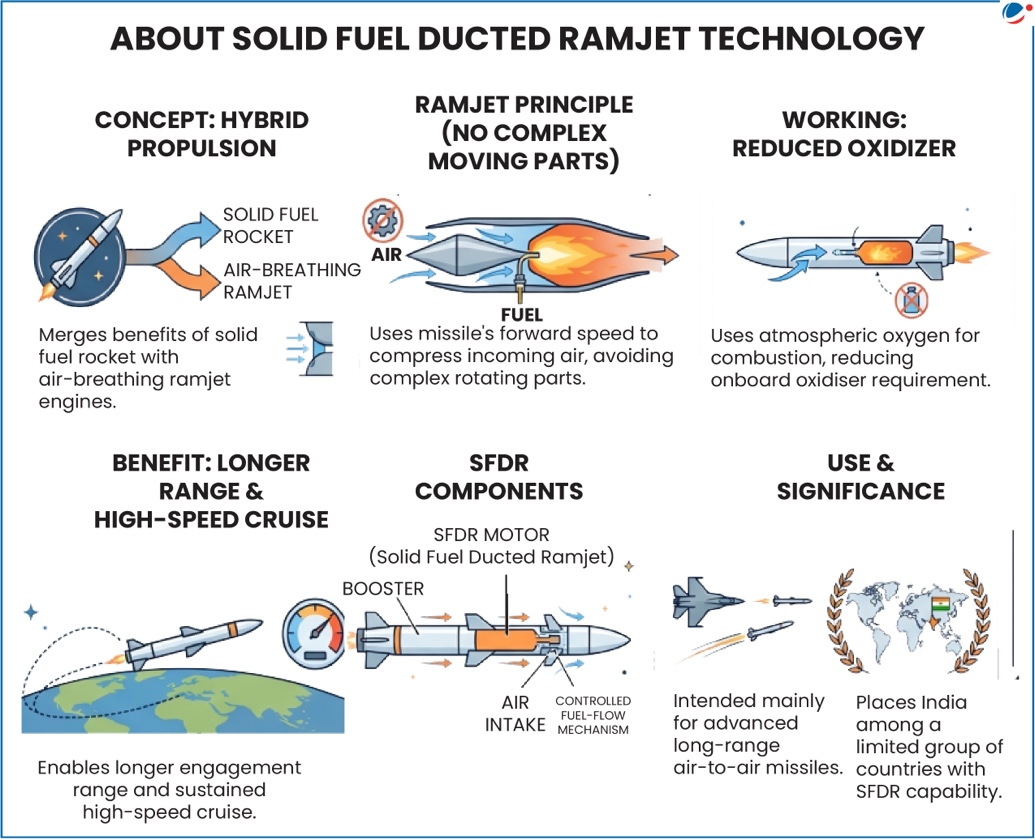
DRDO has carried out successful demonstration of Solid Fuel Ducted Ramjet (SFDR) technology from the Integrated Test Range (ITR), Chandipur, Odisha.
Article Sources
1 sourceChandrayaan-4 Mission identified Mons Mouton, a location on the Moon to land its lander.
- Chandrayaan-4 will be India’s fourth mission to Moon that will demonstrate taking off from the lunar surface after collecting surface samples, and bringing back the same to the Earth.
- The planned timeline for Chandrayaan-4 mission is 2027.
About Mons Mouton
- Mountain near Moon's south pole, known informally as Leibnitz Beta, named after NASA mathematician and computer programmer Melba Roy Mouton.
- Key Features: Flat-topped spanning almost 100 kilometres and rises roughly 6000 meters above the surrounding terrain.
Article Sources
1 sourceThe 2026 Union Budget has sanctioned the establishment of two new telescopes to study the sun and the origins of the universe in Ladakh.
About the Two New Telescopes
- National Large Solar Telescope (NLST): A 2-metre aperture telescope in Merak (Ladakh) to study solar dynamics, magnetism, and space weather.
- Once operational, NLST will serve as India’s third ground-based solar observatory.
- Currently, the Kodaikanal Solar Observatory (in Tamil Nadu, established 1899) and the Udaipur Solar Observatory (in Rajasthan, established 1975) are operational.
- National Large Optical Telescope (NLOT): A 13.7-metre segmented-mirror telescope in Hanle (Ladakh). It will research exoplanets and the universe's origins using optical-infrared wavelengths.
The Compact was launched by World Economic Forum and is supported by Unified Coalition for AMR Response.
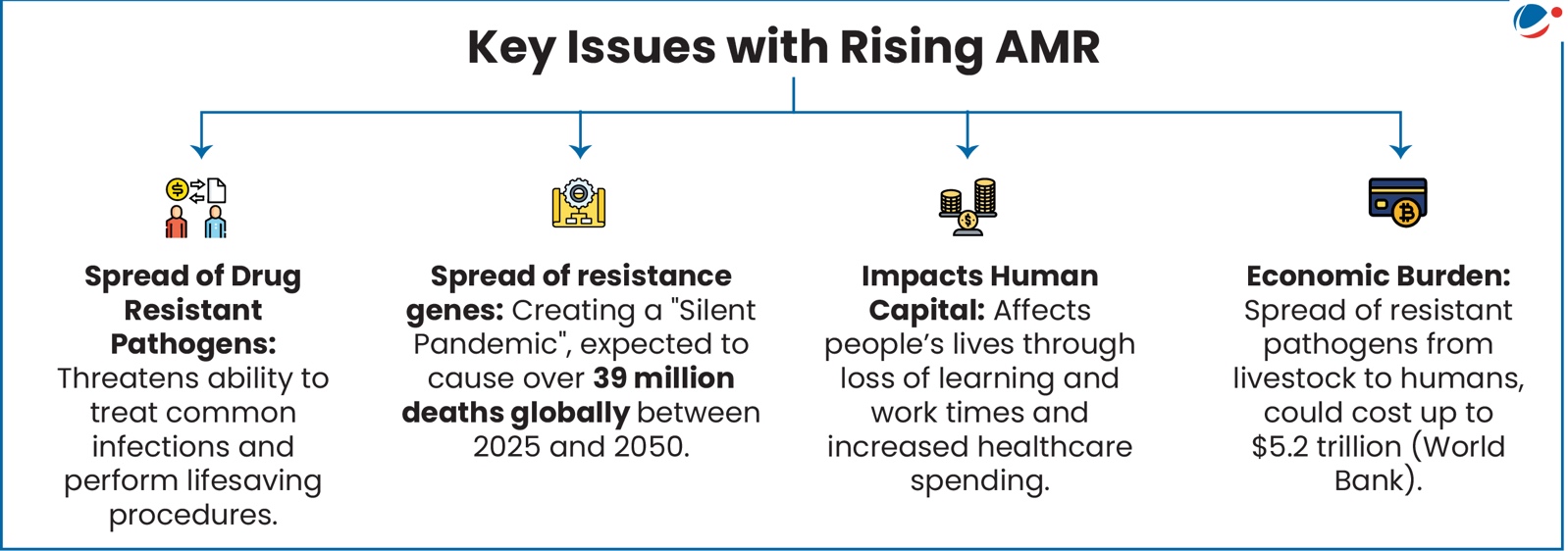
- It aims to unlock sustainable financing from both public and private sources to reduce the global AMR deaths, saving more than 100 million lives by 2050.
About AMR
- It occurs when bacteria, viruses, fungi and parasites no longer respond to antimicrobial medicines (antibiotics, antivirals, antifungals, etc.) making them ineffective.
- It is a natural process that happens over time through genetic changes in pathogens.
- However, its spread is accelerated by human activity, mainly the misuse and overuse of antimicrobials.
- Status in India: Around 6 lakh lives are lost each year due to resistant infections.
Key Initiatives taken to address AMR
- National Action Plan on AMR 2.0 (2025-2029): Unified and coordinated effort across the human, animal, agriculture and environmental sectors.
- First Indigenous Antibiotic, Nafithromycin: Launched in 2024 ,it is designed to treat both typical and atypical drug-resistant bacteria.
- National surveillance networks: Generate annual AMR surveillance reports, with data submitted to the Global AMR Surveillance System (GLASS).
- Global Initiatives Efforts:
- Global Action Plan (GAP) on AMR during 2015 World Health Assembly.
- United Nations General Assembly High-Level Meeting on AMR, 2024, to reduce global deaths associated with bacterial AMRs by 10% by 2030 against the 2019 baseline, etc.
Article Sources
1 sourceKerala becomes first state in the country to declare Bacillus subtilis as ‘State microbe’.
What is Bacillus subtilis?
- It is a type of probiotic or “good” bacteria found widely in the environment and naturally in the gut of humans as well as in fermented foods.
- Industrially, it is valuable for producing enzymes (e.g., amylases, proteases), antibiotics (e.g., bacitracin), and as a probiotic in agriculture and livestock feed.
- Its GRAS (Generally Recognized as Safe) status makes it suitable for food and pharmaceutical applications.
According to Ministry of Health and Family Welfare (MoHFW), number of organ transplants increased nearly fourfold over past decade – from fewer than 5,000 in 2013 to almost 20,000 in 2025.
- Around 18% of these involve organs donated by deceased donors, reflecting a rise in cadaveric (deceased donors) donations.
Organ Transplantation Framework in India
- Legal Framework: Transplantation of Human Organs and Tissues Act, 1994 (THOTA) enacted by the MoHFW.
- Regulatory Mechanism: Three tiered structure under THOTA, 1994:
- NOTTO: Apex body for coordination, networking, and registry of organ/tissue donation and transplantation.
- Regional Organ and Tissue Transplant Organization (ROTTO).
- State Organ and Tissue Transplant Organization (SOTTO).
- National Organ Transplant Program (NOTP): Central Sector Programme to improve access to organ transplantation for needy citizens.

