


Why in the News?
Union budget 2026-27 prioritises budgetary provisions for Urban Local Bodies (ULBs) and their implications for the long-term trajectory of urban growth.
Key highlights of Budget announcements
- Development of City Economic Regions (CERs): To harness the economic potential of urban agglomerations, the government will map City Economic Regions based on their growth drivers, with ₹5,000 crore allocated per CER over five years.
- The introduction of CERs marks a move from managing cities as administrative units to planning them as integrated economic systems.
- Focus on Tier II, Tier III Cities and Temple Towns: The budget prioritises infrastructure development in Tier II and III cities with populations above 0.5 million as emerging growth centres, along with modern infrastructure and basic amenities for temple towns.
- Incentives for Municipal Bonds: To promote municipal bonds as a key borrowing tool, the budget offers a ₹100 crore incentive for single issuances above ₹1,000 crore, while the AMRUT will continue to support bond issuances of ₹200 crore or less by smaller and medium towns.
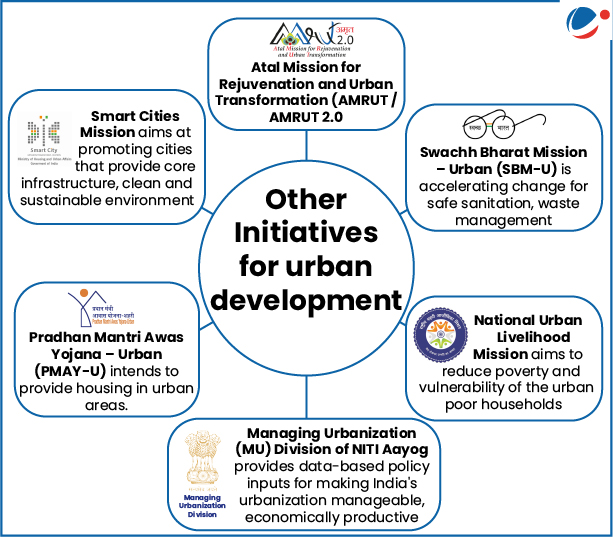
- 16th Finance Commission Grants: The budget allocates ₹1.4 lakh crore to States for 2026–27 as grants for urban and rural local bodies and disaster management.
- Creation of University Townships: The budget proposes five university townships near major industrial and logistics corridors, envisioned to evolve into vibrant urban centres.
- Implementation through 'Challenge Mode': Cities and states will compete for funding to implement their development plans and university townships through this challenge route, ensuring that financial support is directly linked to structural reforms and outcomes.
- Urban Challenge Fund (UCF): ₹1 lakh crore funds approved to support reform-driven urban projects.
Urbanisation in India
- The Census of India requires settlements to be marked by three conditions to be classified as urban:
- The settlement population must be greater than 5,000;
- 75 per cent of male employment should be non-agricultural;
- Minimum population density of 400 persons/square kilometre.
- The definition also adds those towns that have been administratively classified as statutory towns.
- According to the census definition, India's urbanisation has been slowing.
- However, there is a growing acknowledgement of the importance of measuring urbanisation using data on mobility, labour markets, density, built-up areas, and night-time light data. (Economic Survey 25-26)
- The Janagraha Foundation's Annual Survey of India's City Systems (ASICS) 2023 report suggests that India may be far more urban than the Census indicates.
- Based on satellite data from the Global Human Settlements Layer (GHSL) of the Group on Earth Observations at the European Commission, India was 63 per cent urban in 2015, which is nearly double the urbanisation rate reported in the 2011 Census.
Key issues with Urbanisation in India
- The Urban Paradox: The Economic Survey 2026 argues that population scale has not resulted in proportionate global economic influence or liveability because infrastructure investment has lagged behind growth.
- As a result, the potential benefits of density have been diluted by congestion, environmental stress, and informalisation.
- New Urban conurbation: Metropolitan expansion is overwhelmingly outward, often following transport corridors and converting agricultural land into urban use beyond statutory municipal boundaries.
- For example, Census classifies Kerala's urbanisation at 47.7 per cent (2011), spatial analysis using the Degree of Urbanisation (DEGURBA) methodology places it at roughly 80.8 per cent when functionally urban settlements (outside municipal limits) are included.
- Urban Mobility: Congestion causes massive economic losses across major metros. The guiding principle is to prioritise moving people, not vehicles.
- Waste & Cleanliness: Economic Survey 2026 identifies cleanliness as an institutional and behavioural challenge, not just an infrastructure one.
- Door-to-door waste collection has reached 98% of urban wards, but segregation and processing capabilities lag behind.
- Floor Space Index (FSI) Trap: Restrictive Development Control Regulations, specifically low FSI norms create artificial land scarcity, driving up land prices and increases the per-unit cost of delivering infrastructure.
- Informality in Indian cities: A structural outcome of rapid urbanisation, reflected in slums, informal labour, and unregistered enterprises, arising from gaps in formal housing, services, and employment systems.
- Street vendors and informal labor are often treated as obstacles to be cleared. Displacing informal settlements destroys embedded capital, such as location advantages and social networks.
- Fragmented Governance: Overlap between Urban Local Bodies (ULBs), Development Authorities, and State Line Departments.
- Weak Mayoral Authority: Cities lack a single "Chief Executive" to drive a long-term vision.
- Financial dependency: ULBs are heavily depending on grants-in-aid from the state consolidated fund and taxes assigned by the state, rather than generating sufficient own-source revenues.
- Cities generate <0.6% of GDP in own-source revenue (vs. 2-4% in OECD).
- Professional Vacuum: Deficiency of skilled workforce in planning, data analytics, and modern accounting.
Measures to be taken to improve urbanisation in India
- Infrastructure-Led Growth: Move from reactive to proactive investment in urban infrastructure.
- Urban Infrastructure Development Fund (UIDF) is designed to finance infrastructure in Tier-II and Tier-III cities.
- Improve Mobility: Scale Namo Bharat RRTS for regional labor integration, digitize bus fleets and implement Congestion Pricing as in London/Singapore.
- Integration of Informality: Move from "eviction" to "spatial integration." Explicitly design streets to accommodate formalized vending.
- Metropolitan Governance: Establish unified authorities for mobility and land-use that account for the entire economic region, not just "city limits."
- True Devolution: Unconditional transfer of "Funds, Functions, and Functionaries" (3Fs) as per the 74th Amendment.
- Fiscal Autonomy: Implement self-updating property taxes, user charges, and access Capital Markets (Municipal Bonds).
- Professional Cadres: Create specialized municipal cadres and performance-linked capacity building.
- Design as Nudge: Urban design should act as a behavioural instrument. Legible streets with clear markings, signage, and segregated lanes reduce ambiguity and make the right action intuitive.
- Citizens are more willing to comply when they see tangible returns on their taxes through improved services like lighting and drainage.
- Nature-Based Solutions: Infrastructure should be circular, integrating stormwater drains with wetlands and using tree cover to combat the urban heat island effect.
- Building codes must mandate rainwater harvesting and grey-water reuse, similar to systems in the IIM Kozhikode campus or the solar-powered Cochin International Airport.
Conclusion
Urbanisation in India lacks the necessary institutional foundations. An integrated approach combining physical investment with a stronger civic contract is essential for shared prosperity. Ultimately, cities must be empowered to function as economic engines that are inclusive and liveable.


