


Why in the News?
In case of Re: Phalodi Accident, the Supreme Court passed comprehensive guidelines to enhance road safety on expressways and national highways (NH).
Key observations of Supreme Court
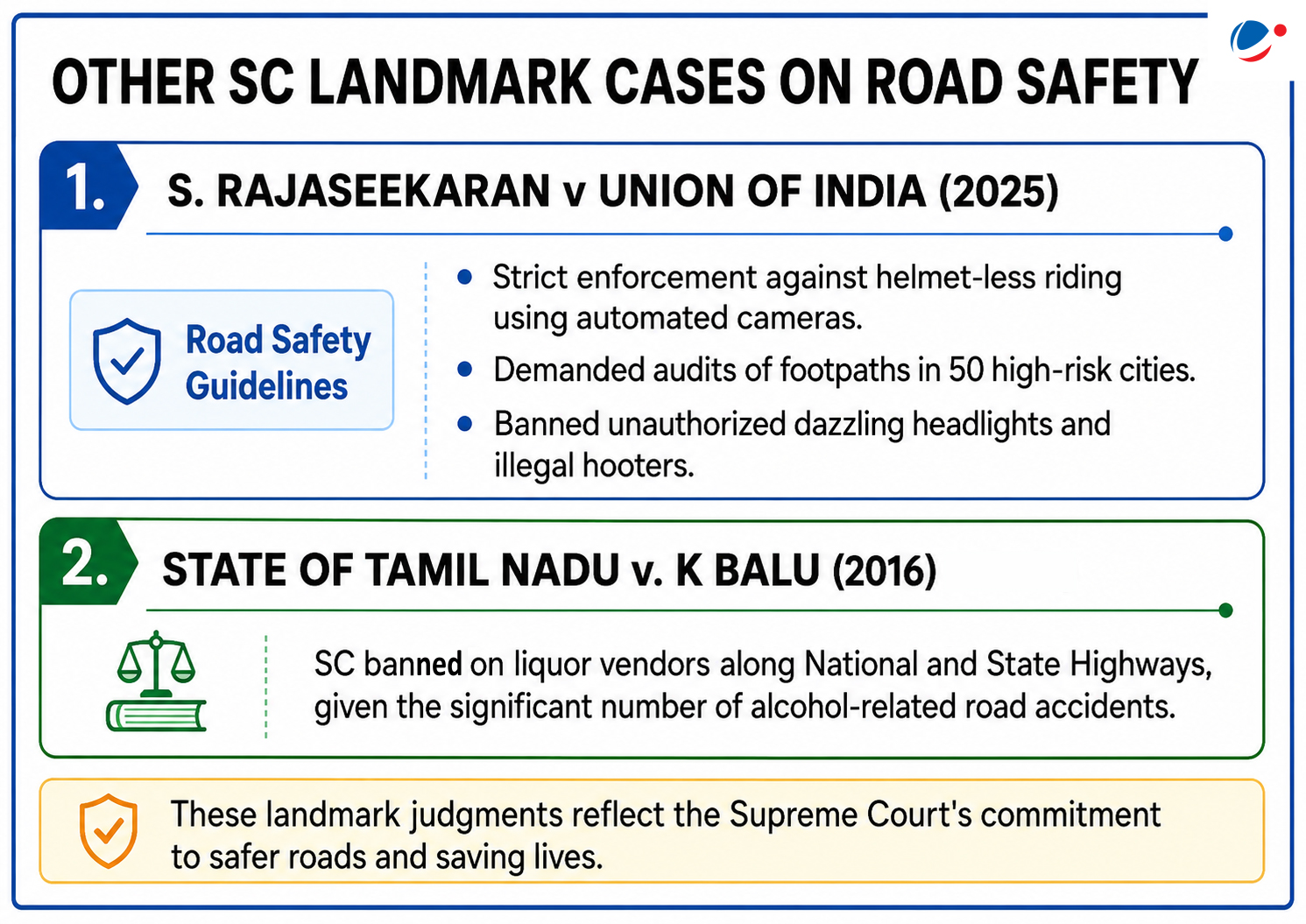
- Expansion of Article 21: SC recognized "right to a safe commuting environment and the safety of a commuter" as integral to the "Right to Life" with dignity under Article 21.
- Human Life over Constraints: The Bench reiterated that no financial or administrative constraint can outweigh the sanctity of human life.
- Invoked extraordinary powers under Article 142 to issue enforceable nationwide directions overcoming administrative and monetary constraints.
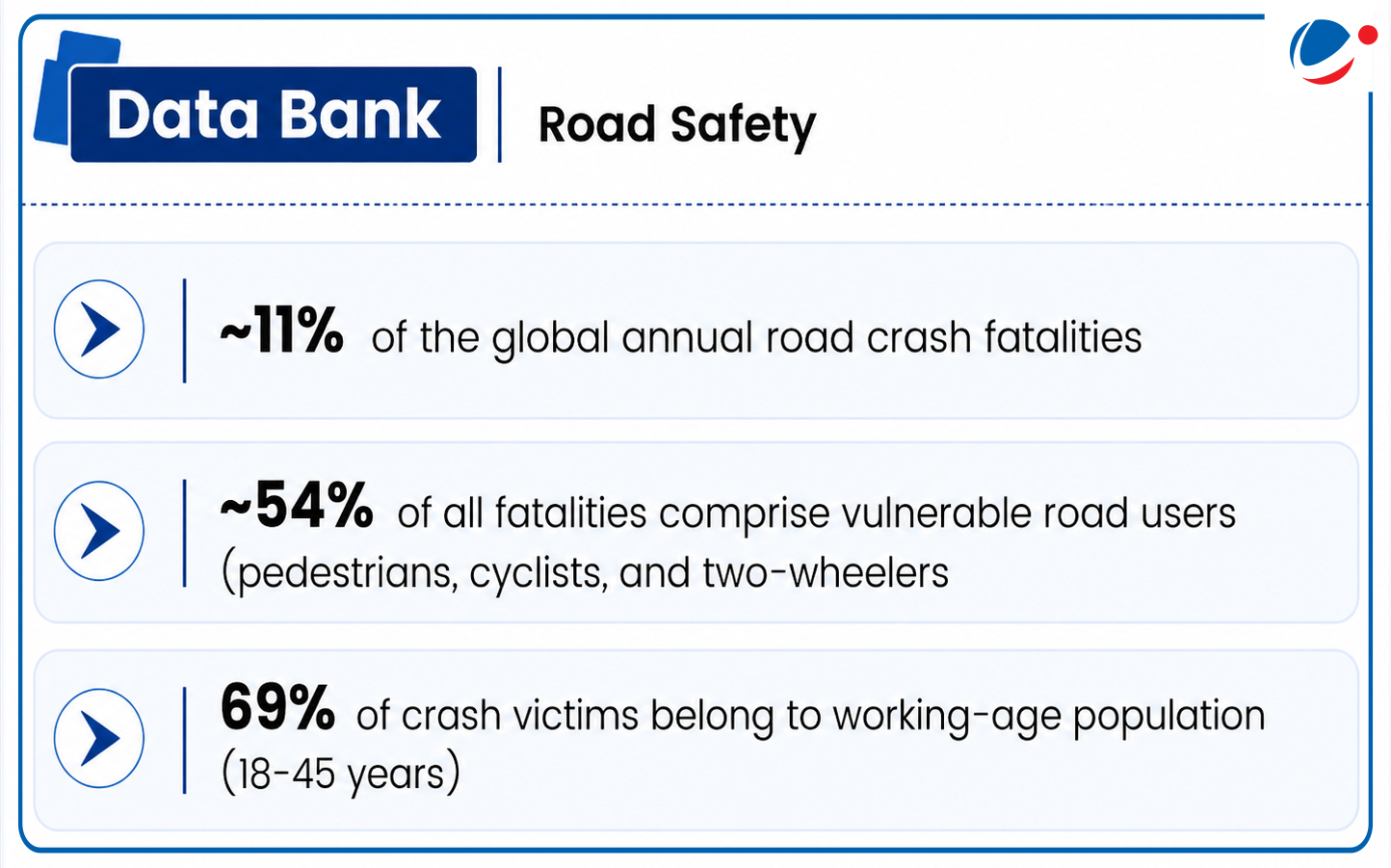
- Disproportionate Fatalities: The SC flagged alarming statistics, noting that NHs account for merely 2% of India's total road length, yet they contribute to nearly 30% of all road fatalities.
Major Directions Issued by the Supreme Court
- Removal of Highway Encroachments: The construction of any new dhabas, eateries, or commercial structures within the Right of Way (ROW) is banned immediately.
- Advanced Traffic Management Systems (ATMS) Mandatory: Cameras, speed detectors, and incident detection systems on all National Highways.
- Heavy vehicle Parking: Restricted to designated areas only.
- District Highway Safety Task Force (DHSTF): Integrate district administration, police, and highway authorities for unified enforcement.
- Deployment of Emergency Services: NHAI must deploy Basic Life Support (BLS) ambulances and recovery cranes within 60 days at intervals not exceeding 75 km across all NH stretches, to ensure prompt medical response.
- Enhanced Surveillance & Patrolling: Dedicated Highway Surveillance Teams must be formed within 30 days to supplement NHAI's 24x7 patrolling vehicles at intervals not exceeding 50 km.
- Accident Blackspots Identification: Mandatory identification and correction of all accident-prone locations.
- Citizen Grievance: NHAI must operationalize the Rajmargyatra encroachment complaint module and the 1033 toll-free number.
- Other: Conduct biannual drone surveys, States must restrict land-use changes near NH, Truck lay-bye facilities and creation of an Inter-State Highway Safety Coordination Committee.
Reasons for low road safety in India
- Infrastructure Deficits: Rapidly expanding high-speed networks often lack safe access or crossings for non-motorized traffic.
- Poor engineering creates dangerous accident "blackspots".
- Weak Enforcement and Compliance: "No concept of lane driving," incredibly low compliance with seat belt (25%) especially rear seats (4%) and helmet laws (50% people wear helmet), and an estimated 30% prevalence of fake driving licenses hamper basic safety.
- Institutional & Governance Gaps: Existing bodies like the National Road Safety Council (NRSC) lack adequate statutory backing, technical capacity, and budgetary resources to execute plans effectively.
- Other: Fake driver's licenses, unregulated local modifications, overloading, post-crash care deficiencies, etc.
Government Initiatives:
- Multi-pronged 4Es Strategy: Interventions based on Education, Engineering (road & vehicle), Enforcement, and Emergency Care.
- Motor Vehicles (Amendment) Act, 2019 (MVAA): A paradigm shift holding road contractors accountable for bad design, enhancing penalties, and proposing the cashless treatment of victims during the 'golden hour'.
- Vehicle Safety Enhancement: Bharat NCAP/ Global New Car Assessment Program (GNCAP) mandates, requirement of Airbags, Anti-lock Braking Systems (ABS), and pedestrian protection designs for vehicles.
- State Road Safety Incentives Program: A massive proposed US$2 billion funding scheme to financially reward states for continuous road safety performance improvements.
- Other: National Road Safety Strategy (2018–2030), to develop Integrated Road Accident Database (IRAD) for tracking crashes nationwide, establishment of the National Injury Surveillance Trauma Registry, etc.
Way Forward:
- Modernizing Enforcement: Shifting to un-manned, automated technology (cameras, ATMS, drones) to reduce human intervention and ensure round-the-clock compliance and objective penalization.
- Institutionalization: Immediately operationalize the fully empowered National Road Safety Board (NRSB) and counterpart state road safety authorities as mandated by the MVAA to ensure strict accountability and coordination.
- Strengthening Post-Crash Care: Fully implement the Good Samaritan guidelines to protect bystanders, integrate trauma care networks along highways.
- SDG 3.6 Roadmap: Publish a state-wise binding target framework for halving road deaths by 2030, with annual performance reviews tied to central highway funding allocations.
- Other: Ensure mandatory safety audits for all road projects, establish automated driver testing tracks to eliminate fake licenses and modern automated vehicle inspection centers in every state to objectively test vehicle fitness.
Conclusion
Road safety in India is not merely a transport issue but a critical public health, economic, and governance priority. Strengthening road safety aligns with the Sustainable Development Goals, particularly SDG 3.6 and 11.2 (universal access to safe transport), while fulfilling India's commitments under international road safety conventions (1968 Vienna Convention on Road Signs and Signals and 1998 Agreement on Global Technical Regulations for Wheeled Vehicles).


