Why in the News?
Lok Sabha clears Bill to make Amaravati the sole capital of Andhra Pradesh
Amaravati and its Cultural Significance
- Amaravati is located in the Guntur district of Andhra Pradesh on the banks of the Krishna River.
- The Capital project began in 2014, when Telangana was carved out of Andhra Pradesh.
- The term "Amaravati" literally means "Abode/Place of Immortals".
- Udumbaravati was the ancient name of Amravati. It was due to the presence of an ample number of Audumber trees in the region.
- Historical Importance:
- Amaravati served as the capital of the Satavahana dynasty and has a historical legacy dating back to the 3rd century BCE.
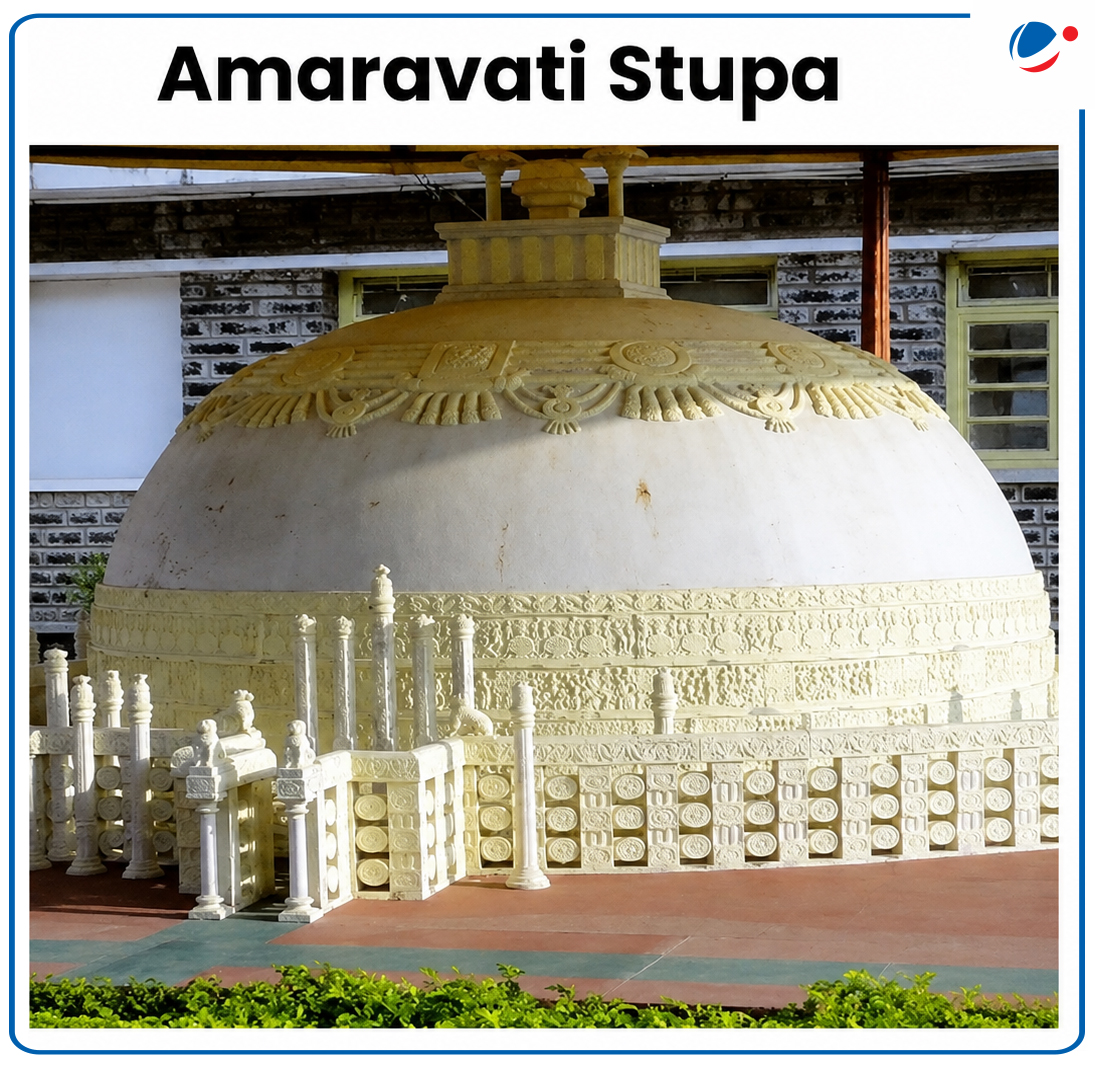
- Amaravati Stupa:
- The stupa was built with white marble.
- Though the Stupa itself has completely disappeared, its sculptured panels have been preserved in Madras and British Museums.
- Also known as the Mahachaitya ("Great Stupa"), was constructed around the 2nd century BCE during the Satavahana period and is regarded as one of the oldest Buddhist monuments in India.
- The stupa featured a circular pradakshinapatha, intricately carved vedika pillars depicting Jataka tales and Buddha's life events, along with toranas adorned with lion and lotus motifs.
- Early phases represented Buddha symbolically, while anthropomorphic Buddha images appeared from the 1st century CE onwards.
- Centre of Buddhism
- Acharya Nagarjuna is believed to have propounded the Madhyamika Philosophy in the Amaravati region, which later became the philosophical basis of Mahayana Buddhism.
- Madhyamaka Marga (Middle Path) advocates a "middle way" between extreme views, specifically eternalism (existence) and annihilationism (non-existence)
- Acharya Nagarjuna is believed to have propounded the Madhyamika Philosophy in the Amaravati region, which later became the philosophical basis of Mahayana Buddhism.
- Believed to be the place where Gautam Buddha first spread his teachings of "Kalachakra".
- Kalachakra ("Wheel of Time") is a Vajrayana Buddhist tradition centred on cosmology, time cycles and spiritual enlightenment.
- Xuanzang visited Amaravati in the 7th century CE to collect Buddhist manuscripts and sacred texts.
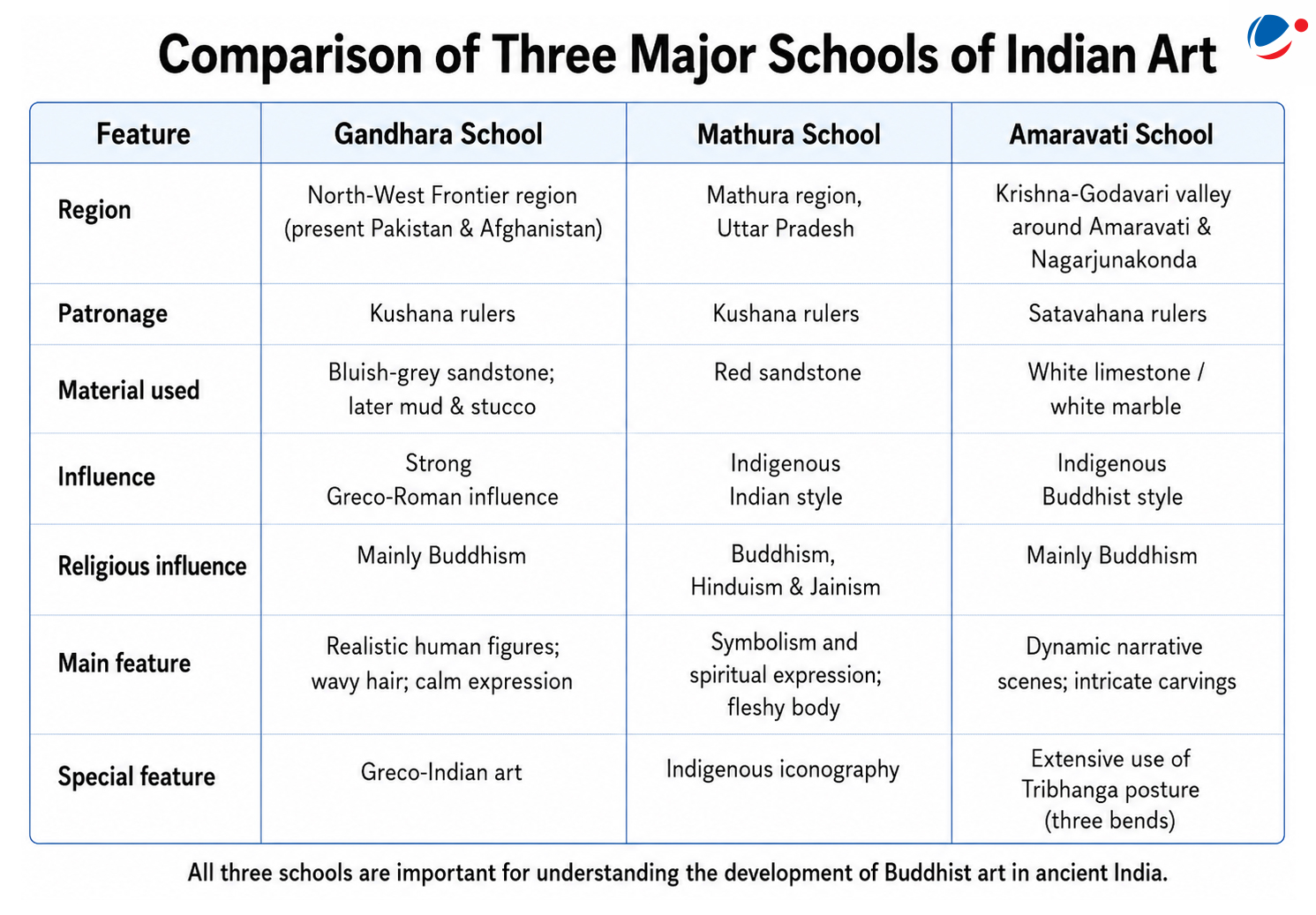
- Amaravati School of Art
- Developed in the Krishna–Godavari valley under the patronage of the Satavahana dynasty and Ikshvaku rulers.
- The main centres of this art were Nagarjunakonda, Amaravati, Goli, Ghantasala, and Jaggayyapeta, etc.
- Emerged as one of the three major schools of Buddhist art in ancient India along with Gandhara and Mathura schools.
- Known for dynamic narrative art depicting Jataka tales, scenes from Buddha's life and Buddhist motifs.
- Example: Buddha statue at Nagarjunakonda in the Amaravathi style.
- Amaravati School of Art
- Other Historical Legacy of Amaravati
- Home to Sri Amaralingeswara Swamy Temple, an important Shaivite pilgrimage centre.
- One of the revered Pancharama Kshetras of Andhra Pradesh.
- The region is famous for traditional handicrafts such as Kondapalli toys and Kalamkari textiles.