


Why in the news?
Recently, Lok Sabha has passed the Jan Vishwas (Amendment of Provisions) Bill, 2026.
About Jan Vishwas (Amendment of Provisions) Bill, 2026
- It seeks to shift India's regulatory approach from a punitive model to "trust-based governance."
- It builds on the earlier Jan Vishwas (Amendment of Provisions) Act, 2023, which decriminalised 183 provisions across 42 Central laws.
- It proposes the amendment of 784 provisions of 79 Central Acts administered by 23 Ministries.
- Key Provisions
- Decriminalising offences: Replaces imprisonment with civil penalties for over 1,000 minor offences. E.g. up to Rs. 1 crore penalty for making national highway impassable instead of imprisonment.
- Omission of offences: E.g. Giving false fire alarm under Delhi Police Act, 1978; failure to give information of births and deaths under Delhi Municipal Corporation Act, 1957 etc.
- Revision of fines and penalties: Increase by 10% of respective minimum amount every three years.
- Graduated response: Provide advisories on first and warnings on second instances of offences. A civil penalty will be imposed for subsequent contraventions.
About Trust-Based Governance
- Trust-based governance is a governance approach in which public institutions are expected to be reliable, responsive, fair, transparent, and integrity-driven, encouraging cooperation and voluntary compliance rather than excessive control and coercion.
- At its core, it implies that trust forms the basis for initiating an inter-organizational relationship.
- OECD defines trust as "a person's belief that another person or institution will act consistently with their expectation of positive behaviour."
Need for Trust-Based Governance
- Regulatory Reform: India's governance framework has been marked by excessive compliances, overregulation leading to increased transaction costs, rigid bureaucratic control.
- India's regulatory framework encompasses 1,536 laws with 69,233 compliances across various levels of government
- Economic Growth: Trust-based governance improves ease of doing business by reducing unnecessary approvals, fear of criminal charges due to non-compliance, and ensures greater policy certainty.
- As Francis Fukuyama argues, societies with higher levels of trust tend to be more economically advanced than those with lower levels.
- Voluntary Compliance: It promotes voluntary compliance through transparency, digital systems, and self-certification mechanisms, instead of punitive enforcement.
- In 2014, self-certification of documents in place of affidavits has eliminated the need of attestations by Gazetted officers or notaries, making life easier for common man and building trust.
- The self-certification mechanism aligns with Rousseau's social contract approach.
- Pendency in courts: More than 5 crores cases are pending across all court levels. Subordinate district courts account for the vast majority (nearly 85% to 87%) of these pending cases.
- Administrative Efficiency: By reducing diversion of resources towards monitoring minor procedural violations, a trust-based approach enables administration to concentrate on governance outcomes.
- Citizen-centricity: It improves accessibility and responsiveness in public administration, making governance more participatory and citizen-friendly.
Challenges associated with Trust Based governance
- Enforcement: Excessive deregulation and overreliance on self-compliance may weaken deterrence against serious violations, such as environmental protection, labour welfare, and financial regulation.
- Institutional Constraints: Effective trust-based governance requires strong institutions, skilled personnel, and robust digital infrastructure; however, shortages in manpower, technological capacity can hinder efficient implementation.
- E.g. As per the parliamentary report there is a 15% vacancy in CBI.
- Digital Divide: Heavy reliance on digital governance may disadvantage rural populations, small businesses, and digitally illiterate citizens who lack internet access, further leading to inequities and exclusion.
- As per, NSSO (National Sample Survey Office) data only 24% of rural households have internet access, compared to 66% in cities.
- Cyber-security: Rapid digitisation of governance increases the risk of data breaches, cyber-attacks, and misuse of personal information, undermining public trust in digital governance mechanisms.
- E.g. Cybersecurity incidents rose from 10.29 lakh in 2022 to 22.68 lakh in 2024.
- Colonial Legacy of Distrust: India's colonial bureaucracy created a culture of suspicion and excessive control, making trust-based governance difficult.
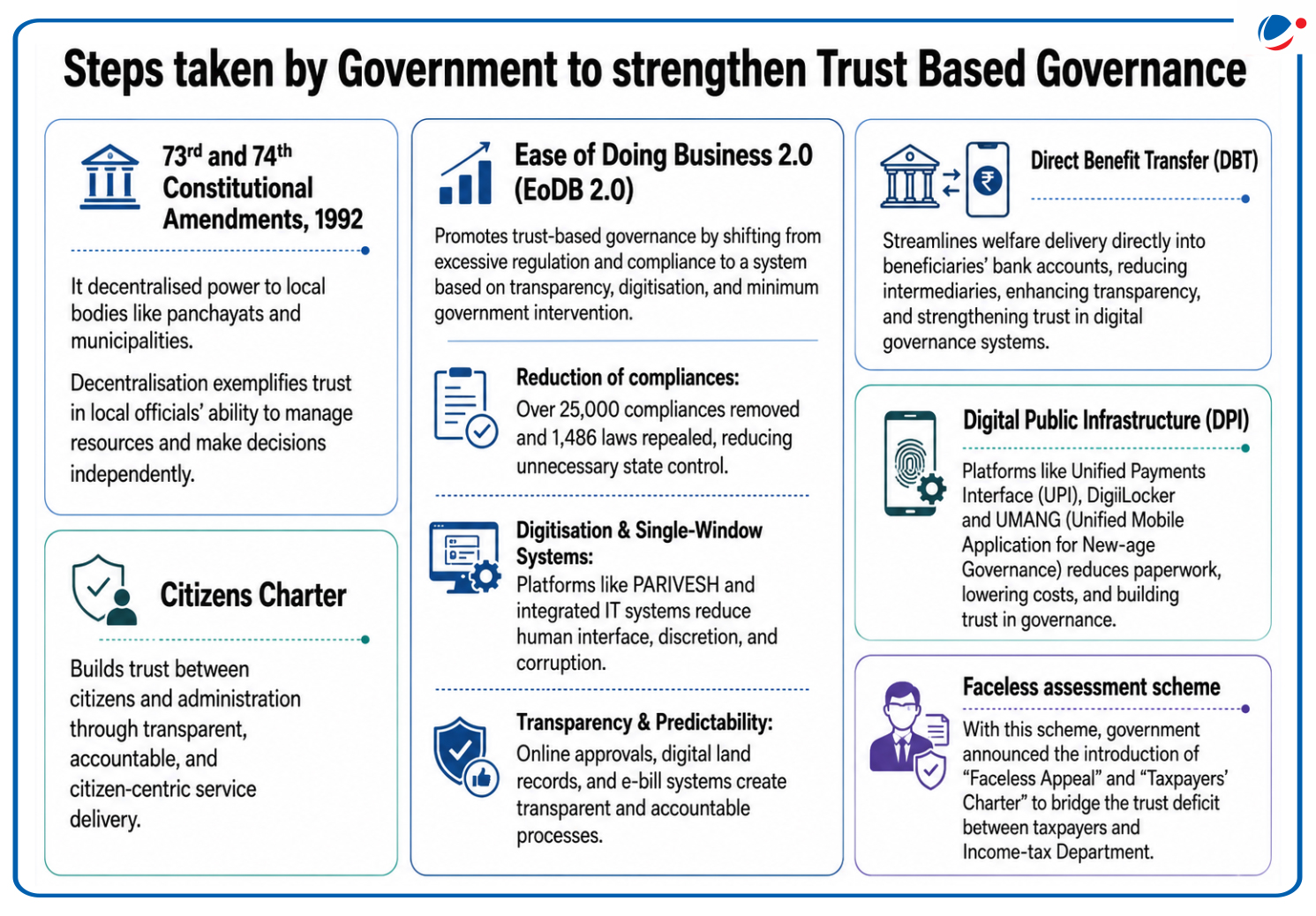
Way ahead
- Encourage Cooperative Federalism: Centre and States should work together to harmonise regulations, simplify compliance systems, and share best governance practices to ensure uniform implementation.
- Enhance Citizen Participation: Institutionalising stakeholder consultations, grievance redressal systems, and public feedback mechanisms can strengthen transparency, accountability, and participatory governance.
- Strengthen Institutional Capacity: Administrative reforms should be accompanied by capacity building of civil servants, filling up vacancies, investment in digital infrastructure, and adoption of outcome-oriented governance practices to ensure effective implementation.
- Embrace technology-based governance: Digital transactions create an audit trail that discourages unethical behaviour and allows real-time identification of misconduct.
- Digital Inclusion: Improving internet connectivity, digital literacy, and accessibility of e-governance services is necessary to ensure that the benefits of trust-based governance reach rural and vulnerable populations.
- Comprehensive compliance reforms: Strengthen trust-based governance through digitisation, AI-enabled compliance systems, removal of redundant regulations, reduced inspections, lower compliance costs, and transparent enforcement mechanisms.

