


Genome India Project (GIP) data reveals 44 million unique Indian genetic variants.
Key Findings of Study
- Genetic Variants: Over 129 million genetic variants were identified.
- Endogamy (marriage within communities): has resulted in genetically distinct and isolated groups.
- Contrasting Population Dynamics:
- Non-tribal populations: greater genetic mixing and population growth.
- Tribal populations: low effective population size, high genetic drift, and strong founder effects (certain rare global variants become locally common due to prolonged isolation).
About Genome India Project (GIP)
- Launched: in 2020 by Department of Biotechnology (DBT), under the Ministry of Science and Technology.
- It is an Indian equivalent of the Human Genome Project (HGP), a global-level effort to map human genomes, launched in October 1990 and completed in April 2003.
- Objective: To build a comprehensive catalogue of genetic variations that reflects the unique diversity of the Indian population.
- Sample Size and Diversity: The study collected samples from 10,000 healthy and unrelated individuals.
- These individuals represent 83 distinct population groups and span India's four prominent linguistic families: Indo-European, Dravidian, Austro-Asiatic, and Tibeto-Burman.
- Significance:
- Healthcare: Disease prediction and early diagnosis with better disease gene discovery, population-specific diagnostics (e.g. impact of endogamy on diseases), etc.
- Reduces Bias: as global genetic databases remain dominated by European populations.
- R&D: Boosts India’s and global genomic researchand innovation ecosystem.
Key Concepts
|
The therapy, called Otarmeni, made by Regeneron Pharmaceuticals was approved by United States Food and Drug Administration under National Priority Voucher Program.
- Therapy is designed to treat hearing loss caused by OTOF gene mutations.
- OTOF Gene codes for a protein called otoferlin, needed by inner ear cells to translate vibrations into signals interpreted by brain.
- When people carry two defective copies of this gene (one from each parent), it causes severe-to-profound hearing loss, accounting for 2%- 8% of inherited, non-syndromic cases.
About Gene Therapy
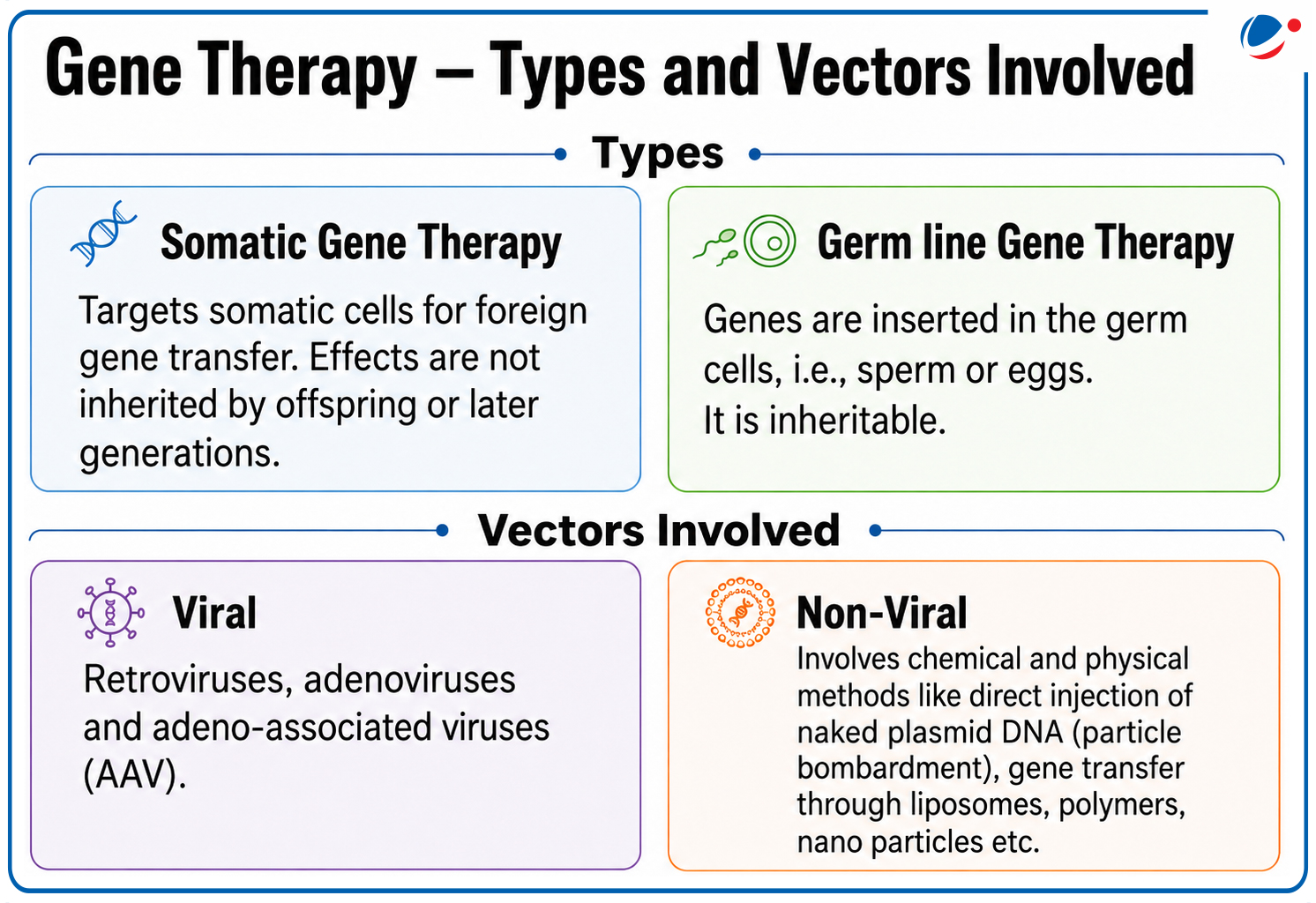
- Meaning: Refers to a collection of methods that allows correction of a gene defect. It involves insertion of genes into a person’s cells and tissues to treat a disease.
- A vector is a carrier used to deliver the therapeutic gene into target cells.
Department of Science & Technology has released a national roadmap for Post-Quantum Cryptography (PQC) Migration.
It aims to develop cryptography techniques that are secured against attacks from advanced quantum computers for ensuring future cryptographic security and digital sovereignty.
- It was necessitated as advancements in quantum computing have potential to break existing cryptography algorithms which form the backbone of today’s IT systems, online communications, financial transactions, and other sensitive digital information.
- These algorithms include benchmark RSA (Rivest–Shamir–Adleman) and ECC (Elliptic Curve Cryptography) public-key encryption.
Risks of Quantum Computing to Cybersecurity
- Breaking of Existing Encryption: Quantum computers can break public-key cryptography, compromising banking, emails, and government communications.
- Harvest Now, Decrypt Later: Encrypted data collected today can be decrypted in the future, exposing long-term sensitive information.
- Systemic Risk: Breaking cryptography can disrupt critical sectors like power, telecom, finance, and governance.
- Threat to National Security: Exposure of defence and intelligence data can weaken national security and create strategic risks.
India’s Efforts for Developing Secure Quantum Computing
- National Quantum mission: Aims to develop comprehensive indigenous quantum technology ecosystem with establishment of four thematic hubs.
- DST’s Quantum-Enabled Science and Technology (QuEST) program: To groom young researchers in quantum technology.
- State-Level Initiatives: Amaravati Quantum Valley (AQV) Initiative (Andhra Pradesh), Quantum Mission (Karnataka), Telangana Quantum Strategy etc.
Article Sources
1 sourceMeghalaya becomes the third Indian state after Maharashtra and Gujarat to partner with Starlink formally.
- Starlink was launched in 2019 by SpaceX and plans to have 42,000 satellites in Low Earth Orbit (LEO).
About Satellite Internet
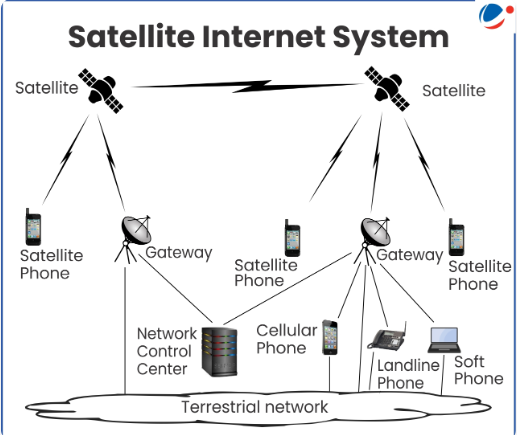
- Definition: Satellite internet refers to the internet service provided through satellites placed in Geostationary Orbits (GSO) or Non-Geostationary Orbits (NGSO).
- LEO and MEO (Medium Earth Orbit) are NGSO.
- Unlike land-based internet services such as fiber, cable, etc., it doesn't rely on wires to transmit data. improving accessibility, deployment speed, and long-distance transmission.
- Infrastructure: It generally includes three segments:
- Space Segment: Includes network of several communication satellites.
- Ground segment: Includes satellite measurement and control networks, gateway stations, etc.
- User segment: Includes communication terminals used by users.
Advantages over existing land-based internet services:
- Global reach: Connects remote and underserved regions lacking fiber or cellular infrastructure.
- Rapid deployment: Requires only power and clear sky, avoiding costly and time-consuming civil works.
- Disaster resilience: Restores communication quickly and acts as backup when terrestrial networks fail.
Regulatory Landscape for Satellite Internet Services
|
ISRO launched Mission MITRA to test Gaganyaan crew for mental, physical and crew operability strengths
About Mission MITRA (Mapping of Interoperable Traits and Response Assessment)
- It is a behavioural study by ISRO for human spaceflight missions, conducted in partnership with Indian Air Force's (IAF) Institute of Aerospace Medicine (IAM).
- Objective: To assess physiological, psychological and operational performance of Gaganyaan crew under stress.
- It was conducted at Leh, Ladakh simulating extreme conditions such as hypoxia, low temperature and isolation
New mineral Cerium-Magnesium Changesite has been discovered in lunar meteorite named Pakepake 005 found in Taklamakan Desert, China.
- The finding raises total known lunar minerals to 11.
About Cerium-Magnesium Changesite
- It is a rare earth-bearing phosphate mineral with distinctive physical and chemical characteristics.
- Physical Properties: Colourless, transparent, with a glass-like lustre.
- It is also fragile and shows shell-like fracture, and glows under UV light.
- Scientific Significance: Helps understand volcanic processes on the Moon and distribution of rare earth elements.
- Its fluorescence makes it valuable in development of more efficient LEDs.
