


Part of India's Arihant-class submarines, INS Aridaman is a more advanced ballistic missile submarine (SSBN)than its predecessors INS Arihant (2016) and INS Arighaat (2024).
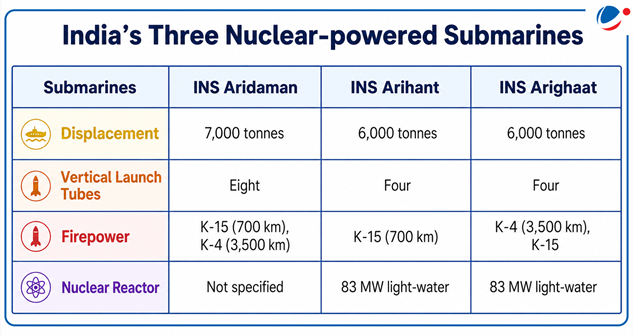
About India’s Nuclear Powered Submarine Programme
- The Advanced Technology Vessel (ATV) programme was initiated more than three decades ago, involving both private firms and the Defence Research & Development Organisation, with help from Russia.
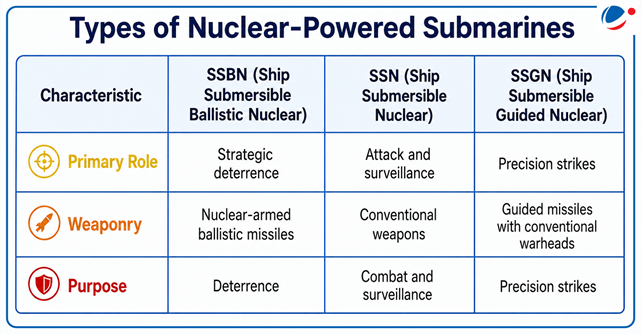
- It primarily focused on developing the ballistic missile submarines (SSBNs), which are nuclear propelled, and can carry multiple sets of submarine-launched ballistic missiles (SLBMs), tipped with single or multiple nuclear warheads.
Significance of Nuclear Powered Submarines for India
- Nuclear Triad Completion: The submarine cements India's position in the select group of nations (alongside the US, Russia, China, and France) capable of launching nuclear weapons from land, air, and sea.
- Strategic Deterrence: Carries nuclear ballistic missiles, strengthening India’s deterrence against regional adversaries China and Pakistan.
- Stealth & Endurance: Nuclear propulsion allows long underwater missions, making it highly survivable and hard to detect.
- Extension of Nuclear doctrine: Showcases guarantee of India's second-strike capability with No-first Use policy.
Defence Ministry has signed contracts for procurement of Tunguska Air Defence Missile System
About Tunguska Air Defence Missile System
- Also Known by its NATO designation SA-19 “Grison”
- Origin: It is a Soviet-origin, tracked, self-propelled air defence system designed to protect ground forces from low-flying aerial threats.
- Feature: It integrates surface-to-air missiles with twin 30 mm autocannons, allowing it to engage targets across varying ranges and altitudes.
- Range:
- Detection: up to 18 km away
- Target: Can engage targets at ranges of up to 8–10 km and altitudes of up to 3,500 metres.
- Significance: Hybrid design makes it effective against helicopters, drones and cruise missiles.
Indian Air Force (IAF) is preparing to induct unmanned stealth fighters under the Remotely Piloted Strike Aircraft (RPSA) programme.
About RPSA Programme
- RPSA aims to develop Unmanned Combat Aerial Vehicles (UCAVs), known as Ghatak UCAVs.
- UCAVs usually carries aircraft ordinances such as missiles and/or bombs and is used for drone strikes and other military operations.
- Ghatak is a stealth-capable UCAV, based on a flying-wing configuration.
- Once operational, Ghatak could undertake deep-strike missions, penetrating heavily defended airspace to hit high-value targets without placing pilots at risk.
- Exercise Cyclone-IV: Bilateral India–Egypt joint Special Forces military exercise.
- Exercise Dustlik: Annual India-Uzbekistan joint military exercise.
- Conducted alternatively in India and Uzbekistan.
Tags:

