


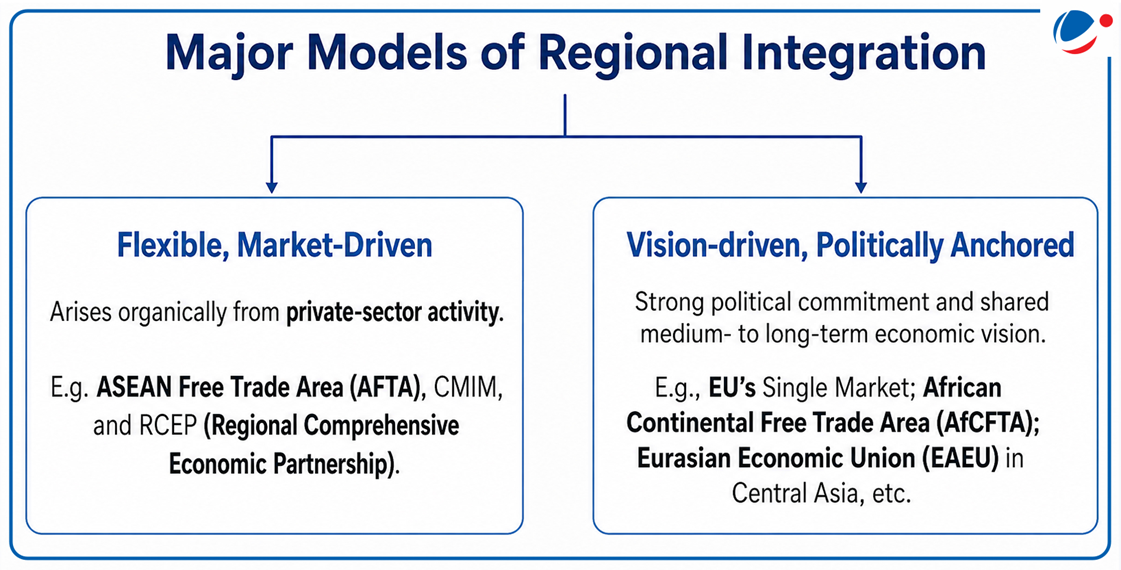
Mounting volatility of global system has underscored the growing importance of regional cooperation and integration, with ASEAN leading as an example.
ASEAN’s Key Achievements Re-enforcing Regional Cooperation
- Commitment to Core Beliefs: Despite significant differences in culture, political models and socio-economic indicators, ASEAN functioned as cohesive, viable economic and political bloc for almost 60 years.
- Mutual Support and Trust: Accession of Timor Leste to ASEAN in 2025 is an example how members (in this case Indonesia) can put aside years of enmity for mutual support and growth for entire bloc.
- Wider Integration: E.g., Digital Economy Framework Agreement (DEFA) represents an example of “coalitions of smaller economies”, to accelerate digital transformation throughout the region.
Other Key Benefits of Regional Integration
- Regional Financial Stability: E.g., Chiang Mai Initiative Multilateralisation (CMIM), established due to Asian Financial Crisis, provided ASEAN+3 (China, Japan, and Republic of Korea (ROK)) economies with a crucial safety net.
- Expands Markets and Input Sources: Ensuring better allocation of resources and accelerating economic growth.
- Reduce Inequality between countries: Freer trade and factor mobility from integration allow less-developed members to grow faster.
- Political Stability and Collective Bargaining: Strengthens diplomatic relationships and Increases the influence of member states in global trade negotiations.
Article Sources
1 sourceThe RELOS pact signed between India and Russia has recently become operational.
About RELOS
- Objective: Enables reciprocal use of military bases, ports, and air facilities, including Arctic access for India.
- Scope: Covers logistics support, joint exercises, training, and humanitarian missions.
- Deployment Provision: Allows stationing of up to 3,000 troops, 5 warships, and 10 aircraft in each other’s territory for 5 years.
- Significance: Strengthens defence cooperation, interoperability, and support for Russian-origin equipment amid global geopolitical tensions.
India and United Nations conducted review of UN Development Partnership Fund operations.
About UNDPF
- Overview: Launched in 2017 with $150 million, led by Government of India.
- Objective: Supports Global South in achieving Sustainable Development Goals and shared prosperity.
- Approach: supports Southern-owned and led, demand-driven and country-led sustainable development projects.
- Focus Areas: Least Developed Countries (LDCs) and Small Island Developing States (SIDS).
- Implementation: managed by the United Nations Office for South-South Cooperation (UNOSSC) and executed by UN agencies with partner governments.
Indian Navy launched ‘Operation Urja Suraksha’.
About Operation Urja Suraksha
- Launched to escort, guide, and safeguard India-bound energy shipments (e.g. LPG, crude oil, etc.) through the Strait of Hormuz, currently blockaded by Iran.
War in the middle eastern region and resultant disruptions of supplies through Strait of Hormuz threatens Global Agriculture.
Impact of War on Agriculture
- Disruption of Fertilizer Supply Chains: Middle East is critical hub for the production and export of essential agricultural chemicals, including ammonia, urea, phosphate, and sulphur.
- Surge in Agricultural Input Costs: Increase in prices of key fertilizer products.
- Global Food Price Inflation: The combined surge in energy and fertilizer prices directly drives up the cost of food production, which ultimately leads to higher consumer food prices and raises serious concerns regarding global affordability.
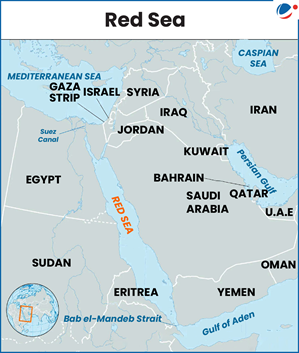
- Red Sea: Iran's threatened to block trade through the Red Sea, if the US naval blockade continues around its ports.
- It is a fiord type marginal sea.
- It is connected to the Gulf of Aden via Strait of Bab El Mandeb and to the Mediterranean sea via Suez Canal.
- Bordering Nations: Egypt ,Sudan and Eritrea (West), Israel & Jordan (North East) via the gulf of Aqaba and Saudi Arabia & Yemen (East).
- It receives very little precipitation and no water enters the Red Sea from rivers.
- Qeshm Island (Iran): Iran’s Qeshm Island desalination plant out of service since early March strike.
- Largest island in the Persian Gulf.
- Lies near Bandar Abbas, separated by Khuran (Clarence) Strait.
- Close to Strait of Hormuz.
- Ust-Luga Port (Russia): Russia's Baltic Ust-Luga port was damaged by a Ukrainian drone attack.
- Located in Gulf of Finland.
- Other ports in Russia: Primorsk; Kaliningrad; Vladivostok; St. Petersburg; Murmansk (Arctic), etc.
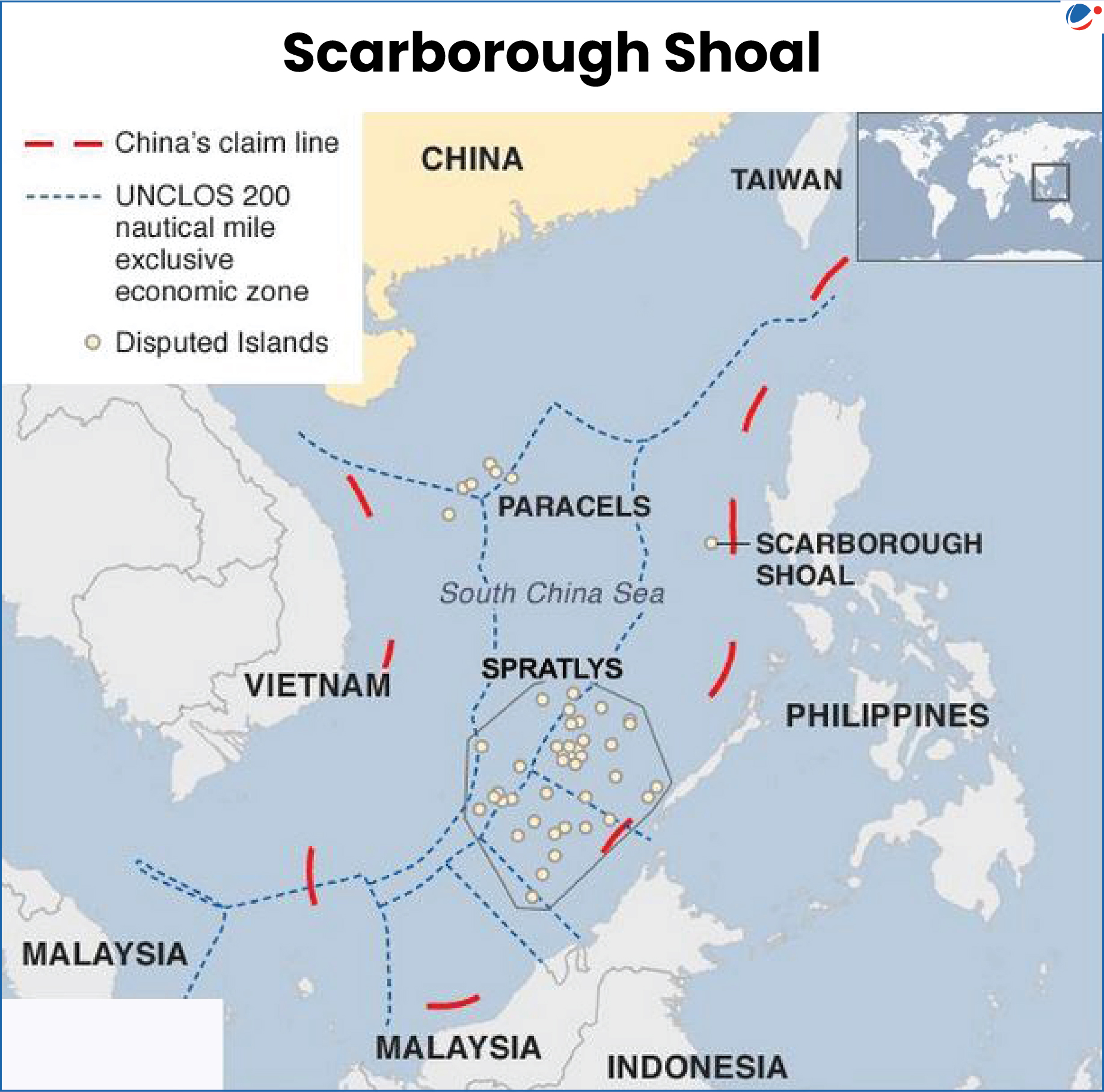
- Scarborough Shoal: China deployed ships, barrier to block disputed South China Sea (SCS) Scarborough Shoal.
- It is a disputed atoll in the SCS, claimed by both China and the Philippines as part of their territory.
- Strategic importance: Located along major sea lanes with rich fishing grounds and potential resources.
- Other disputed islands in the SCS: Paracel, Spratly Island, etc.
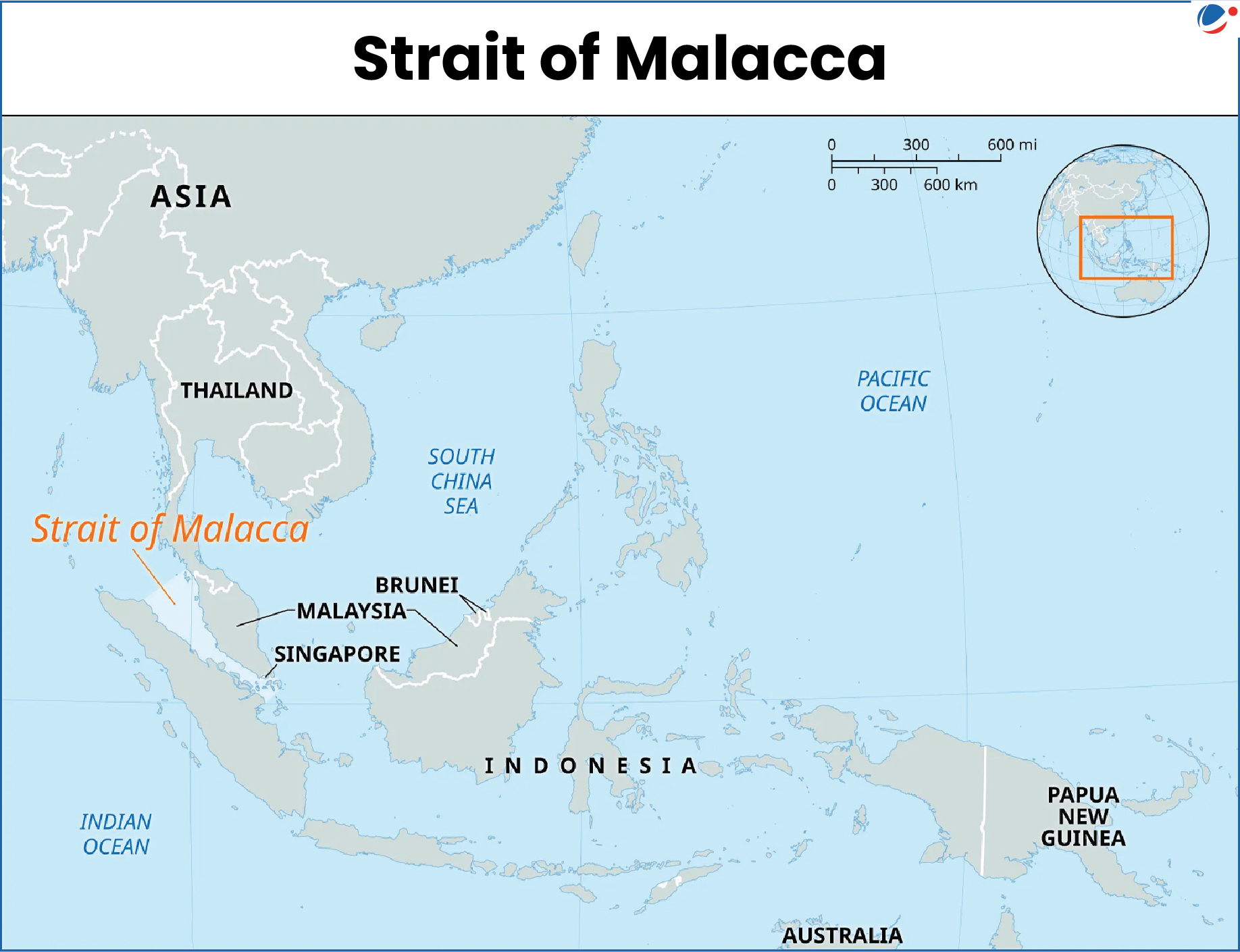
Hormuz crisis throws spotlight on world's other largest chokepoint, the Malacca Strait.
About Strait of Malacca
- Location: Waterway connecting Andaman Sea (Indian Ocean) and South China Sea (Pacific Ocean).
- Bounded by: Indonesia, Thailand, Malaysia and Singapore,
- Strategic Significance:
- Carries nearly 22% of world’s maritime trade,
- considered largest “oil transit chokepoint”,
- Shortest sea route from East Asia to Middle East and Europe.
- Concerns:
- Narrowest point (Phillips Channel of Singapore Strait) creates a natural bottleneck with concerns for collisions or oil spills.
- Some parts are relatively shallow restricting largest vessels.
- Piracy and attack on merchant vessels.
INS Sudarshini makes maiden visit to Las Palmas, Canary Islands, first by any Indian naval ship.
- The visit is a strategic halt during its transoceanic deployment, under Lokayan 26, preceding a trans-Atlantic voyage.
About Canary Islands
- It is an autonomous region of Spain.
- Location: Situated in the Atlantic Ocean, about 100 km off the northwest coast of Africa.
- Geography: A volcanic archipelago with islands like Tenerife and Gran Canaria. It includes Mount Teide (Spain’s highest peak).
Article Sources
1 sourceIndia and Bhutan signed Tariff Protocol of Punatsangchhu-II Hydroelectric Project.
About Project
- 1020 MW Run of the river project on Punatsangchhu river.
- Origin: The rivers Phochhu and Mochhu confluence to form the Punatsangchhu river in Bhutan.
- It flows southerly to enter the Indian plains of West Bengal and is a tributary of Brahmaputra river.


