


Why in News?
Parliament passed Insolvency and Bankruptcy Code (Amendment) Act, 2026.
About Insolvency and Bankruptcy Code, 2016
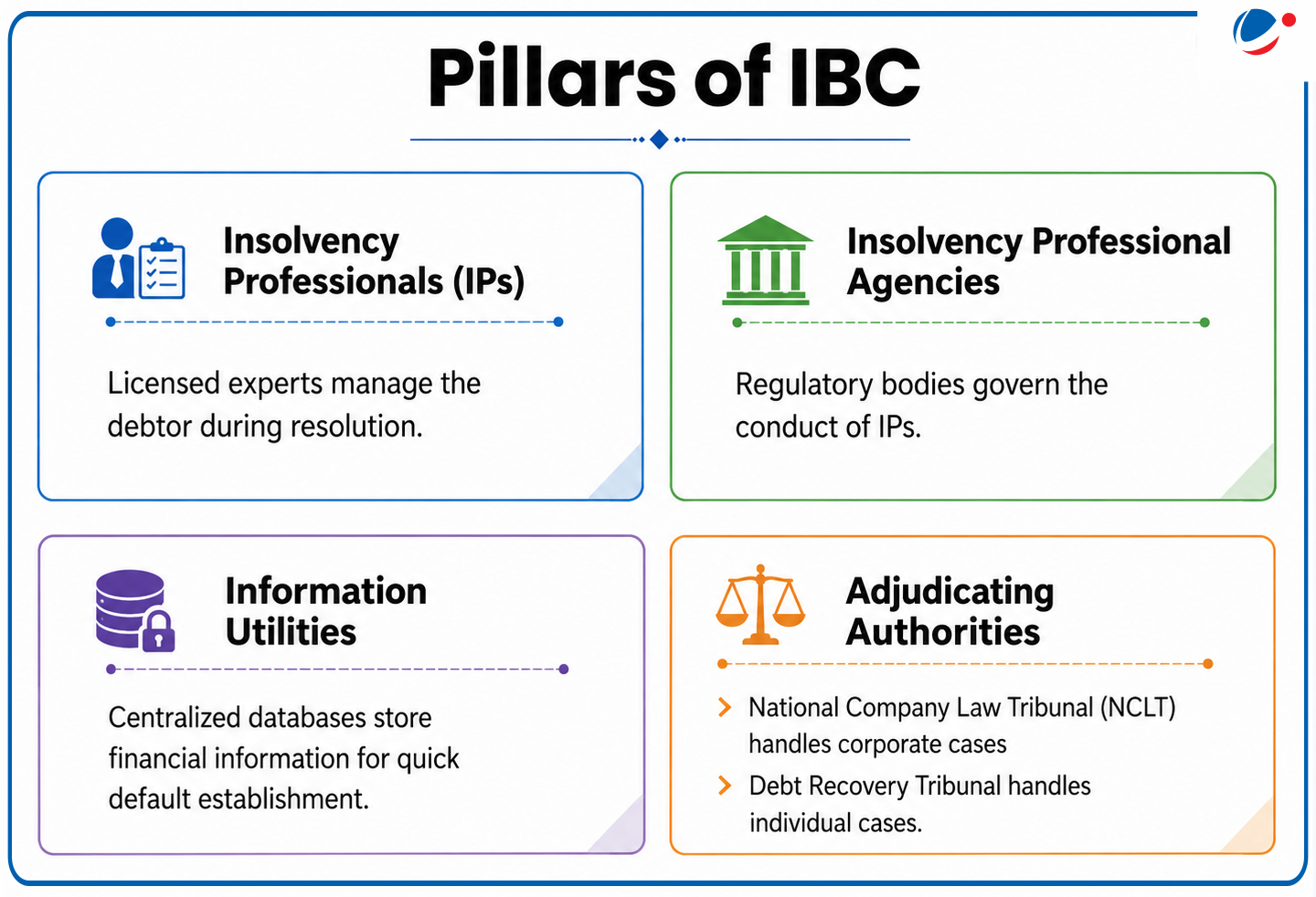
- It was enacted to consolidate and amend the laws relating to reorganisation and insolvency resolution of corporate persons, partnership firms and individuals in a time bound manner.
- Insolvency is a situation where individuals or companies are unable to repay their outstanding debt.
- Aim: Maximisation of value of assets, promote entrepreneurship, enhance availability of credit and balance the interests of all the stakeholders.
- It established the Insolvency and Bankruptcy Board of India (Board).
- Previous amendments to IBC, 2016:
- IBC (Amendment) Act, 2019: Set a 330-day limit for finishing the Corporate Insolvency Resolution Process (CIRP) and 14-day limit for NCLT to decide within if a company has failed to pay its debts; allowed insolvency cases for personal guarantors etc.
- IBC Second Amendment Act, 2020: Provided critical relief to Indian businesses during the pandemic by temporarily suspending the initiation of Corporate Insolvency Resolution Processes (CIRP).
- IBC (Amendment) Act, 2021: To provide an efficient alternative insolvency resolution framework for corporate persons classified as micro, small and medium enterprises (MSMEs).
- Key achievements of IBC:
- Facilitated the resolution of 1376 companies: Enabling creditors to recover 4.11 lakh crore rupees.
- Financial creditors have recovered more than 64% of their claims under the process.
- Reduction in NPAs: E.g., Public Sector Banks gross NPAs was around 14.58% in 2016, which dropped to 2.3% in 2025.
- Improved recovery from stressed assets: Improved significantly to 36.6% in 2024-25 (earlier 15 to 20%).
- Facilitated the resolution of 1376 companies: Enabling creditors to recover 4.11 lakh crore rupees.
Key Provisions of IBC (Amendment) Act, 2026
- New Creditor-Initiated Insolvency Resolution Process (CIIRP): It is a novel out-of-court resolution mechanism introduced for select financial institutions.
- Cross-Border and Group Insolvency: It provides an enabling framework for cross-border insolvency and group insolvency, crucial for promoting international investor confidence and handling complex corporate structures.
- Clean Slate Principle: Explicitly reinforces the "clean-slate principle," stating that once a resolution plan is approved, claims against the corporate debtor are extinguished (unless specified otherwise).
- Enhanced Role of the Committee of Creditors (CoC): In relation to the power to appoint or remove the liquidator and supervise the liquidation process.
- Strict timelines for Faster Resolution:
- Liquidation Process: Must be completed within 180 days (extendable by a maximum of 90 days).
- Application Admission: The NCLT must admit insolvency applications within 14 days of default.
- Resolution Plan Decision: The NCLT must approve or reject submitted resolution plans within 30 days.
- Appeals Handling: The NCLAT must dispose of any appeals within 3 months to prevent delays.
- Clarified Scope of "Secured Creditor": Government dues (taxes, statutory levies, etc.) are not to be treated as secured creditors for distribution priority.
- Others: Penalties for Frivolous Filings; New Definitions for terms like avoidance transaction and fraudulent or wrongful trading etc.
Significance of IBC (Amendment) Act, 2026
- Faster Resolution: Strict timelines for admission, approvals, and appeals reduce delays and ensure quicker decision-making.
- Enhanced Creditor Role: Empowering the Committee of Creditors (CoC) increases accountability and improves financial recovery outcomes.
- Business Continuity: The new CIIRP and debtor-in-possession models allow companies to keep operating during resolution, preserving their value.
- Global Alignment: Introducing group and cross-border insolvency provisions aligns India with international standards, boosting foreign investor confidence.
Concerns Related with IBC (Amendment) Act, 2026
- CIIRP Related:
- CIIRP may only be initiated by select financial institutions specified by the central government, giving some financial institutions priority over others.
- Trigger for initiating CIIRP remains default, when value erosion has already set in which undermines the Code's objective of achieving maximum value for assets.
- Restricts out-of-court settlements: It allows withdrawal of insolvency application only after the CoC has been constituted and before the first invitation for resolution plans is issued.
- The consent of 90% of the CoC will be required for such withdrawals.
- Liquidator's Powers: Taking away the liquidator's adjudicatory powers over claims removes the necessary finality required during liquidation, where the rights of all parties are ultimately extinguished upon asset distribution.
Conclusion
The new amendments aim to address practical challenges, incorporate evolving global best practices, and reflect the experience gained since the law's implementation in 2016. They will help address procedural delays and interpretational issues among companies and individuals.



