


Why in the News?
India's defence exports have touched an all-time high of Rs 38,424 crore in the FY 2025-26.
More on the News
- This is a 62.66% increase from the previous year.
- Defence Public Sector Undertakings (DPSUs) and the private sector contributed 55% and 45% respectively.
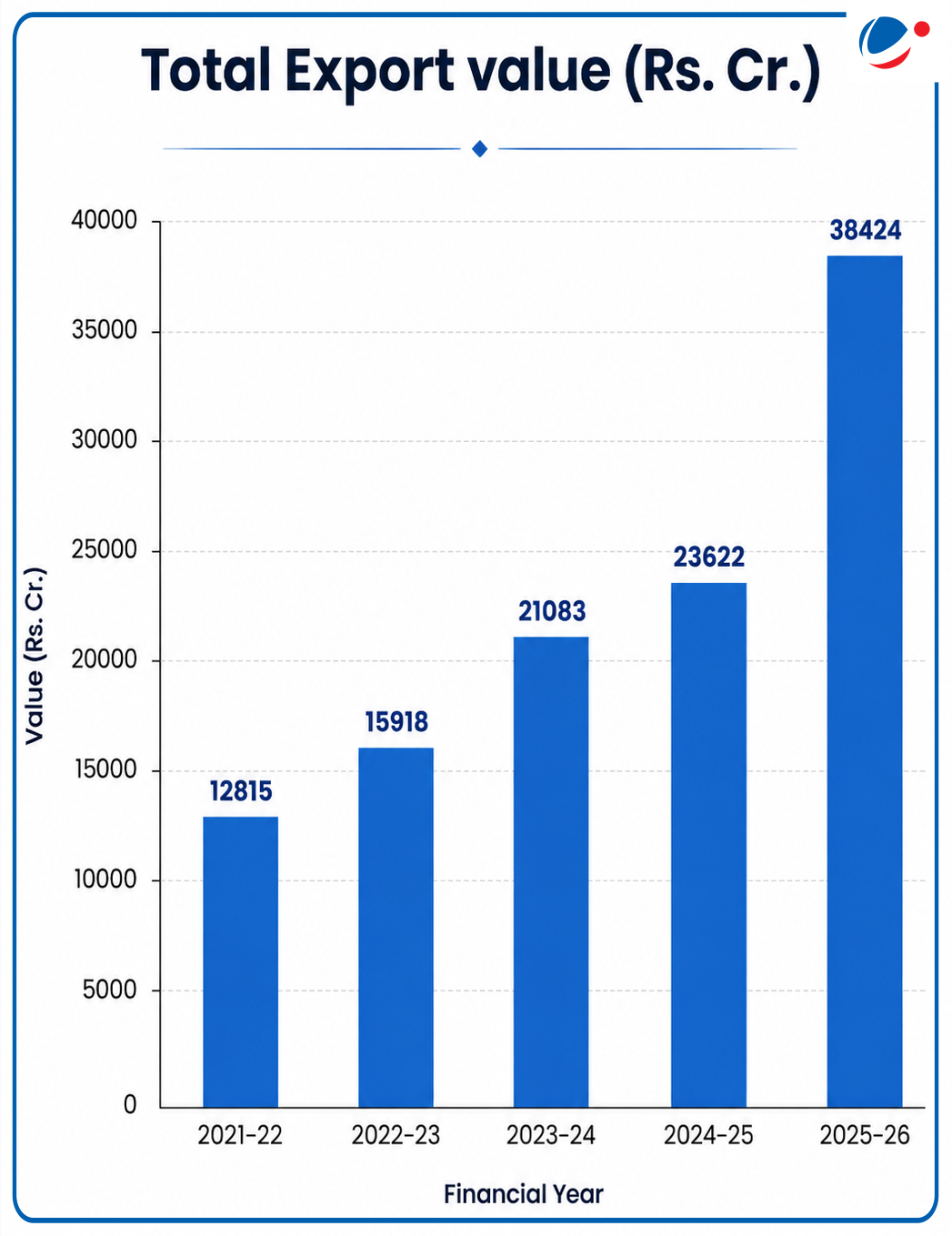 Overview of India's Defence Sector
|
Key factors behind rise in India's defence exports
- Policy and Procurement Frameworks
- Draft Defence Acquisition Procedure (DAP) 2026: Raises Indigenous Content from 50 to 60% for prioritized categories.
- Defence Production and Export Promotion Policy (DPEPP) 2020: Aims for a ₹1,75,000 crore turnover by 2025 by strengthening the manufacturing ecosystem.
- Restricting Imports
- Positive Indigenisation Lists: Five lists banning the import of over 5,000 items to mandate local sourcing by specified deadlines.
- SRIJAN Indigenisation Portal: Launched in 2020, this platform invites domestic industry and startups to locally develop previously imported defence items.
- Budgetary and Financial Reform: The government reserved 75% of the defence capital budget for the domestic industry in FY 2024-25 to secure local market demand.
- Liberalised FDI: FDI limits were raised to 74% under the automatic route and 100% via government approval for advanced technologies.
- Innovation and R&D
- iDEX: Provides funding for startups and MSMEs. The armed forces have procured over Rs 2,400 crore from iDEX-supported firms.
- Technology Development Fund (TDF): DRDO offers grants up to Rs 50 crore to startups/MSMEs for advanced aerospace and defence capabilities.
- Dedicated R&D Budgets: 25% of the defence R&D budget is reserved for the private sector and academia to democratize research.
- DRDO has also shared testing facilities and patents with Indian industry at zero fees.
- Institutional and Infrastructure Reforms
- Corporatisation of Ordnance Factory Boards (OFBs): 41 ordnance factories were converted into seven corporate DPSUs to enhance efficiency and autonomy.
- Defence Industrial Corridors (DICs): In UP and Tamil Nadu, optimize logistics and attract investment.
Significance of Atmanirbharata in defence
- Strategic Autonomy: Self-reliance shields India from supply disruptions, provides the flexibility to address regional and global security challenges.
- Economic Growth
- Trade Balance: Transitioning from an importer to a producer preserves foreign exchange and corrects trade imbalances.
- Multiplier Effects: Integrating MSMEs stimulates ancillary industries, fosters innovation, and creates high-skilled jobs.
- Capability Development: Focus has shifted from acquiring weapons to creating indigenous intellectual property and deep technical capabilities.
- Dual-Use Tech: R&D in defence has spillovers into civilian sectors like AI, materials, and telecommunications.
- Diplomatic Leverage: Defence exports strengthen bilateral ties and plurilateral security partnerships. E.g. supply of Brahmos to the Philippines and Vietnam.
Challenges to overcome to boost the defence exports further
- Technological Gaps: R&D spending remains low (5.5%-6.5% of defence expenditure) compared to global competitors.
- Supply Chain and Foreign Dependence: Dependence on foreign jet engines (e.g., GE engines for LCA Tejas) subjects production schedules to global supply constraints.
- Infrastructure and Level Playing Field: Private firms struggle with land acquisition and overlapping regulations.
- Preferential treatment for DPSUs prevents a truly level playing field for the private sector.
- Export Limitations: Growth is constrained by weak global marketing and limited international partnerships.
Conclusion
Building a domestic defence base is vital for India's strategic autonomy. In an era of global uncertainty, self-reliance ensures supply continuity, operational readiness, and independence from external geopolitical pressures.

