
Self-Sufficiency in Edible Oils | Current Affairs | Vision IAS

Upgrade to Premium Today

Start Now
MENU
Home
Quick Links

High-quality MCQs and Mains Answer Writing to sharpen skills and reinforce learning every day.

Watch explainer and thematic concept-building videos under initiatives like Deep Dive, Master Classes, etc., on important UPSC topics.

A short, intensive, and exam-focused programme, insights from the Economic Survey, Union Budget, and UPSC current affairs.

ESC

Self-Sufficiency in Edible Oils

22 May 2026
4 min

In Summary

  • Parliamentary Committee report highlights India's 56% edible oil import dependency, straining forex reserves.
  • Reasons for dependency include reliance on rainfed agriculture, yield gaps, processing inefficiencies, and low Seed Replacement Rate.
  • Recommendations include expanded MSP procurement, incentivizing palm oil, improving irrigation, and technological integration for self-sufficiency.

In Summary

Why in News?

Parliamentary Standing Committee's report on "Production and Availability of Oilseeds and Pulses in the Country" highlighted high import dependency of edible oil, straining foreign exchange reserves.

Key Findings of the report

  • High import share: India imports 56% of its edible oil needs (15.66 MMT in 2023-24)
    • Palm oil contributes 60%, Soyabean oil 20% and Sunflower oil contributes 20%.
  • Rising consumption outpacing production: Domestic consumption of Oilseeds has always outpaced their domestic availability during every year from 2013-14 to 2022-23.
    • Per capita consumption of edible oils has more than doubled from 2000-01 to 2020-21, due to population growth, changing consumption patterns, and increasing urbanization.

Reasons for Import Dependency of Edible Oils

  • Reliance on Rainfed Agriculture: Over 70% of Oilseeds are grown under rainfed conditions which makes the sector highly vulnerable to erratic weather patterns, heat-waves and potential El-Nino events.
  • Yield Gaps: Almost all Indian edible oil crops exhibit lower yields compared to major global producers, partly due to the lack of genetically modified (GM) and herbicide-tolerant varieties used in other countries.
    • E.g. India's groundnut productivity at 2,067 kg/ha vs. Uzbekistan's 15,519 kg/ha.
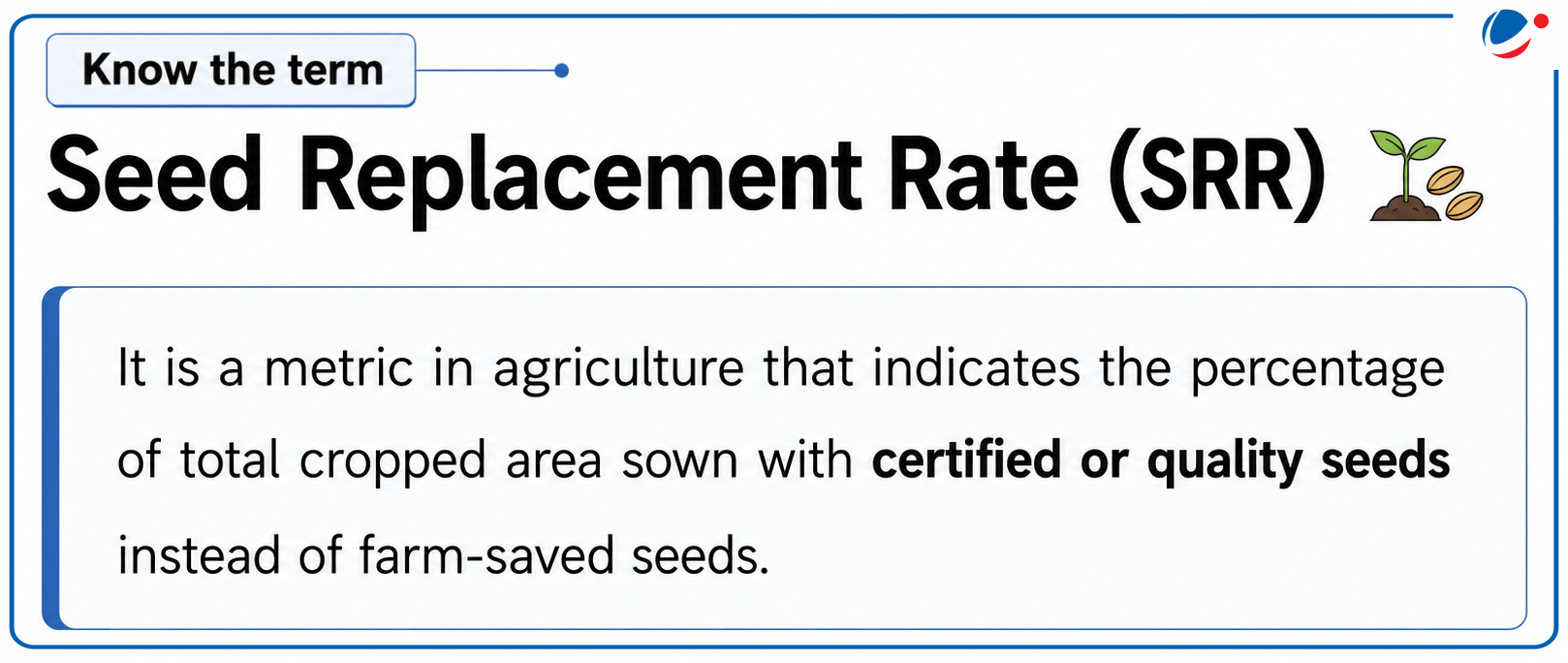
Explanation of term Seed replacement rate
  • Processing Inefficiencies: The Indian vegetable oil sector is hindered by small-scale, low-technology plants.
    • The industry currently utilizes only about 30% of its edible oil refining capacity.
  • Low Seed Replacement Rate (SRR): The SRR ranges from just 25% for groundnut to 62% for rapeseed-mustard, falling far short of the government target of 80-85%.
  • Biotic and Abiotic Stresses: Weeds, pests, and diseases consistently plague oilseed crops in traditional farming systems, reducing yields by 20% or more.

Government Efforts for ensuring Self Sufficiency in Edible Oils

  • National Mission on Edible Oils – Oilseeds (NMEO-OS): Aimed at improving productivity, seed quality, processing, and market linkages for traditional oilseed crops.
  • National Mission on Edible Oils - Oil Palm (NMEO-OP): Focused on expanding oil palm cultivation and increasing domestic crude palm oil output.
  • Pradhan Mantri Annadata Aay Sanrakshan Abhiyan (PM-AASHA): Enables procurement of oilseeds at MSP by the Central Nodal Agencies like National Agricultural Cooperative Marketing Federation of India Ltd. (NAFED) under Price Support Scheme component. 
  • Raised the effective customs duty: On crude edible oils like palm, sunflower and soybean from 5.5% to 16.5% to discourage the import of cheap edible oils.
  • Farmer Producer Organizations (FPOs): Under the 10,000 FPO Scheme, 1,341 FPOs have been specifically formed for oilseeds to empower small and marginal farmers with better input access and market linkages.
  • Others: Seed Authentication, Traceability and Holistic Inventory (SATHI) portal; National Pest Surveillance
  • System etc.

Way Ahead: Recommendations of the Committee 

  • Expanded Procurement: Expanding MSP procurement under Price Support Scheme of PM-AASHA to 100% of national oilseeds production (from 25% at present).
  • Incentivize production of Palm oil: Through Viability Gap Payments (VGP) adequately for Fresh Fruit Bunches (FFBs) and subsidizing planting material costs upto 80%.
  • Improve irrigation practices: Improve coverage of Per Drop More Crop (PDMC) Scheme should be implemented in rainfed Oilseeds areas; increase subsidies for Small/Marginal farmers for purchasing drip and sprinkler systems; train Farmers on micro-irrigation maintenance  etc.
  • Import Safeguards: Dynamically adjusting import duties based on domestic production and imposing a 20% safeguard duty on palm oil imports if global prices fall below $800/tonne.
  • Launch of a 'Bharat Oil' Brand: To protect lower and middle-income households from market fluctuations.
  • Seed Pricing and Regulation: A National Commission should be set up to fix the upper price ceiling for seeds to prevent exploitation by private companies. 
    • Furthermore, a new Seeds Bill must be enacted urgently to regulate modern biotechnology, track quality, and protect seed sovereignty.
  • Technological Integration: Adequate investments in biotechnology (like CRISPR-Cas9), Marker-Assisted selection (MAS) etc. to develop climate-resilient high-yielding, and pest resistant varieties. 

Conclusion

India's growing dependence on edible oil imports highlights the urgent need to strengthen domestic oilseed production through technological innovation, improved irrigation, better seed quality, and stronger procurement support. 

Explore Related Content

Discover more articles, videos, and terms related to this topic

RELATED VIDEOS

3
The Contribution of Indian Cinema to the Creative Economy

The Contribution of Indian Cinema to the Creative Economy

YouTube HD
Impact Investments

Impact Investments

YouTube HD
Universal and Meaningful Connectivity

Universal and Meaningful Connectivity

YouTube HD

RELATED TERMS

3

Seed Sovereignty

The right of communities and nations to control their own seeds, including their selection, production, conservation, and distribution, without undue influence from external entities.

Marker-Assisted Selection (MAS)

A technique used in plant breeding that utilizes molecular markers (DNA sequences) to identify desirable genes or traits in plants. It helps in developing improved crop varieties more efficiently.

CRISPR-Cas9

A revolutionary gene-editing technology that allows for precise modification of DNA. It is being considered for developing climate-resilient, high-yielding, and pest-resistant crop varieties, including oilseeds.

Title is required. Maximum 500 characters.

Search Notes

Filter Notes

Loading your notes...
Searching your notes...
Loading more notes...
You've reached the end of your notes

No notes yet

Create your first note to get started.

No notes found

Try adjusting your search criteria or clear the search.

Saving...
Saved

Please select a subject.

Referenced Articles

linked

No references added yet