


Why in the News?
Recent spontaneous and sometimes violent Protests by factory Workers across Key Industrial Hubs such as in Barauni (Bihar), Surat (Gujarat), Manesar (Haryana), and Noida (Uttar Pradesh) have created concerns.
Key Reasons for Workers' Protests in India
- Unchecked Contractualization: To slash operational costs, employers have embraced third-party labour, pushing the share of contractual workers in manufacturing to 42% in 2023–24 (Annual Survey of Industries)
- Scale of informality: over 90 per cent of workers are employed in the informal sector, mostly in tiny, unregistered enterprises with virtually no social protection.
- The e-Shram Survey illustrates that the informal non-agricultural sector alone employs over 150 million workers and continues to expand post-pandemic.
- Issues concerning Labour Laws: Code on Wages creates a National Floor Wage and National Minimum Wage, but offers no clear methodology for setting either.
- Regulatory failure: According to an analysis of the Periodic Labour Force Survey (PLFS) data for 2023–24, nearly 64 per cent of Indian workers earn less than the minimum wage, even mandated by law.
- Issues with Trade Unions: The existence of multiple trade unions in the same industry creates conflict amongst them.
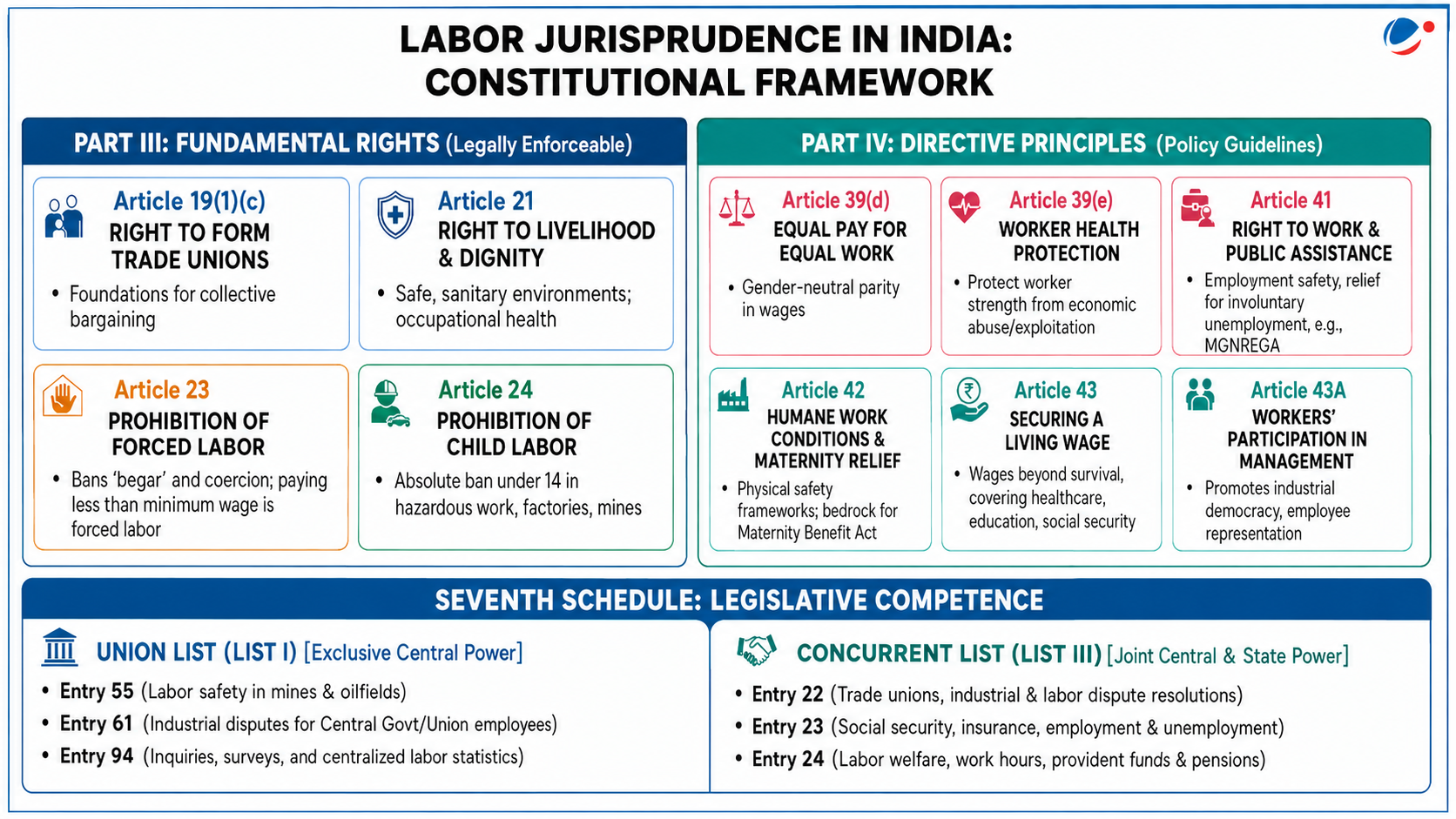
Key Reforms taken by the government for labour welfare
- Simplification of labour laws: The government consolidated 29 labour laws into four comprehensive Labour Codes.
- Social Security: Code on Social Security, 2020 covers Gig and Platform Workers with aggregators contributing 1- 2% of annual turnover (capped at 5% of payments to such workers).
- Conditions of employment: Industrial Relations Code, 2020 offers Fixed Term Employment (FTE) to reduce excessive contractualization; recognises Trade Unions with 51% membership as Negotiating Union.
- Worker Rights and Safe Working Conditions: Occupational Safety, Health and Working Conditions Code 2020 provide National Database for Unorganised Workers along with victim compensation in case of injury or death.
- Universal Minimum Wages: The Code of Wages, 2019, establishes a statutory right to minimum wages for both organized and unorganized sectors.
- Earlier, the Minimum Wages Act applied only to scheduled employments covering ~30% of workers.
- e-Shram Portal: A centralized database enabling registration and access to welfare schemes for workers in the unorganized sector.
- "One Nation One Ration Card" (ONORC) Scheme: It enables migrant workers and their family members to access PDS benefits from any Fair Price Shop anywhere in the country, thus ensuring food security.
- The Maternity Benefit (Amendment) Act, 2017: It extended paid maternity leave in India from 12 weeks to 26 weeks for working mothers with up to two surviving children.
- She-Box Portal: Centralized platform for registering and monitoring complaints of sexual harassment of women at workplace.
Issues with recent labour reforms
- Failure to Deliver Promised Wage Hikes: Although the Code on Wages aims to reduce wage inequality, through national floor wage but anticipated upward revisions to minimum wages have not materialized in practice yet.
- Delayed operationalisation of provisions: Such as for gig and platform workers, including the establishment of a functional Social Security Fund, notification of contribution rates, and design of a tangible benefit scheme under the Code on Social Security (2020).
- Higher layoff threshold: The threshold for government approval before layoffs/retrenchment increased from 100 to 300 workers, making it easier for companies to fire employees.
- Stringent Strike Conditions: The new framework makes executing a legal strike exceptionally difficult, mandating a 14-day notice period for all industrial establishments before striking.
- Uneven State-Level Notification: As labour is a subject on the Concurrent List; both the central and state governments must notify their respective rules for the codes to fully come into effect.
Way forward
- Re-establishing Robust Tripartite Dialogue: On the line of The ILO's Tripartite Consultation Convention (No. 144), adopted in 1976, revive and formalize the Indian Labour Conference (ILC), which has not met regularly (last met in 2015) to promote dialogue with Central Trade Unions, employers, and government.
- Careful Calibration of Wage Policy: To address real wage erosion, authorities must establish a binding yet sustainable national floor wage that accounts for regional variations in the cost of living and sectoral productivity differences.
- Anoop Satpathy Committee's methodology of 2018, which recommended a national minimum wage can be implemented with some modifications by taking inflation into consideration.
- Participation of workers in governance: The German model of Co-determination & works council can be promoted to institutionalize worker participation in corporate governance.
- Effective data collection: Developing integrated national labour databases, real-time compliance monitoring, and making workplace safety data publicly available will increase accountability and aid evidence-based policymaking
- Robust Enforcement and Digital Integration: Authorities must invest heavily in digital compliance systems, including mandatory digital wage payments and electronic employment records.
- Improving conditions for workers: Strict adherence to the 8-hour workday, double pay for overtime, equal pay for equal work, and better working conditions can be implemented.
- Address increased Contractualization: India can adopt the "Flexicurity" Model of Denmark. It combines high labour market flexibility for employers (easy hiring and firing to stay competitive) with deep social security cushions for workers (high unemployment benefits).
