


Why in the news?
Recently, the Legal Services Authorities Act, 1987, which was implemented on November 9, 1995 and annually observed as National Legal Services Day, completed 30 years of its implementation.
Journey of Legal Aid in India
- 1949: Bombay Government Committee emphasized the government's duty to provide free legal aid, e.g. coverage for court fees, lawyer fees, etc.
- 1958: 14th Law Commission Report - emphasized free legal aid was the state'sobligation.
- National Conference on Legal Aid (1970) and Expert Committee Report (1973): chaired by V.R. Krishna Iyer, advocated for a statutorybasis for legal aid.
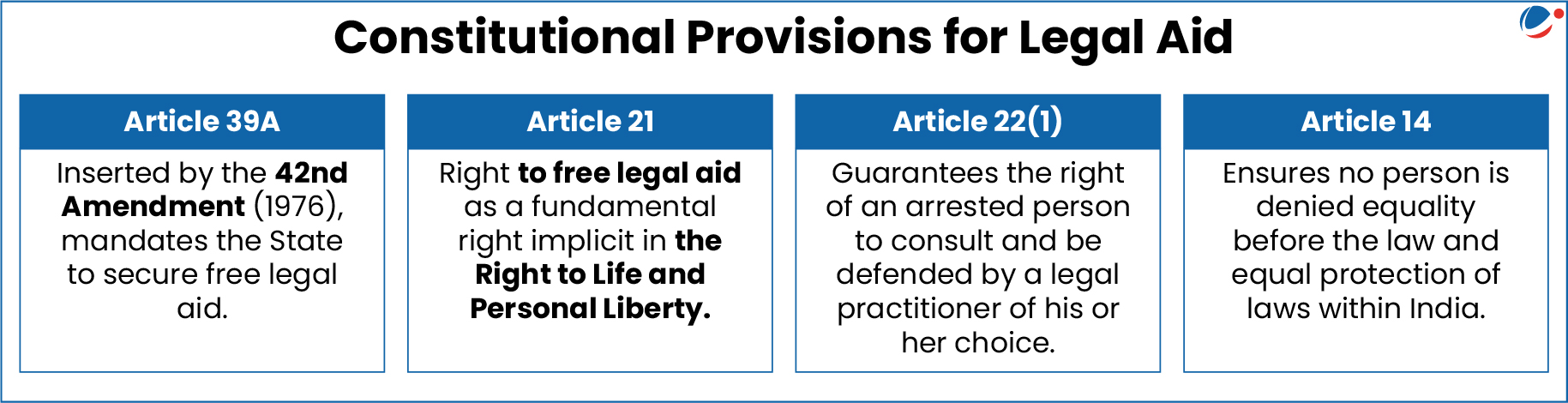
- 1976: Legal aid was formalized under the constitution with the insertion of Article 39A.
- 1980: The Committee for Implementing Legal Aid Schemes was established under Justice P.N. Bhagwati to manage legal aid programs nationwide.
- 1987: Legal Services Authorities Act, 1987, was enacted.
About Legal Services Act 1987
- The act established a three-tier system to provide free and competent legal services
- National Legal Services Authority (NALSA): Headed by the Chief Justice of India.
- State Legal Services Authorities (SLSA): Headed by the Chief Justice of High Court.
- District Legal Services Authorities (DLSA): Headed by the District Judge.
- Persons eligible for getting free legal services
- SC/ST members, women and children, victims of trafficking or disasters, the mentally ill or disabled, industrial workmen, persons in custody, and those with income below the prescribed limit (below ₹5 lakh for Supreme Court cases).
- States can decide the threshold for eligibility under the act, which varies from 1 Lakh to 3Lakh.
- Establishment of Lok Adalats: An alternative dispute resolution mechanism that settles cases amicably, including pre-litigation matters (See the box after the article)
Role of NALSA
- Policy and Scheme Development: NALSA lays down policies and frames schemes for legal services implementation.
- Victim Compensation: Through schemes like "Compensation Scheme for Women Victims/Survivors of Sexual Assault/other Crimes" NALSA aims to provide compensation and support to women who are victims or survivors of sexual assault or other crimes.
- Capacity Building: It mandates standardized selection processes for lawyers and develops Training Modules for Legal Services Lawyers and Para-Legal Volunteers (PLVs).
- Prison Legal Aid: Oversees the functioning of Jail Legal Aid Clinics (PLACs) in almost all prisons.
- Legal Aid and Assistance: It includes advocate representation, process fee payments, document preparation, including drafting and translation, and provision of certified copies of legal documents in proceedings.
- Social Justice Litigation (PIL): e.g. NALSA filed a PIL that resulted in the Supreme Court's landmark 2014 judgment recognizing the rights of the transgender community.
Note: Free legal services also include providing aid and advice to help beneficiaries access welfare schemes of the Central or State Government and to ensure their overall access to justice.
Challenges Related to Legal Aid in India
- Lack of Awareness and Legal Literacy: Only 15% of rural residents are aware of these free legal services (NALSA report 2022).
- Substandard Quality of Representation: Legal aid to the poor often becomes poor legal aid due to inadequate remuneration, high workload, etc.
- Underfunding: Department-related parliamentary committee report (2024) flagged India's per capita free legal aid spend is critically low, i.e., just ₹0.75 per capita annually.
- Digital Divide: While tech programs like Tele-Law exist, their effectiveness is limited in rural areas due to low digital literacy and inadequate digital infrastructure.
- E.g. Only 33% of rural India has access to the internet, compared to 67% in urban areas.
- Limited Physical Outreach: 1 lawyer for every 10,000 people in rural India Vs. 1 for every 1,000 in urban areas portrays low availability in rural areas.
Conclusion
A stronger legal aid system requires better public awareness, improved quality of counsel, and enhanced institutional capacity. Using technology, empowering PLVs, and adopting a needs-based approach for vulnerable groups can greatly improve access to justice.
LOK ADALAT
|


