


Why in the News?
Government to launch National One Health Mission (NOHM).
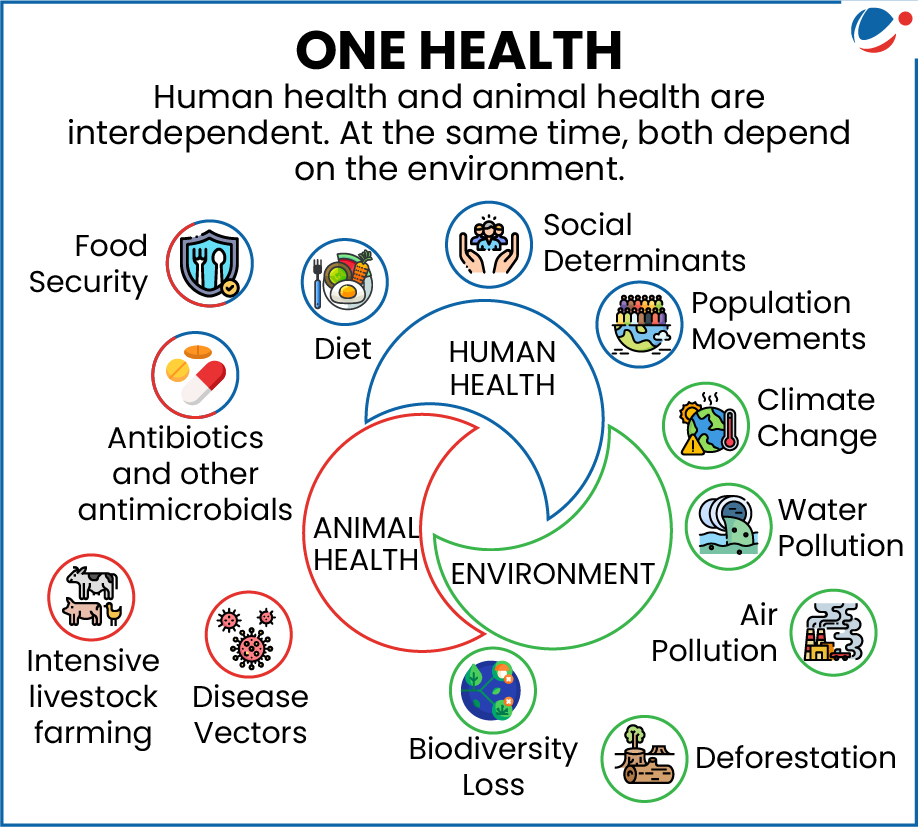
About National One Health Mission
- A multi-sectorial initiative integrating human, livestock, wildlife and environmental health to strengthen coordinated surveillance, diagnostics and outbreak response.
- Vision: To build an integrated disease control and pandemic preparedness system in India by bringing human, animal and environmental sectors together for better health outcomes, improved productivity and conservation of biodiversity.
- Approved by: Prime Minister's Science, Technology, and Innovation Advisory Council (PM-STIAC) in its 21st meeting in 2022.
- Nodal Agency: Anchored by Indian Council of Medical Research (ICMR) under Office of the Principal Scientific Adviser (PSA)
- Anchor Institution: National Institute of One Health, Nagpur.
Key Pillars of One Health Mission:
- Research and Development: Driving targeted R&D to develop essential tools such as vaccines, diagnostics, and therapeutics.
- Clinical Readiness: Enhancing preparedness in terms of clinical care infrastructure and response capabilities.
- Data Integration: Streamlining data and information linkages across the human, animal, and environmental sectors for improved access and analytics.
- Community Engagement: Ensuring close community participation to maintain a constant state of response readiness.
About 'One Health' Approach
|
Need of the Mission:
- Zoonotic Risk Mitigation: It responds to the global evidence that nearly 60% of emerging infectious diseases are zoonotic in origin.
- Thereby enhancing India's capacity for early detection and prevention of potential spillover events.
- Pandemic Preparedness: Establishes predictive and preventive health-security architecture, shifting India from a reactive response model to an anticipatory, systems-based public-health framework.
- Rise of Antimicrobial Resistance (AMR): Misuse of antibiotics in humans, livestock, and aquaculture is accelerating drug resistance.
- Climate Change Impacts: Changing climate patterns are expanding the range of vectors like mosquitoes, increasing diseases such as dengue and malaria.
- Livelihood Protection: Enhances livestock health, productivity, and disease resilience, contributing to higher farmer incomes and greater rural economic stability.
- Ecosystem Health: Strengthens wildlife disease surveillance and biodiversity monitoring, reinforcing ecological security and addressing environment-linked disease dynamics.
- Global Alignment: Aligns India with the WHO, FAO, WOAH, and UNEP One Health Quadripartite, positioning the country as a regional leader in integrated health governance.
Initiatives related to one-health approach:
|
Way Forward
- Legal Mandate: Establish a statutory or formally notified inter-sectorial coordination authority to institutionalize convergence across human, animal and environmental health domains.
- Capacity Building: Prioritize systematic training in veterinary epidemiology, wildlife disease surveillance, genomic science and field diagnostics to strengthen technical and operational capacity.
- State-Level Strengthening: Set up State One Health Cells with dedicated financial resources, trained manpower, and technological support to ensure decentralized implementation.
- Improved Diagnostics and Technological Innovations: Develop a unified National One Health Digital Platform to enable real-time data fusion, risk assessment, and coordinated decision-making across ministries.
- Climate Change Adaptation: With climate change potentially influencing the transmission dynamics of diseases, research into its impacts and the development of climate-adaptive control strategies are required
- Global Partnerships: Expand strategic collaboration with WHO, FAO, WOAH, UNEP, and regional One Health networks to align with global standards and enhance cross-border disease preparedness.
Conclusion
The Mission reflects a shift towards integrated, anticipatory health governance by unifying human, animal and environmental systems. With sustained coordination and investment, it can position India as a global model for managing zoonotic, environmental and emerging public-health threats.
