


Why in the News?
Silver Jubilee of the Protection of Plant Varieties and Farmers' Rights (PPV&FR) Act, 2001 was celebrated.
More about the news
- The PPV&FR Act was enacted to fulfil the enforcement of the TRIPS (Trade-Related Aspects of Intellectual Property Rights) Agreement of the WTO that India ratified.
- The TRIPS Agreement offer member countries the choice to protect plant varieties through patents, an effective sui generis system, or a combination of both patent and sui generis systems.
- A sui generis system refers to a customised, unique legal framework designed to protect something that doesn't fit neatly into existing categories, especially in intellectual property (IP) law.
- India opted not to grant patents for plants, instead choosing to safeguard plant varieties through the sui generis system.
- The TRIPS Agreement offer member countries the choice to protect plant varieties through patents, an effective sui generis system, or a combination of both patent and sui generis systems.
About PPV&FR Act
- Objective: To establish an effective system for the protection of plant varieties, the rights of farmers and plant breeders, and to encourage the development of new plant varieties.
- About: It is in conformity with the International Union for the Protection of New Varieties of Plants (UPOV), 1978 and also protects the interests of public sector breeding institutions and the farmers.
- Variety Registration: A variety is eligible for registration if it essentially fulfils the criteria of Distinctiveness, Uniformity and Stability (DUS).
- Rights under the Act:
- Breeders' Rights: Breeders will have exclusive rights to produce, sell, market, distribute, import or export the protected variety.
- Researchers' Rights: Researchers can use any of the registered varieties for conducting experiments or research.
- This includes the use of a variety as an initial source of variety for the purpose of developing another variety but repeated use needs prior permission of the registered breeder.
- Farmers' Rights: Entitled for registration of a new variety and protection in like manner as a breeder of variety.
- Farmers' variety can also be registered as an extant variety.
- Farmers are eligible for recognition and rewards for the conservation of Plant Genetic Resources of land races and wild relatives of economic plants.
- Farmers shall not be entitled to sell branded seed of a variety protected under this act.
- Benefit Sharing: If any organisation or individual uses a farmer variety for production, development, or breeding, the farmer must receive a share of the profits.
- Categories of Varieties: Categorized into three major groups:
- Extant Varieties: Varieties notified under section 5 of the seed Act 1966, and also the varieties in the public domain, are called extant varieties.
- Farmers' Varieties/ Community Varieties: These varieties are traditionally cultivated and evolved by the farmers in their fields. The wild relatives, land races which the farmer possess also fall in this category.
- Essentially Derived Varieties: These varieties are predominantly derived from an initial variety that retains the characters of the initial variety and is clearly distinguishable from such initial variety at least for one trait.
- Protection of Plant Varieties and Farmers' Rights Authority (PPV&FRA): It is a statutory body established under PPV&FR Act, under
- Ministry: The Ministry of Agriculture & Farmers' Welfare.
- Headquarters: New Delhi,
- Primary objectives are to:
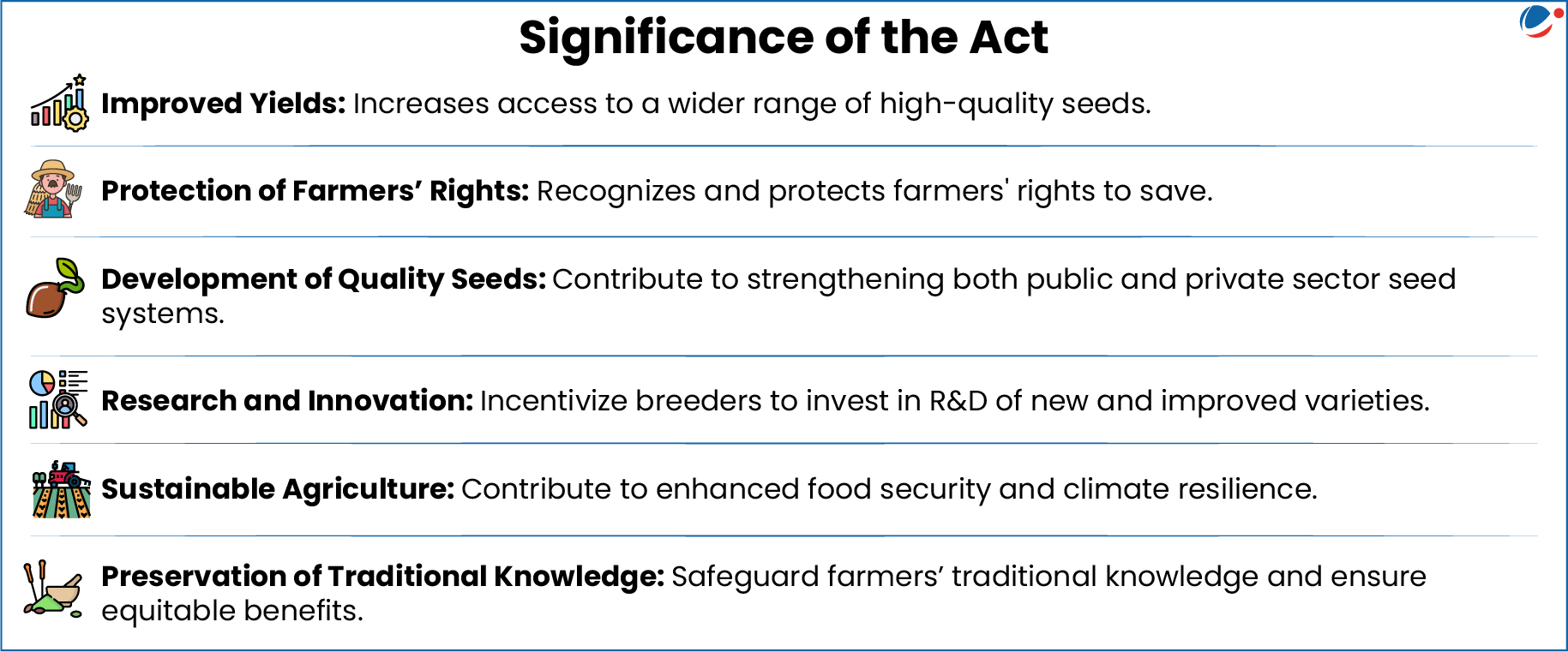
- Grant intellectual property rights to plant breeders for their innovations in developing new plant varieties.
- Recognise and reward farmers and communities who conserve traditional varieties and biodiversity.
- Promote the protection of farmers' rights to save, use, sow, resow, exchange, share, and sell farm-saved seed of registered varieties
- Encourage research and innovation in plant breeding and agriculture
- Members: Chairperson and 15 other members, including representatives of farmers, tribal organization, seed industry and women's organisation.
- Establishments under PPV&FRA:
- National Register of Plant Varieties: The National Register contains the names of all registered plant varieties along with the rights of breeders in respect of registered varieties.
- National Gene Bank: Established to store the seed material, including parental lines submitted by the breeders of the registered varieties.
- National Gene Fund: Utilized for any amount to be paid by way of benefit sharing, compensation payable to farmers and supporting sustainable use of genetic resources.
Limitations of the Act
- Procedural Complexities: There are obstacles in the registration process, and meeting DUS testing criteria can be difficult without technical assistance.
- Disputes: Potential disputes in benefit sharing and difficulties in balancing between breeders' rights and farmers' rights.
- Weak Enforcement Mechanisms: There are challenges in Effective Execution due to a lack of awareness among farmers and the non-availability of sufficient enforcement capacity.
- Balancing Rights and Access: There are concerns that it can facilitate the monopolization of particular varieties by large firms, which may disadvantage small-scale farmers.
- Loss of Traditional Knowledge: Lack of sufficient incentives for traditional breeding practices that may hamper the proliferation of traditional climate-resilient seed varieties.
Conclusion
As the Protection of Plant Varieties and Farmers' Rights (PPV&FR) Act, 2001, completes twenty-five years, it stands out as a distinctive Indian response to global intellectual property obligations, one that consciously balances innovation with equity. Going forward, simplifying registration processes, strengthening institutional capacity, expanding farmer outreach, and ensuring fair benefit-sharing will be crucial to realise the Act's full transformative potential.



