


Why in News?
The 20th G20 Summit was held in Johannesburg, South Africa, under the theme of 'Solidarity, Equality, and Sustainability'.
More on the News:
- It was the first ever G20 Summit held on African soil.
- South Africa's G20 Presidency was guided by the African philosophy of Ubuntu (I am because we are).
Key Takeaways of the G20 Summit 2025 (Johannesburg Declaration)
- Debt Sustainability: It proposed a Cost of Capital Commission to examine structural issues that drive up borrowing costs for developing economies.
- Global Resilience and Development:
- Pledged universal coverage of early warning systems by implementing UN Early Warnings for All Initiative by 2027 for disaster risk reduction.
- Launched the AI for Africa Initiative to expand computing power and talent across African Countries.
- Energy and Climate Transition:
- Mission 300 led by World Bank Group and African Development Bank aims to connect 300 million people to electricity in Africa by 2030.
- Reaffirmed the commitment to triple global renewable energy capacity and double the global average annual rate of energy efficiency improvements by 2030.
- G20 Critical Minerals Framework: It is a voluntary and non-binding blueprint to focus on securing sustainable value chains, investment in mineral exploration, and strengthen governance for sustainable mining practices.
- It fully preserves the sovereign right of mineral-endowed countries to harness their endowments for inclusive economic growth.
- Youth & Gender Targets:
- Adopted the Nelson Mandela Bay Target to reduce the rate of youth Not in Employment, Education, or Training (NEET) by 5% by 2030.
- Adopted revised Brisbane-eThekwini Goal: reduce the gender gap in labour force participation by 25 percent by 2030 from 2012 levels.
Significance of the G20:
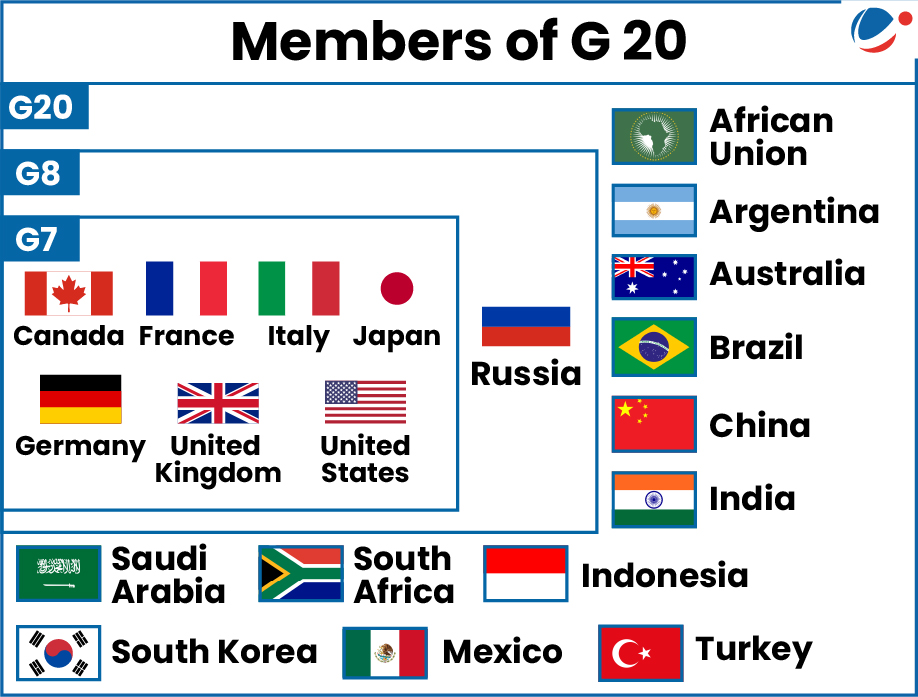
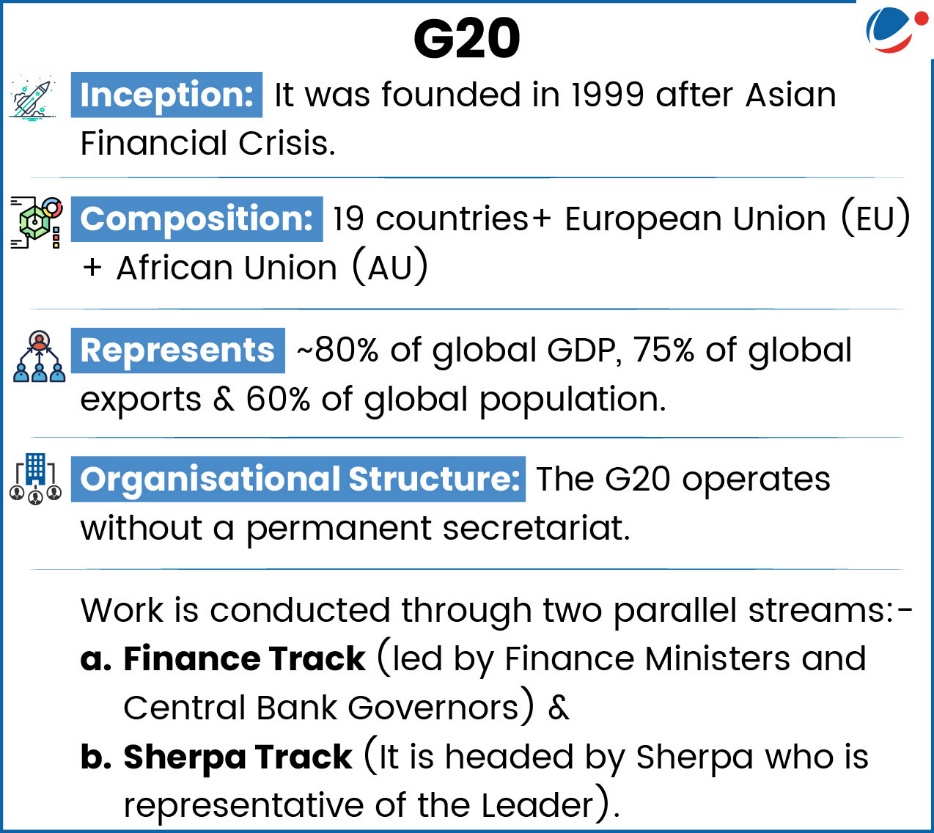
- Legitimacy and Inclusivity: The G20 brings together Advanced Economies (G7) and the Emerging Market Economies (BRICS), giving its decisions greater global legitimacy than any smaller grouping.
- The inclusion of the AU further solidified its representative stature.
- Economic Crisis Management: It serves as the primary coordinating body for global economic policy, having demonstrated its efficacy in preventing the 2008 Financial Crisis from escalating into a global depression.
- Multilateral Reform Driver: It acts as a powerful collective voice to drive the reform agenda of key international institutions, specifically the IMF, World Bank, and WTO.
- It aims to ensure that they are fit for the challenges of the 21st century and represents the multipolar reality.
- Global Agenda Setter: The G20 effectively establishes and mainstream key global norms and policies, from international taxation {Base Erosion and Profit Shifting (BEPS), Global Minimum Tax} to the adoption of Digital Public Infrastructure (DPI) models and the framework for global efforts.
- Effectiveness Related to Global South in G20 Summit 2025:
- Shifting Power Dynamics: The four-year continuum of Global South Presidencies (Indonesia, India, Brazil and South Africa) successfully used the platform to articulate development priorities such as debt sustainability, building a fairer international order at the global stage.
- Africa at the Centre: G20'sability to achieve a consensus declaration, despite major geopolitical rifts demonstrates operational resilience and growing influence of the Global South.
Challenges Faced by G20 in Contemporary World Order:
- Consensus Fatigue: Rising tensions and diverging interests among major powers (e.g., US-China rivalry, Russia-USA issues) create profound diplomatic friction, leading to vague and watered down language in declarations on sensitive issues.
- Undermined Legitimacy: The absence of key world leader (E.g. USA) from 2025 summit due to political disagreements undermines the G20's legitimacy as the premier global steering committee.
- Non-Binding Pledges: G20 commitments are non-binding in nature. Moreover, lack of enforcement mechanism leads to chronic delays in implementing critical pledges, particularly in climate finance and debt restructuring.
- Ineffective Common Framework for uncommon challenges: E.g. G20 Common Framework for Debt Treatment has been criticized for being too slow and complex.
- Other Challenges:
- Protectionism and Trade: Despite commitments to free trade, a resurgence of nationalistic industrial policies and subsidies among major members threatens to create geo-economic fragmentation and undermine the global trading system. E.g. MAGA in USA.
- Agenda Overload: The G20's agenda has expanded significantly to include a vast array of issues (AI governance, health security, gender equality, etc.), which can dilute focus and strain resources, further contributing to implementation difficulties.
Conclusion
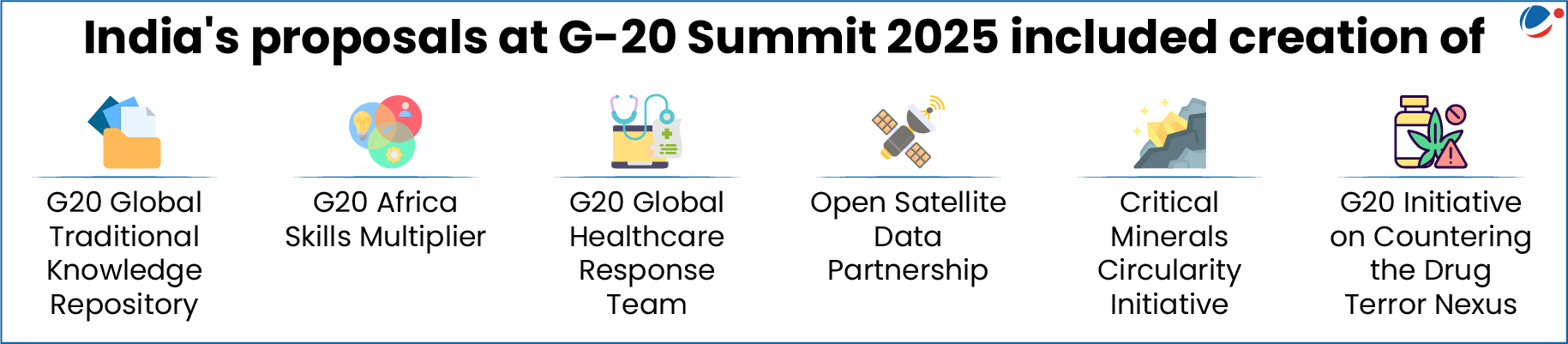
India's ability to drive G20 priorities on debt relief, critical minerals, and digital public infrastructure will define its role in shaping a multipolar world order. The Johannesburg Summit therefore marks a strategic inflection point for India to translate agenda-setting into sustained global leadership.




