


Why in News?
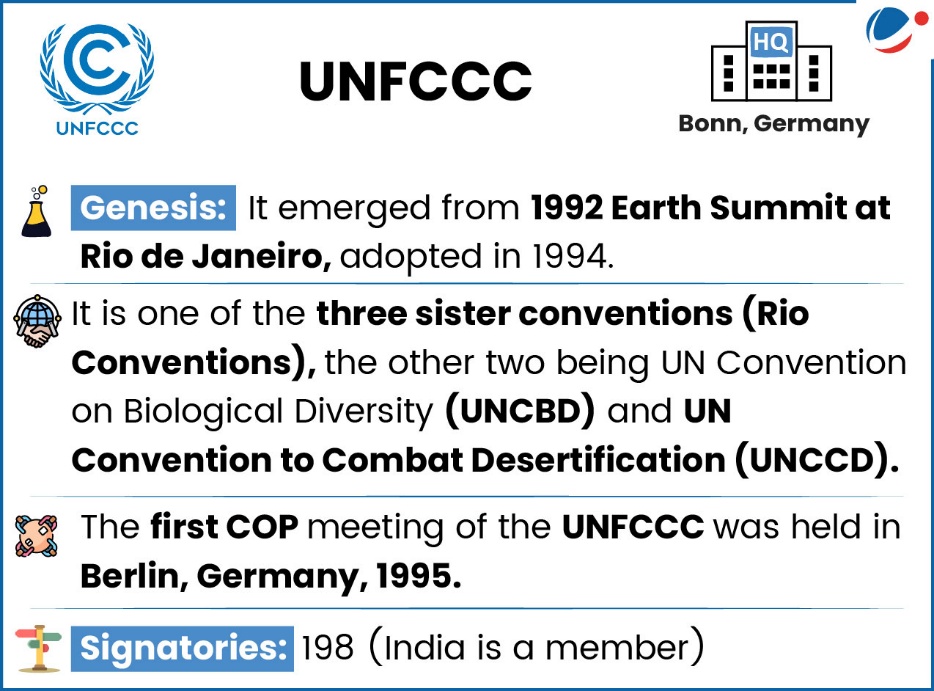
Recently, 30th Conference of Parties (COP30) to United Nations Framework Convention on Climate Change (UNFCCC) was held in Belém, Brazil which also coincided with the 10th anniversary of the Paris Agreement.
More on News
- Hosted in the Amazon region, the summit was framed as the "COP of Implementation", "COP of Truth", and the "Forest COP".
- COP30 aligned with the deadline for countries to submit updated Nationally Determined Contributions (NDC 3.0) in 2025.
- It concluded with adoption of Belem Package, by 195 Parties, including agreements on topics such as just transition, adaptation finance, trade, gender, and technology etc.
- Key meetings included:
- COP 30 (UNFCCC), CMP 20(Conference of the Parties serving as the Meeting of the Parties to the Kyoto Protocol) & CMA 7 (Conference of the Parties serving as the meeting of the Parties to the Paris Agreement).
Outcome | Primary Purpose | Launched By/Under |
Implementation Work Programme (Mutirao Decision) | ||
Belém Mission to 1.5°C |
| COP29-COP31 Troika (UAE, Azerbaijan, Brazil) |
Global Implementation Accelerator |
| COP 30 & 31 Presidencies |
National Adaptation Plans (NAPs) Implementation Alliance
|
| UNDP, Italy, Germany, NAP Global Network, NDC Partnership |
Forests & Nature | ||
Tropical Forest Forever Facility (TFFF) |
| Brazil, Indonesia, DRC, China etc.(India has joined as an Ob server) Trustee and Interim host: World Bank
|
Resilient Agriculture Investment for net-Zero land degradation (RAIZ) Accelerator |
| Brazil & 10 Partner Nations Hosted by Brazil's Ministry of Agriculture under the FAO FAST Partnership |
Scaling J-REDD+ Coalition (Jurisdictional Reducing Emissions from Deforestation and forest Degradation+) |
| UK, Singapore, Costa Rica, Ethiopia, Ghana, Guyana, Kenya etc |
Finance & Economy | ||
Baku to Belém Roadmap to 1.3T |
| COP 29 & 30 Presidencies |
Tripling of adaptation finance |
| - |
Baku Adaptation Roadmap |
| - |
FINI (Fostering Investible National Implementation) |
| Supported by: Interamerican Development Bank (IDB) and the Green Climate Fund (GCF) |
Open Coalition on Compliance Carbon Markets |
| Brazil,, China, EU,UK Canada, Germany, Singapore etc. |
Belem Declaration for Green Industrialization
|
| 35 countries and organisations (such as UNDP,UNIDO) etc. |
Energy & Infrastructure | ||
Plan to Accelerate the Expansion and Resilience of Power Grids |
| Green Grids Initiative (GGI) |
Plan to Accelerate Coal Transitions (PACT) |
| Powering Past Coal Alliance (PPCA) |
Belém 4x Pledge on Sustainable Fuels
|
| Italy, Japan, India and Brazil etc. International Energy Agency (IEA) will track progress |
Social & Health | ||
Belém Health Action Plan |
| >30 countries & 50 organizations |
Belém Gender Action Plan (GAP) |
| Adopted by Parties at COP30 for 2026–2034 |
Declaration on Information Integrity on Climate Change |
| Global Initiative for Information Integrity on Climate Change Endorsed by Brazil, Canada, Chile, Denmark, etc. |
Belém Declaration on Hunger, Poverty, and People-Centered Climate Action |
| Signed by43 countries and the European Union |
Emergency Action | ||
2030 Strategy |
| Climate Risk and Early Warning Systems (CREWS) |
Call to Action on Integrated Fire Management and Wildfire Resilience |
| Brazil |
Significance of the COP30
- Implementation over promises: The summit shifted global climate governance from pledge-making to implementation and accountability.
- Adaptation Priority: It marked a global push for adaptation finance and operational frameworks addressing long-standing Global South concerns.
- Forest Leadership: The TFFF introduces a scalable global model for forest conservation not tied to carbon markets.
- Finance Overhaul: The USD 1.3 trillion/year goal represents the most ambitious climate finance mobilisation target.
- Multilateral Resilience: Despite geopolitical tensions, all 195 parties adopted the Belém Package.
Way Forward
- Closing the gaps: Countries must ensure that NDC 3.0 includes economy-wide absolute emission reduction targets.
- Policies need to integrate "enabling conditions" (grids, storage) to make these targets credible, as seen in the "Belém Mission to 1.5°C".
- The promised finance and technology support must materialize: Developed nations should spell out contributions to the NCQG and fulfill fast-start adaptation pledges.
- Operationalising mechanisms: Parties should finalize GGA (Global Goal on Adaptation) indicators and build data systems for adaptation monitoring.
- The Global Implementation Accelerator (GIA) and Belem 1.5 Mission need clear mandates and resources to assist vulnerable countries.
- Strengthening equity and collaboration: The CBDR (Common but Differentiated Responsibilities) principle must guide mitigation timelines and finance flows
- International cooperation platforms (e.g. UNFCCC, WTO climate-trade dialogue) should be used to resolve tensions over carbon borders and trade measures.
- A "mutual recognition" agreement where a developing country's verifiable carbon price is accepted by border systems to avoid double taxation.
- Effective operationalisation of TFFF, by closing the capitalization gap can create long-term conservation incentives.
- Engaging non-state actors: Governments need to build on private sector pledges (e.g., from TFFF or Ocean Breakthroughs) by creating enabling environments: clear regulations, incentives, and monitoring to ensure these voluntary commitments yield real emission cuts.
- Public engagement (as seen in the Belém Climate March) also needs institutional pathways to inform policymaking.
Conclusion
COP30 signaled a shift toward operationalising the Paris Agreement by expanding adaptation finance, refining implementation mechanisms, and institutionalising forest conservation. The Belém Package signals a pivotal shift toward implementation and inclusion. The task now is to implement Belém's blueprint by raising NDC ambition further, executing forest and ocean pledges, and swiftly operationalizing climate finance flows.



