
Second World Summit for Social Development | Current Affairs | Vision IAS
MENU
Home

Periodically curated articles and updates on national and international developments relevant for UPSC Civil Services Examination.

Quick Links

High-quality MCQs and Mains Answer Writing to sharpen skills and reinforce learning every day.

Watch explainer and thematic concept-building videos under initiatives like Deep Dive, Master Classes, etc., on important UPSC topics.

ESC

News In Shorts

23 Dec 2025
5 min

In Summary

The summit in Doha reaffirmed commitments to social development goals, focusing on poverty eradication, employment, social inclusion, and reforming global financing to support sustainable progress.

In Summary

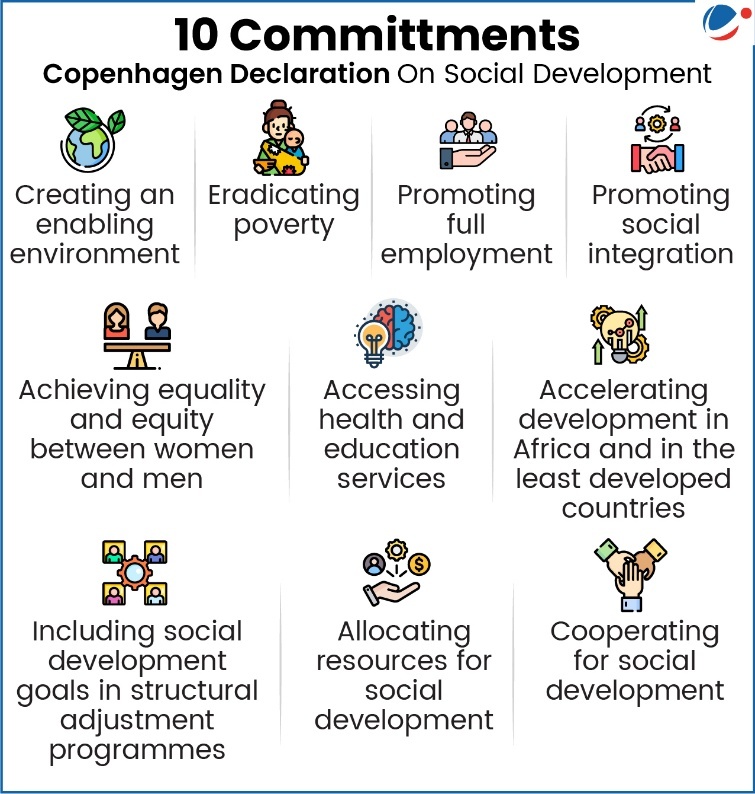
"Infographic titled '10 Commitments - Copenhagen Declaration On Social Development' displaying nine visible commitments with icons: 1) Globe with leaves icon - Creating an enabling environment, 2) Person with belongings icon - Eradicating poverty, 3) People at podium icon - Promoting full employment, 4) Person at desk with gear icon - Promoting social integration, 5) Male and female figures with scale icon - Achieving equality and equity between women and men, 6) Lightbulb and gear icon - Accessing health and education services, 7) Raised fist with Africa map icon - Accelerating development in Africa and in the least developed countries, 8) Four connected people icons - Including social development goals in structural adjustment programmes, 9) Hand with coin and gear icon - Allocating resources for social development, 10) Two hands shaking icon - Cooperating for social development. Logo appears in top right corner."

Second World Summit for Social Development concluded in Doha, Qatar with adoption of Doha Political Declaration of the “World Social Summit”.

About Second World Summit for Social Development

  • Convened by: United Nations General Assembly, through its resolutions 78/261 and 78/318.
    • The 1st World Summit for Social Development took place in Copenhagen, Denmark, in 1995.
  • Aim: To address the gaps and recommit to the Copenhagen Declaration on Social Development and the Programme of Action and its implementation, and give momentum towards the implementation of the 2030 Agenda.
  • Major events held on the sidelines of the Summit 
    • Global Alliance Against Hunger and Poverty: The first high-level meeting of this Alliance, launched under Brazil’s G20 Presidency in 2024.
    • Private Sector Forum: Specialized forum, co-hosted by the International Organisation of Employers, the UN Global Compact, and UN DESA, focused on how companies can support inclusive growth.

Key highlights of Doha Political Declaration

  • Renewed Commitment to Copenhagen Declaration and Programme of Action.
  • Monitoring Role: UN Commission for Social Development, a Commission within the United Nations Economic and Social Council (ECOSOC), retains the primary responsibility for the follow-up and review of the implementation.
  • Three Pillars Reaffirmed: It centers social development on the 3 mutually reinforcing pillars-poverty eradication, full and productive employment and decent work for all, and social inclusion.
  • Financing and Architecture: Reaffirms the Addis Ababa Action Agenda and welcomes the Sevilla Commitment to renew the global financing for development framework. 
    • It stresses the urgency of reforming the global financial architecture to ensure fair access to development and climate finance, especially for developing countries facing debt distress.
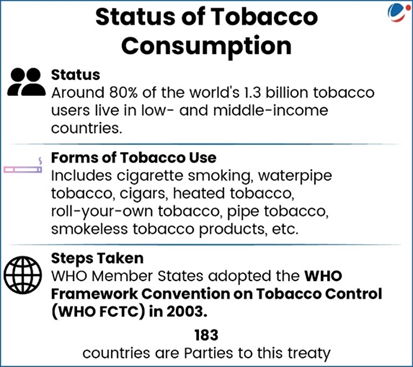
"Infographic titled 'Status of Tobacco Consumption' with three sections: 1) Status (people icon) - Around 80% of the world's 1.3 billion tobacco users live in low- and middle-income countries, 2) Forms of Tobacco Use (cigarette icon) - Includes cigarette smoking, waterpipe tobacco, cigars, heated tobacco, roll-your-own tobacco, pipe tobacco, smokeless tobacco products, etc., 3) Steps Taken (globe icon) - WHO Member States adopted the WHO Framework Convention on Tobacco Control (WHO FCTC) in 2003, with 183 countries Parties to this treaty.

Maldives became first country to impose generational ban on tobacco.

About Generational Ban 

  • Generational Tobacco Ban, or Lifetime Tobacco Ban, refers to a policy that permanently prohibits the sale of cigarettes or other tobacco products to anyone born after a specified date—meaning they can never legally purchase tobacco at any age.
  • Other measures used for tobacco control: Monitoring use, warning about harms, banning advertising, raising taxes, stopping illicit trade, and regulating new nicotine products.

Reports

Details

International Migration Outlook 2025

  • Released by: Organization for Economic Co-operation and Development (OECD).
  • Major Findings:
    • In 2023, 225 000 Indian citizens acquired the nationality of an OECD country.

World Urbanisation Prospects 2025 Report


  • Released by: United Nations Department of Economic and Social Affairs (UN DESA).
  • Major findings: 
    • The cities are now home to 45 % of the global population (approx. 8.2 billion).
    • The number of megacities quadrupled from eight in 1975 to 33 in 2025. (A megacity has population of over ten million people)
      • Jakarta (Indonesia) is now the world’s most populous city, followed by Dhaka (Bangladesh), Tokyo (Japan) and New Delhi. 
      • India has 44 per cent population living in towns in India.
      • India, along with six other countries, will add more than 500 million city residents between 2025 and 2050

Ex. president of Chile Michelle Bachelet, was conferred with the Indira Gandhi Peace Prize 2024.

About Indira Gandhi Peace Prize

  • The Indira Gandhi Prize for Peace, Disarmament and Development is awarded annually. 
    • Instituted by the Indira Gandhi Memorial Trust
  • It is awarded to a person or organization without any distinction of nationality, race or religion, in recognition of creative efforts towards: Promoting racial equality, and goodwill and harmony among nations, etc.

Explore Related Content

Discover more articles, videos, and terms related to this topic

RELATED VIDEOS

1
Transformation of Family Structures in India

Transformation of Family Structures in India

YouTube HD
Title is required. Maximum 500 characters.

Search Notes

Filter Notes

Loading your notes...
Searching your notes...
Loading more notes...
You've reached the end of your notes

No notes yet

Create your first note to get started.

No notes found

Try adjusting your search criteria or clear the search.

Saving...
Saved

Please select a subject.

Referenced Articles

linked

No references added yet

Subscribe for Premium Features