Founded in 1875 by Maharshi Dayanand Saraswati, Arya Samaj is a revivalist movement promoting Vedic religion and social reforms, aiming to make the world noble.
Key contributions include religious reforms like 'Suddhi', social reforms for untouchables and women's emancipation, and educational initiatives like DAV schools and Gurukuls.
Dayanand Saraswati advocated for 'Back to the Vedas', social equality, women's rights, and promoted Hindi as a unifying language, influencing national awakening.
In Summary
Why in the News?
Recently, Prime Minister addressed the International Arya Summit 2025 as a part of Jyāna Jyoti Festival commemorating 200th Birth anniversary of Dayanand Saraswati and 150 years of Arya Samaj.
About Arya Samaj
Foundation: Founded by Maharshi Dayanand Saraswati in 1875,Bombay.
A Branch of Arya Samaj at Lahore was established in 1877.
Nature: A Revivalist movement aiming to bring religious and social reforms in Hindu with the conviction that reform was to come through revival of Vedic religion.
The goal of the Arya Samaj has always been, Krinvanto Vishvam Aryam– Make This World Noble.
Organisational Structure of Arya Samaj: Every branch of Arya Samaj located in villages, towns and cities was a unit in itself.
Executive committee governed the affairs of Samaj, comprising of members elected annually by ballot with re-election permissible.
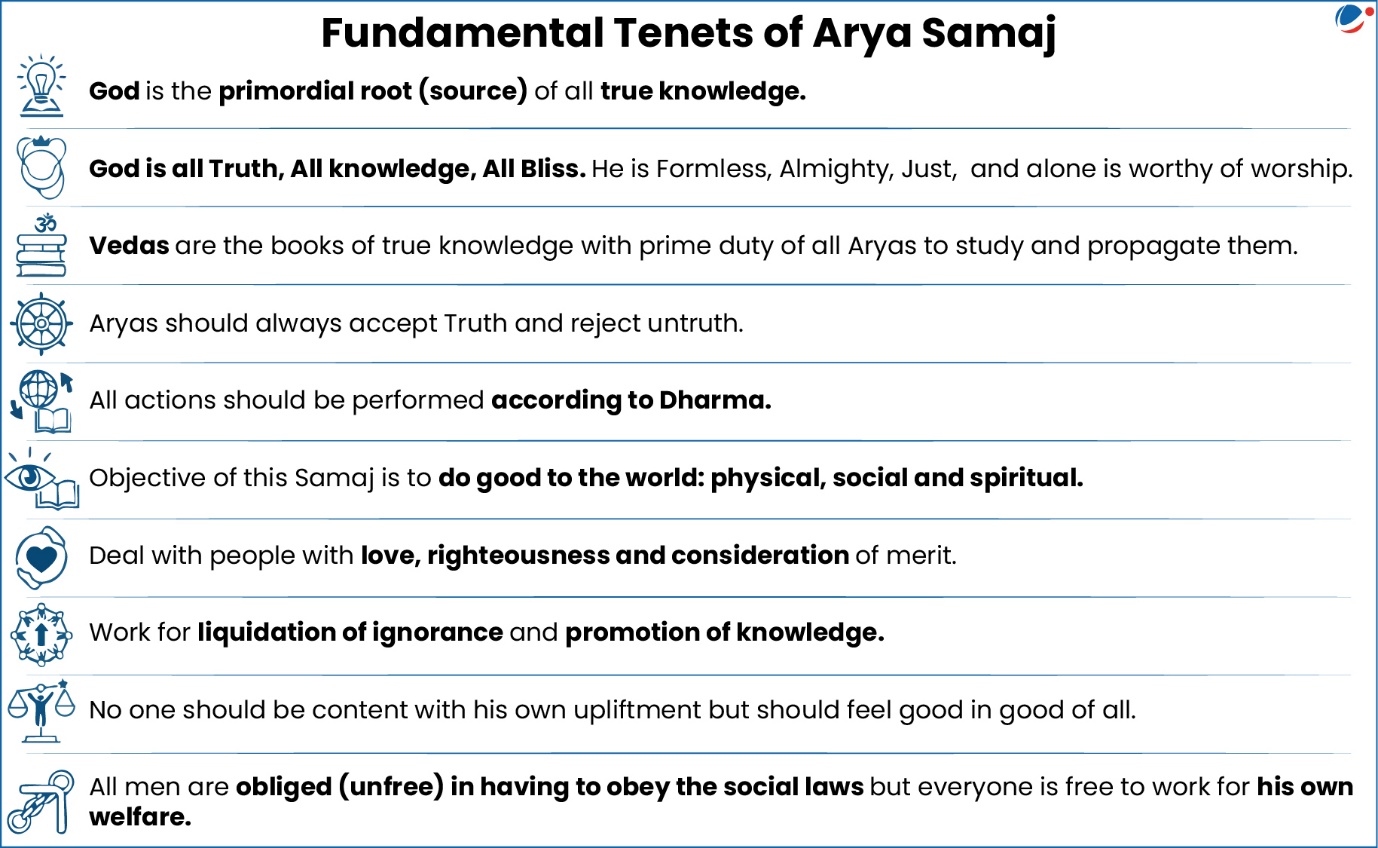
Membership: Involved acceptance of ten fundamental tenets of the Samaj (see infographic), payment of 1% of monthly/yearly income to help its cause and participate in its meetings, etc.
Person regardless of caste conduced these meetings.
The Arya Samaj organization is live and sound in all parts of the world. Arya Samaj has branches in North America, Europe, Asia, Africa and in Australia.
Key Contributions of Arya Samaj
Religious Reforms: It promoted the monotheistic Hindu order rejecting the ritualistic excesses and social dogmas of orthodox Hinduism promoting a united Hindu society based on Vedic teachings.
They pioneered the highly unconventional step of "Suddhi" (purification ceremony), which involved the en masse reconversion and reclamation of Hindus who had changed their religion to Islam, Christianity, or other faiths.
It helped Moplas of Malabars to reconvert into Hinduism (1923), promoted Vedic Teachings through 'Kumbh Ved Abhiyaan, where Vedic Knowledge was disseminated during Kumbh Melas, etc.
Social Reforms: Arya Samaj tried to get untouchables rganizati as equal members of Hindu Society before Mahatma Gandhi took up the cause of untouchables.
Hyderabad Satyagraha (1938-39)
About: A Satyagraha launched by Arya Samaj against Hyderabad Nizam's oppressive rule that prohibited Arya Samajists to propagate Vedic teachings.
Prominent Leaders: Mahatma Narayan Swami, Chand Kiran Sharda, etc.
Significance: Movement's role was acknowledged by Sardar Vallabhbhai Patel in Hyderabad's liberation and integration into India
Emancipation of Women: It established a network of educational institutions to equip girls with intellectual knowledge and practical skills.
E.g., Kanya Mahavidyalaya in Jalandhar, Kanya Pathshala in Dehradun, Hans Raj Mahila Mahavidyalaya in Jalandhar, etc.
Contribution towards National Movement: Although the Samaj consistently stated it was a religious, social, and cultural rganization, it was a forerunner in India's national and political awakening.
It was reflected through support of Hindi Language; Khadi and Swadeshi; and opposition to salt taxes.
Prominent leaders inspired with Arya Samaj included Lala Lajpat Rai, Bhagat Singh, Ram Prasad Bismil, Madan Lal Dhingra, Swami Shraddhanand, Sachindra Nath Sanyal, Bhai Parmanand, Vinayak Damodar Savarkar, etc.
Educational Reforms: It promoted integration of spiritual knowledge with modern academic learning through establishment of Gurukuls and DAV (Dayanand Anglo-Vedic) schools.
Humanitarian Reforms: Samaj offered relief work during crisis before and after independence including the Bikaner Famine (1895) ; Awadh Famine (1907-08); Earthquake in Gujarat (2001), etc.
Promotion of Hindi Language: Samaj established Hindi newspapers and journals like Arya Darpan (1878), Arya Samachar (1878), Bharat Sudasha Pravartak (1879), and Desh Hiteshi (1882).
Contemporary Relevance of the Arya Samaj
Removing Superstitions and Ignorant Beliefs:Certain superstitious beliefs have been existing for such a long time that they have been taken for granted. E.g., Wearing charmed lockets to ward off evil eye.
Ending Discrimination: Caste based discrimination remains a pressing issue even in the present times, even though constitutionally addressed, it is socially prevalent in many parts.
Sustainable Development: Present day ideas of yoga and Environmental consciousness are based on the pillars of Vedic ideals and lifestyle advocated by the Arya Samaj.
India's Mission LiFE and One Sun, One World, One Grid, are a global movement in this regard.
Women Empowerment: Involvement of women constituting half of India's workforce in various domains like Agriculture (Drone Didis), defense (operation of Rafale fighter aircraft), and leadership in science, technology and politics, etc.
Education: Samaj's assertion for education especially for unprivileged is essential to provide a life of dignity to all.
Instilling Humanitarian Values: Developing inspiring qualities in individuals like empathy, compassion and sensitivity which strengthens brotherhood and promotes peace in society.
Arya Samaj's Educational Programme
Dayanand Anglo-Vedic (DAV): The first DAV school was established in Lahore in 1886 under the leadership of Lala Lajpat Rai.
It aims to induce scientific temperament in students without uprooting them from their spiritual, cultural, religious moorings.
Gurukul Kangri: Founded in 1902 by Swami Shraddhananda in Haridwar. Led by traditionalists, it prioritized Vedic teachings over Western education.
Based on ancient ideal of residential school where teachers and students lived as a family.
Conclusion
Arya Samaj's timeless principles and its ability to adapt to changing times along with its emphasis on equality, education, and rational thinking aligns with needs of contemporary society, making it a significant force in shaping India's socio-religious landscape.
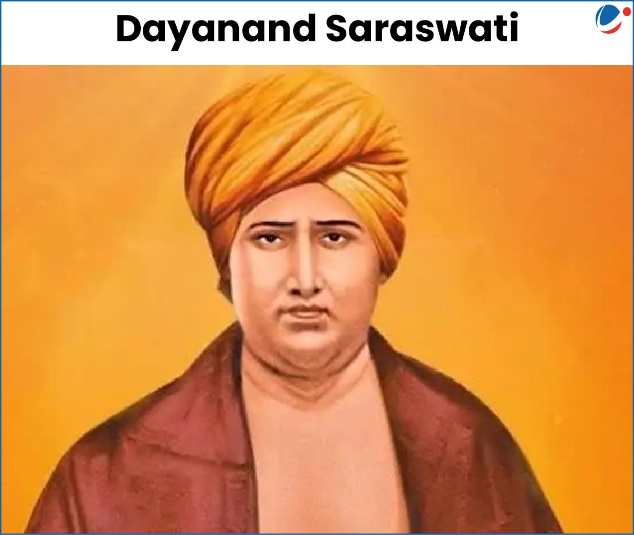
About Dayanand Saraswati(Mula Shankara)
Birth:February 12, 1824, in Morbi, Kathiawar, Gujarat to a Brahmin family.
Early Life and Education: Started education at 5, was invested with the sacred thread at 8, his religious transformation began at 14. He received Vedic Education and was educated in Sanskrit.
Renunciation: Ran away from home at 21, became a sadhu and wandered for 15 years meeting scores of other sadhus and pandits.
Death: October 30, 1883, Ajmer, Rajputana.
Guru:Swami Virjanand Saraswati who charged him to purge Hinduism of all evils.
Key Contributions
National Movement: He is credited to have first used the term swaraj (self-rule) in 1875
Belief in Vedas: His call "Back to the Vedas" establishes Vedas as the most important constituent of his ideology.
Social Reforms: Hoisted the Pakhand Khandini Pataka at 1867 Haridwar Kumbh Mela to oppose social evils, blind faith, and superstitions.
Dr. Sarvepalli Radhakrishnan, called him as 'a maker of modern India'.
Women Rights: Advocated equality of sexes, encouraged women to study Vedas, and carried on a crusade against child marriage.
Set down that girls should not marry until age 16 and boys not before age 25.
Religious Reforms: His work, Satyarth Prakash called for religious revivalism and advocated for worshipping of one Supreme God following simple rituals and recitation of Vedic mantras.
Protection of Cows: He actively opposed cow slaughter and promoted cow worship as an essential part of Vedic culture.
In 1881, he published "Gokarunanidhi", a treatise condemning cow slaughter and established the first Gaurakshini Sabha in Punjab in 1882.
Popularising Hindi Language: He believed Hindi, in Devanagari script, to be the unifying language of India despite his proficiency in Sanskrit and his mother tongue being Gujarati.
Satyarth Prakash was written in Hindi.
Education: In his work, Satyarth Prakash he starts with his philosophy of education stressing the parental duty to ensure children education.
Proposed learning Sanskrit, Hindi and a foreign language from the age of 5 itself.
Swami Shraddhanand was an Indian Independence activist and an Arya Samaj sannyas...
YouTube
HD
Loading video...
In conversation: Meaning of Living Heritage
YouTube
HD
Loading video...
RELATED TERMS
3
Revivalist movement
A reform movement that seeks to restore or revive past traditions, beliefs, or practices, often in response to perceived decline or corruption. The Arya Samaj is an example of a religious revivalist movement in Hinduism.
Kinvanto Vishvam Aryam
A Sanskrit motto of the Arya Samaj, meaning 'Make This World Noble'. It encapsulates the Samaj's goal of universal upliftment and betterment.
Satyarth Prakash
A seminal work by Dayanand Saraswati, written in Hindi, advocating for religious revivalism, monotheism, simple rituals, and Vedic mantras. It also outlines his philosophy on education and social reforms.
Title is required. Maximum 500 characters.
Search Notes
Filter Notes
Loading your notes...
Searching your notes...
Loading more notes...
You've reached the end of your notes
No notes yet
Create your first note to get started.
No notes found
Try adjusting your search criteria or clear the search.