


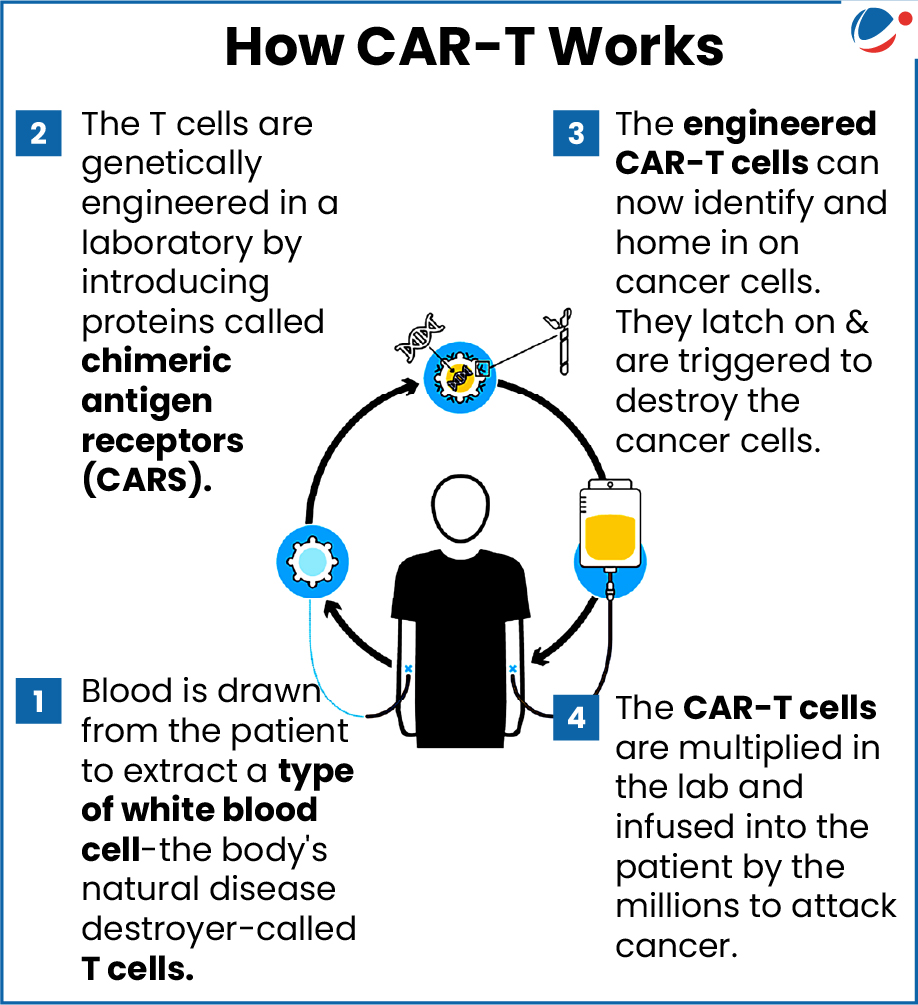
NexCAR19 therapy was developed for B-cell blood cancers by ImmunoACT (a company incubated under IIT Bombay, and Tata Memorial Hospital), supported by DBT and BIRAC.
- NexCAR19, India’s 1st indigenous CAR T-Cell therapy, was granted market authorization by the Central Drugs Standard Control Organisation (CDSCO) in 2023.
About CAR (Chimeric Antigen Receptor) T-Cell Therapy
- It modifies immune cells, specifically T-cells, by turning them into potent cancer fighters known as CAR-T cells.
- T-cells are special cells (types of white blood cells) whose primary function is cytotoxic, meaning killing other cells.
- This treatment is designed for specific types of blood cancer and is given to patients whose cancer has either relapsed or not responded to first-line treatment.
Benefits of CAR T-Cell therapy
- Short treatment duration: Unlike aggressive chemotherapy or stem cell transplants, it allows for a faster recovery.
- Sustained Benefits: CAR T-cells persist in the body, offering long-term protection against cancer relapse.
- Accessibility: Nexcar19 cost is lower compared to imported CAR-T therapies.
Challenges: Therapy for one cancer won't work for another type of cancer, can have negative effects on the nervous system, Cytokine Release Syndrome (Over activation of immune cells), risk of infection, etc.
Article Sources
1 source- QSIP (Quantum Random Number Generator System in Package): It is India’s quantum security chip.
- QSIP provides quantum-certified randomness (random numbers from a quantum computer) that is used in cryptographic algorithms.
- It ensures defence against cyber threats and future quantum attacks.
- 25-qubit QPU: It is India’s first quantum computing chip, developed by Startup QpiAI.
- Quantum information Scrambling: It refers to the rapid spread of information across a quantum system, making it inaccessible to local measurements (measuring only a sub-part of the whole system).
- Mechanism: It distributes quantum data among particles through entanglement, hiding information globally rather than erasing it.
- Global information means information is distributed across the whole system. The information can only be retrieved by measuring the whole system.
- Analogy: Like a drop of dye dispersing in water, information initially stored in one qubit gets distributed among many qubits.
- Significance: Demonstrates a verifiable quantum advantage and enhances understanding of quantum technologies
Elon Musk-owned Starlink has signed an agreement with Maharashtra government to deliver satellite-based connectivity to remote and underserved regions.
Satellite-based internet
- Definition: Satellite internet is wireless broadband delivered via communication satellites orbiting the Earth.
- Difference: Unlike fibre, cable, or DSL, it does not depend on physical ground-based wiring.
- How does it work? Data is transmitted from a user’s dish to a satellite and then to ground stations connected to the global internet.
- Low Earth Orbit (LEO) satellites, like Starlink, offer faster speeds and lower latency than traditional geostationary ones.
India’s largest and first MWh-Scale Vanadium Redox Flow Battery (VRFB) inaugurated at NTPC NETRA.
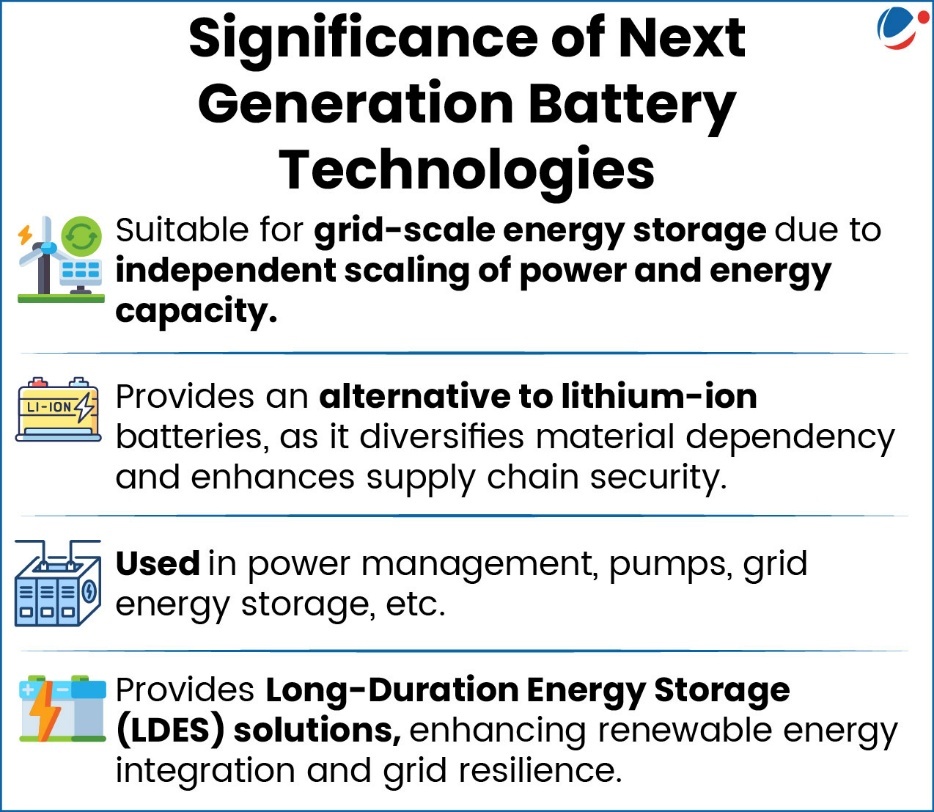
Flow Batteries, along with solid state batteries, are one of the next generation battery technologies and are emerging as an alternative to lithium-ion for grid-scale applications, offering flexibility, longevity, and safety.
About Next Generation Battery Technologies
- Flow Batteries: Flow batteries are powered by reduction-oxidation (redox) reactions and involve two different liquid electrolytes that pass ions or protons back and forth through a porous membrane.
- These batteries can store larger amounts of energy—as much as the size of the electrolyte cells can contain—and don’t use flammable or polluting materials.
- Types of Flow Batteries: Vanadium Redox, Zinc–Bromine, Iron–Salt/Organic systems.
- Solid-State Batteries: These use solid electrolyte solutions, which don’t need a different separator.
- It makes them safer because they are less prone to leakage from damage or swelling in hot temperatures.
Article Sources
1 sourceNASA’s ESCAPADE (Escape and Plasma Acceleration and Dynamics Explorers) spacecraft launched aboard a Blue Origin New Glenn rocket.
About ESCAPADE Mission
- Objective: To investigate how the solar wind interacts with Mars’ magnetic environment and how this interaction drives the planet’s atmospheric escape.
- Mars’ magnetosphere is made up of leftover magnetic fields from an ancient core and a weaker magnetic field in its upper atmosphere.
- The spacecraft launched into a “loiter” orbit that loops around Earth’s Lagrange point 2.
- At Lagrange points, the gravitational pull of two large masses precisely equals the centripetal force required for a small object to move with them.
- These points in space can be used by spacecraft to reduce fuel consumption needed to remain in position.
Article Sources
1 sourceThe Sentinel-6B satellite was launched from the Vandenberg Space Force Base in California on a Falcon 9 rocket.
About Sentinel-6B Satellite
- Joint mission between the United States’ NASA, NOAA (National Oceanic and Atmospheric Administration) and the European Space Agency.
- Purpose: It is an ocean-tracking satellite with six onboard science instruments that will measure the rising sea levels and its impacts on Earth.
Recently terror attacks were averted related to Ricin poison and Ammonium Nitrate.
About Ricin
- It is a protein found naturally in castor beans and can be made from waste residue of castor beans.
- Lethal poison: Even 1 mg mixed in food can kill an adult. There is no antidote or specific treatment for ricin poisoning.
- It works by getting inside the cells of a person’s body and preventing the cells from making the proteins they need.
Ammonium Nitrate
- Pure ammonium nitrate (NH4NO3) is a white, water-soluble, crystalline substance with a melting point of 170°C.
- It is not explosive by itself. However, it is one of the ingredients used for the manufacture of explosives.
Article Sources
1 sourceThe Centre has extended the deadline for applying for Promotion of Research and Innovation in Pharma & MedTech (PRIP) Scheme.
About PRIP Scheme
- Launched by: the Department of Pharmaceuticals, Ministry of Chemicals and Fertilizers.
- Financial outlay: ₹5000 crores
- Aim: Transforming India into a global powerhouse for R&D in the Pharma MedTech sector.
- Features:
- Component A: Strengthening the research Infrastructure with setting up of Centres of Excellence at National Institute of Pharmaceutical Education & Research (NIPERs).
- Component B: Promotion of Research and Innovation in the Pharma MedTech sector.
