


Why in the news?
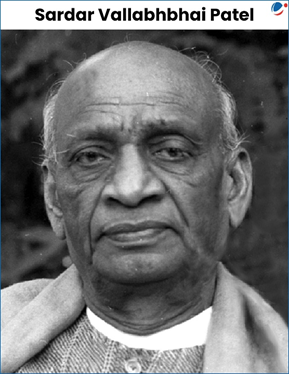
Recently, Prime Minister paid tributes to Sardar Vallabhbhai Patel on his 150th birth anniversary. Since 2014, the day is observed as Rashtriya Ekta Diwas (National Unity Day).
Brief about the Life of Sardar Vallabhbhai Patel
- Birth: Born on October 31, 1875, in Nadiad, Gujarat.
- His father Jhaberbhai, served in Rani Lakshmibai of Jhansi's army and participated in Revolt of 1857.
- Career: Passed his matriculation in 1897 and then pursued law in England. After completing law in 1913, he returned to India and established his practice at Ahmedabad.
- Key Positions Held
- Elected to Ahmedabad Municipal Corporation as the Sanitation Commissioner in 1917.
- Nominated and elected as the President of newly formed Gujarat Pradesh Congress Committee in 1920.
- Elected President of the Ahmedabad Municipal Board in 1924.
- Elected as President of the Karachi session of the Congress in 1931 where resolutions regarding Fundamental Rights and Economic Policy were passed.
- Elected to the Constituent Assembly from Bombay on Congress Party ticket.
- Served as Chairman of the Provincial Constitution Committee to discuss model Provincial Constitution, determining the system and form of provincial government.
- Served as the Member of Advisory Committee on Fundamental Rights, Minorities and Tribal and Excluded Areas.
- Served as Home and Information and Broadcasting Minister in Interim Government.
- Served as the first Home and Deputy Prime Minister of Independent India.
- Honours: He was posthumously awarded the Bharat Ratna in 1991.
- "Ek Bharat Shreshtha Bharat" (EBSB) initiative was announced on 31 October 2015 during Sardar Vallabhbhai Patel's 140th birth anniversary, embodies his vision of a united India.
- Statue of Unity, was inaugurated in 2018 in Kevadia, Gujarat as an ode to Sardar Patel.
Key Contributions of Sardar Vallabhbhai Patel
- Kheda Satyagraha (1918): Sardar Patel's political journey began with his association with Mahatma Gandhi during the Kheda satyagraha.
- He led the peasants in refusing to pay taxes due to famine-induced hardships, marking his first major victory against colonial authorities.
Annexation of Junagadh, Kashmir, and Hyderabad
|
- Non-Cooperation Movement (1919-20): Sardar Patel was given the task of leading the movement in Gujarat.
- He, along with Shankarlal Banker, Umar Sobani, Sarojini Devi, and Indulal Yajnik, popularised the movement in Gujarat by founding the Satyagraha Sabha.
- Bardoli Satyagraha (1928): He led the landowners of Bardoli in their resistance against increased taxes.
- His role elevated him to the pinnacle of national glory and his efficient leadership earned him the title sardar ("leader").
- Builder and Consolidator of Modern India: After Independence, he was tasked with unifying over 560 princely states, covering nearly 40% of India's territory and population, into the Union of India.
- Under the Indian Independence Act, rulers of the Princely States were given the option to decide whether they wanted to accede to India or Pakistan or neither.
- Sardar Patel employed a combination of diplomatic negotiations, persuasion, and, where necessary, firm administrative measures to prevent balkanisation.
- It earned him the reputation of 'Iron Man' because of the manner in which he brought about and maintained internal stability.
Core objectives of EBSB
|
- Creation of All India Services: He envisioned these services as 'Steel frame of India' considering officers in administration as service partners working with integrity and honesty.
- Cooperative Movement: He led Gujarat's cooperative movements and was instrumental in formation of the Kaira District Cooperative Milk Producers' Union.
Key Values associated with Sardar Patel
- Co-existence: He favoured existence of big industries with village and cottage industries for rural and agricultural development ensuring largescale employment.
- Mediation: He insisted on adopting the policy of mediation to solve the problem prevailing between industry and labour.
- Democracy: He supported equality, liberty and justice and fully supported representative democratic institutions with autonomous existence to function effectively.
- Firmness in Administration: To prevent misuse of power by the authority and bureaucracy, promoting the doctrine of intellectual integrity of civil servant.
- Decentralisation of Power: He reinforced the idea of Panchayati Raj system and supported establishment of gram panchayats based on selfless service, morality and dedication ensuring quick justice at the grass roots level. E.g., 73rd and 74th Amendment Act.
- Holistic Education: He held that education should be fair, right and in the medium of our own language.
Conclusion
Sardar Patel passed away on 15th December 1950, leaving behind an indelible legacy as the 'Consolidator of India'. 150th Birth anniversary of Sardar Patel is a reminder to his unwavering commitment to national integrity, good governance and public service.


