


Why in the News?
Prime Minister paid a two-day State Visit to Bhutan, at the invitation of His Majesty the King of Bhutan.
More on the News
- The visit coincided with the Global Peace Prayer Festival in Thimphu, which featured the exposition of the Piprahwa Relics of Lord Buddha from India.
- Major highlights of the visit:
- Inauguration of the Punatsangchhu-II Hydroelectric Project
- India to support Gyalsung National Service Program (mandatory national service for youth in Bhutan) with 200 Crore grant and 1500 Crore concessionary loan.
- MoU for establishment of Railway Links, encompassing the Kokrajhar-Gelephu and Banarhat-Samtse rail links.
- India to allot land in Varanasi for construction of a Bhutanese temple/monastery.
Historical Development of Relationship
|
Significance of India-Bhutan Bilateral Relation
- For India
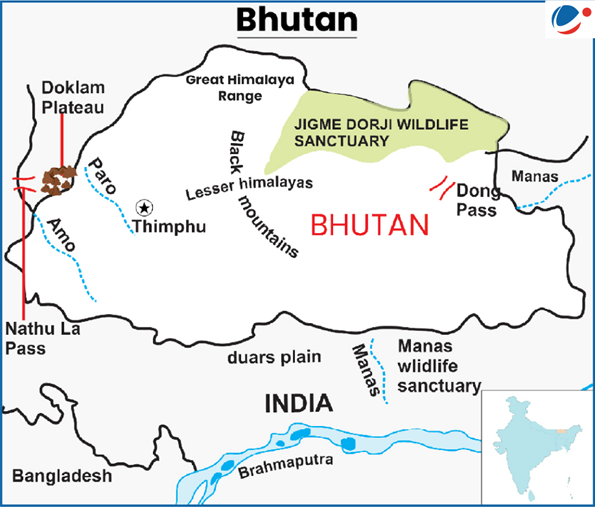
- Strategic Buffer and Security: Bhutan's geographical location acts as a buffer between India and China. Bhutan's western border (Doklam) is vital to ensure the security of India's Siliguri Corridor.
- Energy Security: Bhutan is a dependable hydropower partner, with India involved in five major HEPs totalling 2986 MW (including Chukha, Kurichhu, Tala, Mangdechhu, and Punatsangchhu-II).
- Economic Access: Bhutan remains India's top trading partner and a major investment destination.
- Internationalisation of BHIM UPI & RuPay Card: Bhutan is the first country to adopt UPI standards for its QR deployment. The RuPay Card is fully interoperable.
- For Bhutan:
- Economic Development: India is Bhutan's principal development partner, assisting its socio-economic development since its first Five Year Plan in 1961. For the 12th FYP, India's contribution constituted 73% of Bhutan's total external grant component.
- Revenue Generation: Electricity exports to India generate about 40% of Bhutan's revenue and 25% of its Gross Domestic Product (GDP).
- Tackling Landlocked Nature: The 2016 Trade, Commerce and Transit Agreement establish a free trade regime and provide Bhutan duty-free transit of goods to/from third countries.
- Financial Stability: India provides crucial RBI financing facilities, including the INR 1500 Cr Currency Swap Facility and multiple Standby Credit Facilities.
- Education and Capacity Building: India provides several opportunities, including over 1500 scholarships for students (e.g., Ambassador's Scholarship, Nehru Wangchuck Scholarship) and approximately 325 annual ITEC training slots for professionals.
- Space Collaboration: India and Bhutan jointly developed the India-Bhutan SAT (2022).
- Defense Cooperation: The Indian Military Training Team (IMTRAT) trains Bhutanese security personnel.
Challenges in India-Bhutan Relations
- Geopolitical Pressure from China: China is making concerted efforts to establish formal diplomatic and economic ties and pressures Bhutan to finalize border demarcation. China's road and railway extensions in Tibet (e.g., Lhasa-Shigatse line extension to Yatung) are beginning to erode India's geographic advantage.
- The Doklam Dilemma: China's long-standing 'package deal' offer to settle the border dispute by ceding control of the strategically critical Doklam plateau remains a security concern for India.
- Economic Perceptions: Some Bhutanese perceive India's dominance as exploitative. Critics point out that India's aid often creates "jobless growth" and much of the aid flows back to Indian companies.
- Hydropower Financing Terms: There is growing domestic criticism regarding India's shifting finance model for hydropower projects.
- Historically, the grant-loan component was 60:40, but this has recently reversed, with loans (often at high interest rates) comprising 60-70% of financial support, raising questions about India's motives.
Conclusion
The India-Bhutan relationship is a unique partnership founded on shared spiritual heritage and deep mutual trust, historically cemented by the 1949 Treaty and its revised 2007 version. Recent visits demonstrate India's commitment to remaining a steadfast and substantive partner through massive financial commitments and crucial connectivity projects.


