


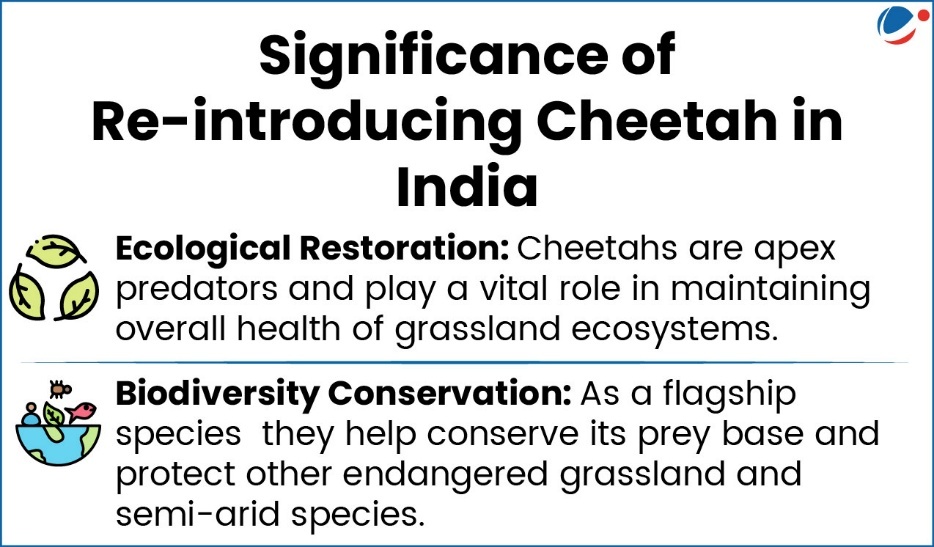
India-Botswana formally announced translocation of eight cheetahs to India as a part of ‘Project Cheetah’.
About Project Cheetah
- About: Launched in 2022, Project Cheetah aims to translocate African cheetahs to India. It is the world’s first intercontinental large wild carnivore translocation initiative.
- In 2022, eight cheetahs from Namibia were translocated to Kuno National Park, followed by twelve cheetahs from South Africa in 2023.
- Implementing agency: National Tiger Conservation Authority (NTCA).
- NTCA is a statutory body under the Ministry of Environment, Forests and Climate Change constituted under enabling provisions of Wildlife (Protection) Act, 1972, as amended in 2006.
- Cheetah Project Steering Committee: Established by NTCA in 2023 to oversee, evaluate, and advise on implementation of Project Cheetah.
- It operates under the umbrella of Project Tiger (renamed as Project Tiger and Elephant from 2023-24).
These directions were issued to address increasing Human-Wildlife Conflicts (HWCs) due to habitat degradation, unregulated tourism, and corridor fragmentation.
Directions issued by the Supreme Court
- Tiger Safari Restrictions: Permitted only on non-forest or degraded forest land in buffer zones;
- No safaris in core areas or designated tiger corridors.
- Night Tourism: To be banned in core/critical tiger habitats.
- Prohibited Activities: Commercial mining, polluting industries, major hydro projects, exotic species introduction, low-flying aircraft or commercial firewood extraction barred in buffer/fringe areas.
- Eco-Sensitive Zones (ESZs): All reserves must notify ESZs as per the 2018 Ministry of Environment’s guidelines under the Environment Protection Act, 1986.
- Tiger Conservation Plans (TCPs): States must prepare/revise TCPs within stipulated timelines;
- Core and buffer areas to be notified within six months.
- Natural Disaster Status: States to treat HWCs as a natural disaster to ensure rapid relief.
- Compensation: Uniform ex-gratia of ₹10 lakh for human deaths due to HWCs.
- Draft HWC mitigation guidelines: To be drafted by the National Tiger Conservation Authority (NTCA) within six months, and to be implemented by all States.
About Tiger Reserves
|
The Vanashakti judgment had previously barred the granting of ex-post-facto environmental clearances (EC).
- Under Vanashakti Judgment, court had struck down a 2017 notification and 2021 Office Memorandum (OM) of Centre, which in effect recognised the grant of ex post facto ECs.
Reasoning for Recalling the Vanashakti Judgment:
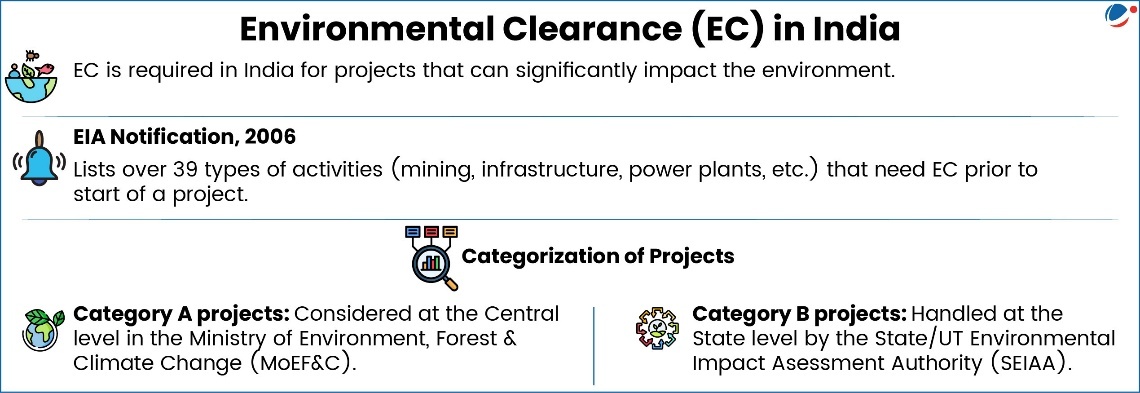
- Legal precedents ignored: CJI observed that the Vanashakti judgment was rendered without taking notice of previous judgments of coordinate benches, thus rendering it per incuriam.
- E.g. D Swamy vs Karnataka State Pollution Control Board (2021) held that post-facto EC can be granted in exceptional cases
- SC in Alembic Pharmaceuticals Ltd (2020) while discouraging post-facto EC, had regularized existing post-facto ECs with directions to pay monetary penalties.
- Economic costs: Adhering to the Vanashakti ruling would lead to the demolition of completed public projects.
- Also demolishing large structures may cause more pollution e.g. debris, reconstruction emissions etc.
About Ex-Post Facto Environmental Clearance:
- An ex-post facto EC essentially allows a project proponent to continue with its project without obtaining an EC prior to project commencement.
- The Environmental Impact Assessment (EIA) Notification, 2006, clearly requires ‘prior environmental clearance’ before a project can start.
- Previously, in Common Cause v. UoI & Ors. (2017), Supreme Court held that the concept of ex post facto or retrospective environmental clearance is completely alien to environmental jurisprudence.
It is a year-long, targeted initiative under Swachh Bharat Mission-Urban 2.0 to achieve the goals of Lakshya Zero Dumpsites by September 2026.
- Swachh Bharat Mission (SBM-U) 2.0 was launched in 2021 to achieve Garbage Free Status for all cities. It also aims at remediation of all legacy dumpsites and converting them into green zones.
About DRAP
- Objective: Prioritize high-impact locations, covering approximately 8.8 crore MT of legacy waste.
- Legacy Waste refers to aged municipal solid waste in landfills or dumpsites, it is a mix of partially or completely decomposed biodegradable waste, plastic waste, etc.
- About 80% of the legacy waste is concentrated in 214 sites across 202 Urban Local Bodies.
- Ministry: Ministry of Housing and Urban Affairs (MoHUA).
- Eligibility: All States/UTs with ongoing legacy waste projects with priority to sites containing over 45,000 MT of legacy wastes.
- No minimum threshold for eligibility for UTs and North Eastern States.
Dumpsites and its Management in India
- Status: Currently, 1,428 sites are undergoing remediation (1,048 have been fully remediated).
- Major emissions of primary concern:
- Leachate: Polluted water that emerges at the base of dumpsite waste.
- Landfill Gas: Mixture of carbon dioxide and methane formed because of anaerobic conditions created in dumpsites during waste decomposition.
Key Technologies for Managing Dumpsites | |
Biocapping | Biomining |
|
|
Recently, the Global Reporting Initiative (GRI) launched the Integrity Matters Checklist, a UN-endorsed framework designed to align corporate climate disclosures with the United Nations’ net-zero standards.
About Global Reporting Initiative (GRI)
- It is an international, non-profit body that sets the world’s most widely used sustainability reporting framework.
- Established: Founded in 1997.
- ESG Disclosure: GRI Standards enable organizations to report economic, environmental, and social impacts.
- Modular Structure: GRI Standards follow a three-part system comprising Universal, Sector, and Topic Standards.
Article Sources
1 sourceUnion Environment Minister of India addresses Leadership Group for Industry Transition (LeadIT) Industry Leaders’ Roundtable at CoP30, Belém, Brazil.
About LeadIT
- Launched jointly by India and Sweden and supported by the World Economic Forum at the UN Climate Action Summit in 2019.
- Aim: It was the first global high-level initiative aimed to achieve net-zero carbon emissions from high-emitting industries by 2050.
- LeadIT drives just and equitable industry transition by fostering public-private partnerships, mobilising resources and supporting knowledge-sharing.
- LeadIT 2.0 (2024-2026) was adopted at the annual LeadIT Summit at COP28.
- Members: 18 member countries and 27 companies.
Article Sources
1 source- Adopted at COP28 (2023): The UAE Consensus marked the first-ever Global Stocktake under the Paris Agreement.
- Energy Transition: Urges nations to transition away from fossil fuels in a just, fair, and balanced way.
- Renewables & Efficiency: Sets clear goals to triple renewable energy and double energy efficiency by 2030.
- Climate Finance: Calls for greater adaptation support and financial reforms to help vulnerable nations.
- Global Goal: Reinforces the collective aim to keep 1.5°C within reach and achieve net zero emissions by 2050.
Article Sources
1 sourceKey Findings
- Finance Gap: Developing nations face an adaptation shortfall of $310–365 billion/year by the mid-2030s.
- Current Funding: Global adaptation finance is only $26 billion, far below needs.
- Implementation Lag: Most nations have plans, but execution and quality remain weak.
- Urgent Action: Calls for a major scale-up in finance, innovative tools, and stronger resilience planning.
- India’s Scenario: India has advanced its National Adaptation Fund and State Action Plans, but remains highly vulnerable to heat stress, erratic monsoons, and coastal flooding.
Article Sources
1 sourceRecently “Emission Gap Report 2025: Off Target” was released by UN Environment Program (UNEP).
Key Highlights of the Report
- Even the updated Nationally Determined Contribution pledges under the Paris Agreement, could lead to global temperature rise by 2.3-2.5 0C by this century.
- This falls short of Paris agreement's goal of limiting warming to well below 2 °C, while pursuing efforts to cap it at 1.5 °C.
- GHGs emissions rose 2.3% in 2024, reaching 57.7 gigatonnes of CO₂ equivalent.
- To align with 1.5 °C target, emissions would need to fall by 55% by 2035.
- Highest absolute increase in total GHG emissions was observed in India and China. However, per capita GHG emission for India remained below the world average.
Article Sources
1 sourceReleased by International Cryosphere Climate Initiative, the report highlights the status and impact of changes in five key components of cryosphere – Ice Sheets, Mountain Glaciers and Snow, Polar Oceans, Sea Ice, and Permafrost.
Key Highlights of Report
- Ice Sheets: Losses from the Greenland and Antarctic ice sheets have quadrupled since the 1990s.
- Impact: Sea-level rise results in widespread loss of infrastructure, agricultural land, homes, and livelihoods in coastal regions.
- Polar Oceans: Rising greenhouse gases are impacting their role as heat/carbon absorbers and drivers of global circulation.
- Impact: Two major ocean current systems, Antarctic Overturning Circulation (AOC) and Atlantic Meridional Overturning Circulation (AMOC), have slowed substantially due to freshwater melt.
- Mountain Glaciers and Snow: Glacier ice loss is increasing exponentially worldwide, with 273 gigatons lost per year between 2000 and 2023.
- Impact: Threatens water, food, economic, and political security for billions of people.
- Sea Ice: Sea ice extent and thickness have declined 40-60% at both poles since 1979.
- Impact: Loss of sea ice drives Arctic amplification, threatens ice-dependent species, disrupts weather and ocean currents and increases sea-level rise risks.
- Permafrost: Over 210,000 km² of permafrost has thawed per decade since current warming began.
- Impact: Thawing permafrost decreases the global carbon budget and releases vast amounts of ancient organic carbon (three times more than currently in the atmosphere).
Article Sources
1 sourceReport published by the UN Environment Programme’s (UNEP) Cool Coalition, details a Sustainable Cooling Pathway aimed at dramatically reducing projected GHG emissions from cooling by 2050.
Key concerns raised in the Report
- Surge in cooling demand: Under a Business-as-Usual (BAU) Cooling Pathway, the global stock of cooling equipment will more than triple by 2050, from 22 terawatts (TW) in 2022 to 68 TW.
- Policy Gaps: Only 54 nations meet full Sustainable Cooling Pathway standards despite broad policy inclusion.
- Escalating extreme heat: Global population exposed to deadly heat stress could rise from 30% today to between 48% and 76% by the end of the century. (IPCC)
- This gets further amplified by urban heat island effect, heatwaves, etc.
Proposed Sustainable Cooling Pathway
- Passive Cooling: Reduce cooling loads through passive design, urban planning, and simple measures like doors on refrigerated cabinets to cut costs and emissions.
- Low-Energy Cooling: Prioritize low-energy systems such as fans and evaporative coolers instead of, or alongside, air conditioning to cut energy use and costs.
- Best Energy Efficiency: Adopt high-efficiency systems with variable-speed compressors and proper maintenance for optimal performance.
- Rapid HFC Phase-Down: Select low-GWP refrigerants that maintain system efficiency to reduce direct emissions and support sustainable cooling.
About Beat the Heat Global Initiative
|
Article Sources
1 sourceRecently, CCPI was released which compares climate performance of 63 countries and the EU, which together account for over 90% of global GHG emissions.
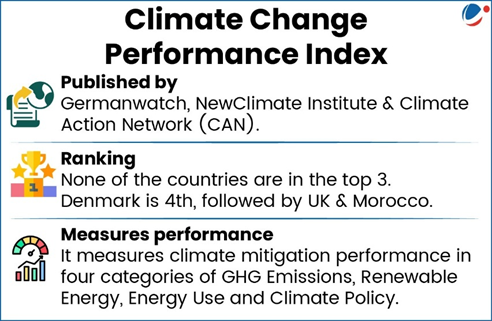
Findings for India
- India ranks 23rd, going from a high performer to a medium one in this year’s CCPI.
- There is no national coal exit timeline and new coal blocks continue to be auctioned.
- Key demands: time-bound coal phase-down and eventually a phase-out and redirecting fossil subsidies toward decentralised, community-owned renewable energy
Article Sources
1 sourceGermanwatch releases Climate Risk Index (CRI) 2026.
- It ranks countries based on the human and economic toll of extreme weather events, highlighting the urgency for stronger climate resilience.
About Climate Risk Index (CRI)
- Genesis: Introduced in 2006 as an annual global climate impact index.
- Key Findings:
- Between 1995 and 2024, 9,700 extreme weather events caused over 8 lakh deaths and $ 4.5 trillion in damages.
- India ranked 15th in CRI Rank 2024 and 9th in CRI Rank 1995-2024.
- India faced nearly 430 extreme weather events in three decades, causing $ 170 billion losses and 1.3 billion affected.
Food and Agriculture Organization of the United Nations (FAO) released The State of Food and Agriculture (SOFA) 2025 Report.
Key Highlights of Report
- Land Degradation is defined as a long-term decline in the land’s ability to deliver essential ecosystem functions and services.
- It is driven by natural causes (soil erosion and salinization) and anthropogenic causes (deforestation, overgrazing, unsustainable cropping and irrigation practices etc.)
- Impact of Land Degradation
- Asian countries are the most affected - both because of their accumulated degradation debt and their high population densities.
- Ecosystem Impact: Degradation affects all agricultural systems, undermining livestock production in rangelands and – through forest loss driven by agricultural expansion – disrupting climate patterns and biodiversity.
- Yield Loss: For about 1.7 billion people, crop yields are 10% lower because of human-induced degradation.
- Productivity Loss: Total factor productivity growth, which reflects technological advancement and efficiency improvements, has declined since the 2000s, particularly in the Global South.
- Convergence with Food Security: Globally, 47 million children under five years of age suffer from stunting live in hotspots where stunting overlaps with significant yield losses.
Policy Options for Sustainable Land Use
|
Article Sources
1 sourceThirty-Seventh Meeting of the parties to the Montreal Protocol on Substances that Deplete the Ozone Layer (MOP37) has recently concluded.
- It highlighted discrepancies in HFCs emissions between reported and measured data, lack of atmospheric monitoring stations in many regions, etc.
About Montreal Protocol
- Signed: in 1987
- It is a global legally binding treaty to eliminate production and use of Ozone depleting Substances (ODS).
- Implemented under the Vienna Convention (adopted in 1985).
- Kigali Amendment to Montreal Protocol: Adopted in 2016 to phase-down production and consumption of HFCs (non-ODS but potent greenhouse gases).
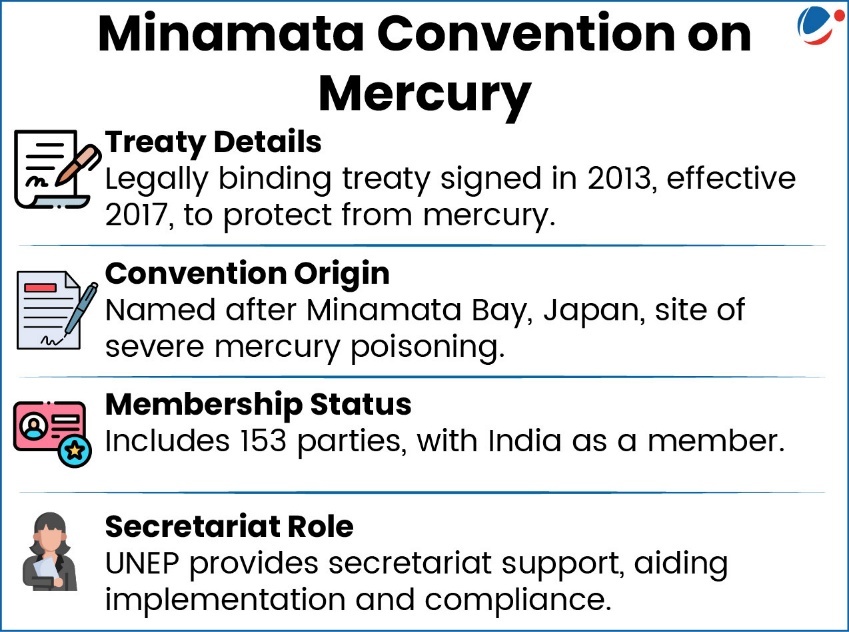
COP-6 to the Minamata Convention on Mercury (COP-6) in Geneva agreed to end the use of dental amalgam by 2034. It was also agreed to step up global efforts to eliminate mercury-added skin-lightening products.
About Mercury
- Properties:
- Mercury (Hg) is a naturally occurring, heavy, silvery-white transition metal with atomic number 80.
- It is ductile, malleable, and is able to conduct heat and electricity.
- It is the only common metal that is liquid at room temperature.
- Sources:
- Natural: Include volcanic eruptions, emissions from the ocean, etc.
- Anthropogenic: Mining (e.g. during gold mining), fossil fuel combustion, metal and cement production, etc.
- Usage: Historically used in thermometers, barometers, fluorescent lighting, certain batteries, and dental amalgams.
- Toxicity:
- Mercury emitted into the air eventually settles into water or onto land. Once deposited, certain microorganisms can change it into methylmercury.
- Methylmercury is a highly toxic form that builds up in fish, shellfish and animals that eat fish (bioaccumulation).
- Even very small amounts of mercury exposure can be highly toxic, affecting the nervous system, kidneys, skin, eyes, digestive system and immune system.
- Mercury emitted into the air eventually settles into water or onto land. Once deposited, certain microorganisms can change it into methylmercury.
Recent studies show that fall in water levels of Lake Turkana due to climate change has led to increased earthquake activity in the region.
- When a lake’s water level drops, the reduced weight decreases pressure on the Earth’s crust, making faults more prone to movement and increasing the likelihood of earthquakes.
Lake Turkana
- It is world’s largest permanent desert lake and largest alkaline lake.
- Location: It lies mainly in Kenya, with the northern tip extending into Ethiopia.
- Over 90% of inflow comes from the Omo River (located in Ethiopia).
- The Lake Turkana National Parks site was inscribed on the World Heritage List in 1997.
- Mount Semeru, Indonesia:
- Highest volcano on Java island.
- Part of the Pacific Ring of Fire, a highly seismically active belt.
- Type: Stratovolcano
- Other recent volcanic eruptions in Indonesia: Mount Lewotobi Laki Laki, Merapi Volcano etc.
- Hayli Gubbi, Ethiopia: Eruption sent a massive ash cloud across Red Sea and South Asia, causing a thick ash cloud toreach India leading to diversion of several flights.



