


Why in the News?
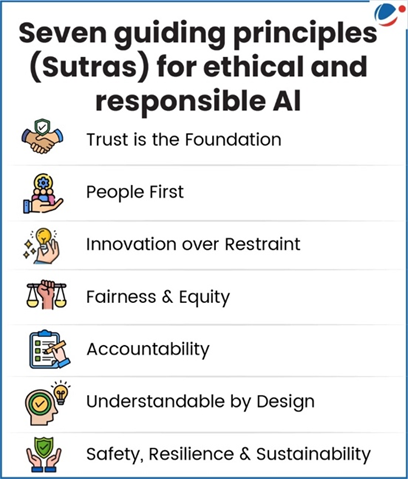
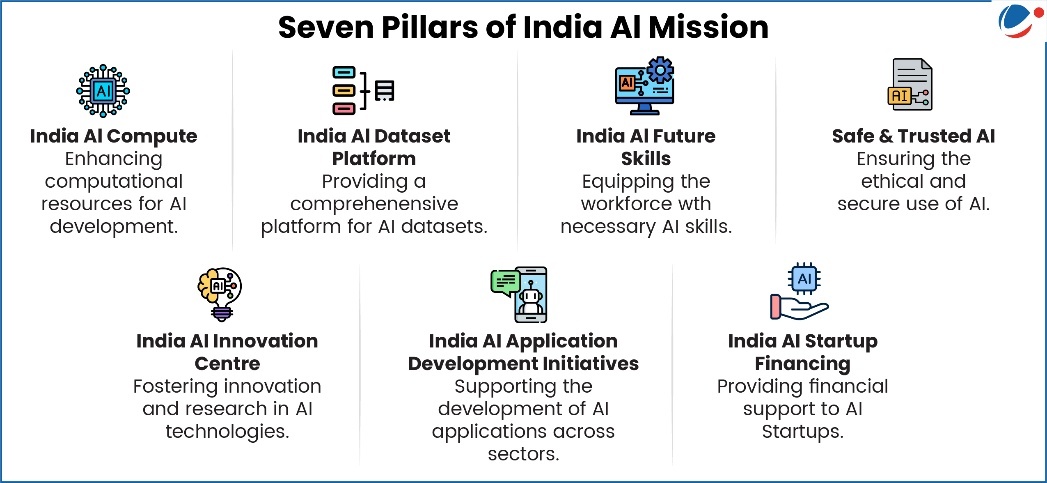
Recently, Union Ministry of Electronics and Information Technology (MeitY) has unveiled India AI Governance Guidelines under the IndiaAI Mission.
About India AI Governance Guidelines
- It proposes a robust governance framework to foster cutting-edge innovation, and safely develop and deploy AI for all while mitigating risks to individuals and society.
- Institutional framework to implement guidelines
- High-level body (AI Governance Group): For overall policy formulation coordination of AI governance in India across all agencies.
- Government agencies (MeitY, MHA, etc.) and Sectoral regulators (RBI, SEBI, TRAI, CCI, etc.): For issuing sector-specific rules, handling grievances in their respective domains, etc.
- Advisory bodies (NITI Aayog, Office of Principal Scientific Advisor, etc.): Supporting AI Governance Group with regular briefings and strategic advice on AI governance.
- Standards bodies (BIS, Telecommunication Engineering Centre, etc.): Developing standards in relation to AI risk taxonomies, certification standards, etc.
Issues in AI Governance
- Digital divide: Rural and underserved regions lag in Digital Public Infrastructure (DPI), high cost of deploying AI solutions and uneven adoption of AI due to weak computing access in sectors like agriculture, healthcare, public services etc. hinder uniform AI adoption.
- E.g., As per Internet in India (2024 Report), 51% rural population still does not access internet.
- Discrimination: AI trained on biased data can produce discriminatory outcomes in welfare, policing etc. deepening existing inequalities and disproportionately affecting marginalised groups without proper safeguards.
- Transparency and Accountability: AI's opaque "black box" decisions hinder transparency and accountability, especially in welfare and law enforcement, making it difficult to assess decisions and hold institutions answerable without clear audit mechanisms.
- Cyber security: Cyberattacks like data manipulation and model hijacking can target AI systems, disrupting public service delivery and leaking sensitive information impacting AI-enabled governance.
- Policy & Regulation: There is a need to urgently review existing sectoral laws to identify and plug regulatory gaps arising from AI-enabled decision-making, particularly in sensitive domains like healthcare and finance.
- E.g., PCPNDT Act must account for AI-based radiology tools that could enable unlawful sex determination.
- IPR-related issues: AI models trained on copyrighted material without consent raise ownership and compensation disputes, creating uncertainty over whether content creators or AI developers hold rights over resulting outputs.
- E.g., lawsuit against Google for providing "AI Overviews" (feature in search engines that uses Gen AI to provide a concise, AI-generated summary of search results).
- Petitioners raised concerns that 'AI Overview" may divert traffic and may adversely impact the revenue of publishers and content providers.
- E.g., lawsuit against Google for providing "AI Overviews" (feature in search engines that uses Gen AI to provide a concise, AI-generated summary of search results).
- Misuse: Malicious uses of AI such as deepfakes, data poisoning, adversarial attacks and AI-driven disinformation campaign, can disrupt critical infrastructure, undermine public safety and national security.
Initiatives taken for AI Governance
India
- National Strategy for AI (NSAI): NITI Aayog's #AIforAll strategy focuses on AI in sectors like healthcare, agriculture, and education.
- Digital Personal Data Protection Act, 2023: It enhances data protection for individuals and address AI-related privacy concerns.
- Global Partnership on AI (GPAI): To direct responsible development and application of AI with a focus on human rights, inclusion, diversity, and economic prosperity. India is a founding member of GPAI.
Global
- Europe's AI Act, 2024: Europe's first major regulation on AI, categorizing applications into four risk levels i.e. unacceptable, high risk, Limited risk and minimal risk.
- Bletchley Declaration, 2023: Signed by 28 countries and European Union, it establishes a shared understanding of the opportunities and risks posed by frontier AI.
- G7 pact on AI, 2023: It aims to establish a global framework for responsible development and use of AI systems, and participation is voluntary.
- OECD AI Principles, 2019: They are first intergovernmental standard on AI and promote innovative, trustworthy AI that respects human rights and democratic values.
 About IndiaAI Mission
|
Conclusion
By coupling risk-based regulation with innovation-friendly standards, investing in inclusive digital infrastructure, and strengthening institutional capacity, India can harness AI as a force multiplier for development rather than a source of exclusion or harm. A collaborative approach guided by transparency, accountability, and global cooperation, will be critical to ensure that AI remains aligned with constitutional values, public trust, and long-term national priorities, positioning India as a responsible and credible leader in the global AI ecosystem.




