


Why in the News?
GSAT-7R (CMS-03) Satellite was successfully launched aboard the LVM3 (India's heaviest operational rocket) from the Satish Dhawan Space Centre, Sriharikota.
More on the News
- CMS-03 is launched by Indian Space Research Organisation (ISRO).
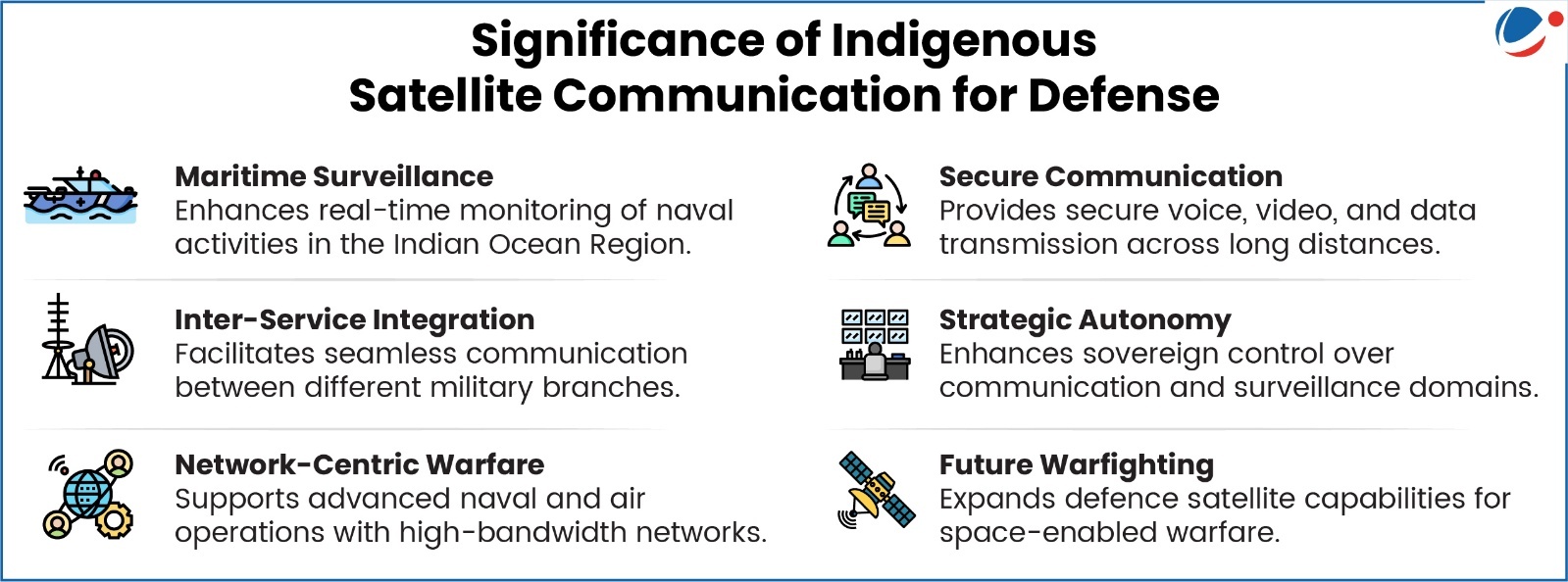
- GSAT-7R represents Indian Navy's determination to protect the nation's maritime interests leveraging advanced satellite communication in Defence through Aatmanirbharta.
About GSAT-7R (CMS-03) Satellite Communication
- It is a part of India's advanced defence satellite communication series GSAT-7.
- Satellite Communication refers to any communication link that involves the use of an artificial satellite in its propagation path.
- It is a form of wireless communication where satellites serve as relay stations in space, enabling the transfer of data over vast distances.
- Weight: ~4,400 kg.
- Orbit: Launched into the Geosynchronous Transfer Orbit (GTO), it will eventually settle into Geostationary Orbit (35,786 kilometers above Earth).
- Coverage: Provides multi-band telecommunication services across the Indian Ocean Region and Indian landmass up to 2,000 kms from India's coastline.
- Multiple Communication channels: The satellite operates on multiple frequency bands, which include UHF, S, C, and Ku. The system enables the transmission of voice, video and data.
- Lifespan: 15 years and will replace the multi-band communication satellite GSAT-7/INSAT-4F Rukmini.
- Purpose: Strengthens space-based communication, maritime domain awareness, and secure links among Navy ships, submarines, aircraft, and Maritime Operations Centres.
Other Satellites in the GSAT-7 Series
|
Conclusion
Satellite communication has become an indispensable pillar of India's defence preparedness, enabling secure connectivity, real-time surveillance and seamless coordination across land, air and sea. As threats grow more complex and space becomes a critical warfighting domain, strengthening SATCOM capabilities is essential for safeguarding national security and ensuring strategic superiority.

