


Why in the News?
Union Minister for Health and Family Welfare launched the National Action Plan on Antimicrobial Resistance (NAP-AMR) 2.0.
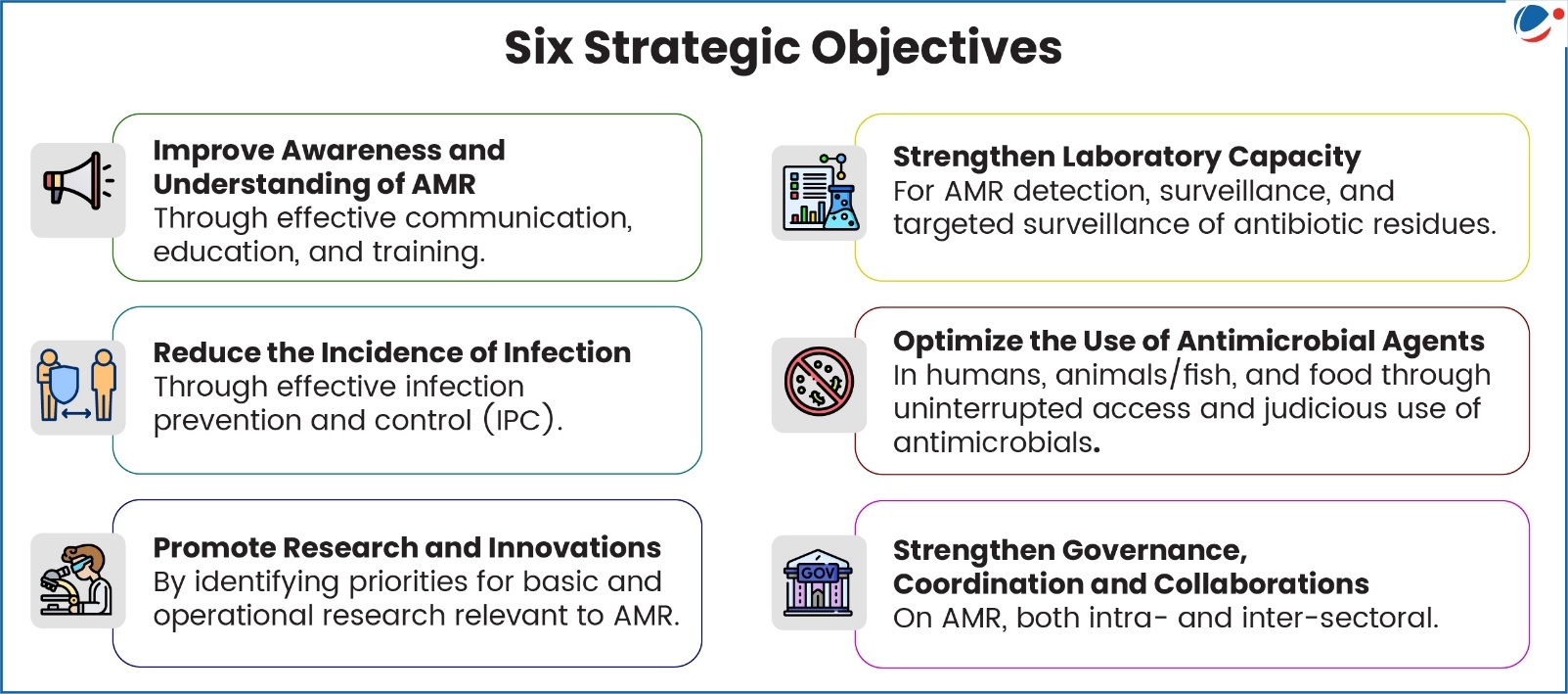
National Action Plan on Antimicrobial Resistance 2.0 (2025-29)
- Vision: To create a sustainable ecosystem for humans, animals, plants and environment by preventing emergence and transmission of AMR through Multisectoral evidence-based 'One Health' approach.
- The 'One Health' concept is the recognition that the health of people, animals, and the environment are fundamentally linked together.
- Key Features
- Based on "Whole of government" approach with sustained funding within each sector/ department.
- "Enforceable Accountability" Model: Over 20 ministries and departments have submitted specific, time-bound, and budgeted action plans.
- Integration of One Health Approach
- For the first time, NAP 2.0 mandates the systematic surveillance of antibiotic residues and resistant pathogens in the environment.
- Joint Working Groups comprising experts, National AMR Steering and Monitoring Committee for resolving inter-sectoral conflicts and ensuring strategic alignment.
- Others: Facilitating data sharing, focus on genomic surveillance, Prescription Audits, and Antimicrobial Stewardship Programs (AMSP) in hospitals to guide empirical prescribing.
Conclusion
NAP-AMR 2.0 represents a mature, comprehensive strategy. By moving from policy to budgeted action and embedding 'One Health' into the administrative DNA of multiple ministries, India aims to build a resilient defense against the escalating threat of antimicrobial resistance.


