


Why in the News?
Recently, the US President announced the resumption of nuclear weapons testing, a move that could weaken non-proliferation and disarmament efforts built over decades.
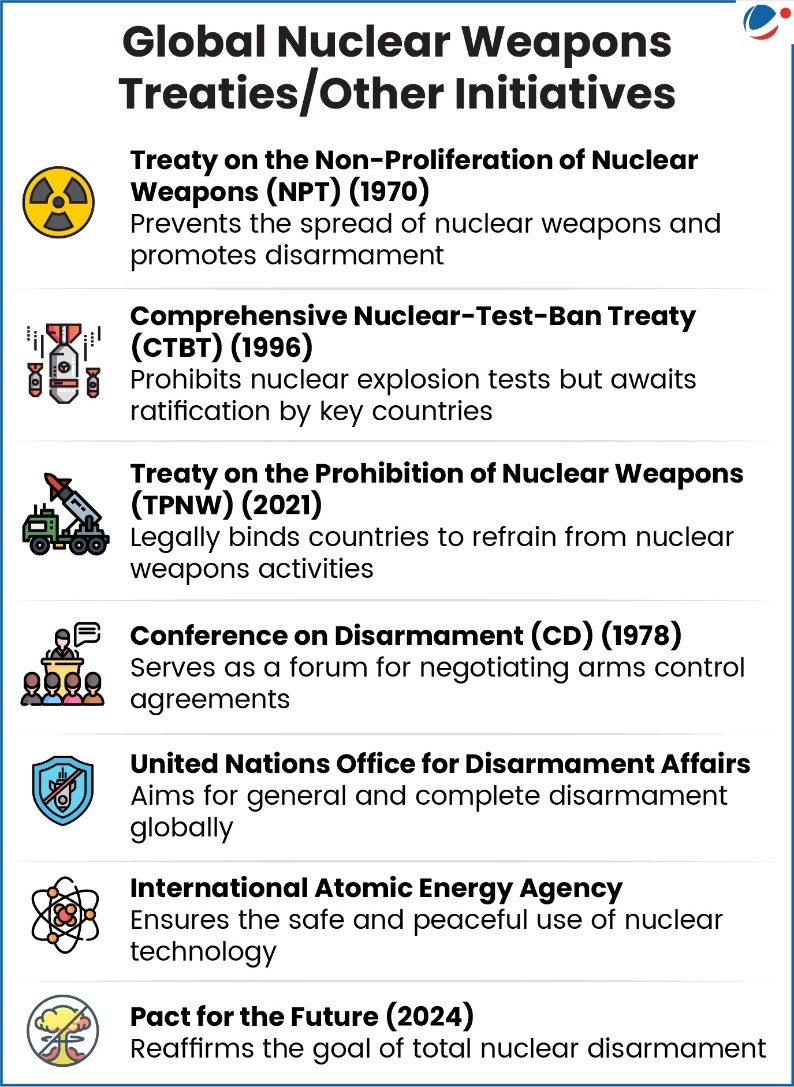
Factors behind Rising Nuclear Risk
- Geopolitical tensions: Rising conflicts push states toward nuclear securitization and readiness.
- E.g., SIPRI Yearbook 2024 notes that operational warheads have been increasing yearly.
- Doctrinal ambiguity: Lack of clarity on nuclear-response thresholds increases miscalculation risk.
- E.g., uncertainty on retaliation to cyber-attack on nuclear command systems.
- Treaty breakdown: Collapse of arms control agreements weakens communication and arms limits, raising escalation risk.
- E.g., Fall of INF Treaty (US–Russia), US withdrawal from Iran nuclear deal, etc.
- Faster delivery systems: New missile tech compresses decision time and raises misidentification dangers.
- E.g., Hypersonic missiles reduce reaction time for states increasing rapid escalation risk.
- False alarm risks: Early-warning errors can trigger accidental conflict unless checked by humans.
- E.g., 1983 Soviet false-alarm incident.
- Space militarization: Arms competition expanding to space creates new strategic instability.
- E.g., U.S. Space Force expansion.
- Weaponization of AI: Increased use of AI in military systems can raise nuclear-escalation risk by speeding decisions and increasing chances of misinterpretation, even outside nuclear platforms.
Nuclear Disarmament
- It aims to reduce or eliminate nuclear weapons globally, through unilateral decisions or international agreements, with the goal of a nuclear-free world.
- Key Issues
- Ineffective Global Platforms: Multilateral bodies show minimal progress, weakening confidence.
- E.g. Conference on Disarmament stagnation over decades reflects stalled diplomacy.
- Treaty Loopholes: Ambiguous clauses allow delay or avoidance of commitments. E.g., NPT lacks strict timelines for arsenal reduction.
- Exit from Agreements: Withdrawal sets precedents for non-compliance and erodes norms. E.g. North Korea's NPT exit.
- States Outside the Framework: De-facto Nuclear-armed countries not bound by core treaties challenge universality. E.g. India, Israel, and Pakistan remain outside NPT obligations.
- Commitment–Implementation Gap: States endorse disarmament in forums but upgrade weapons simultaneously. E.g. Russia backs NPT but also modernizes its delivery systems.
- Dependency on Nuclear Deterrence: Military spending gaps push reliance on nuclear deterrence for strategic parity. E.g., Russia sustains nuclear deterrence against NATO's stronger conventional forces.
- Lack of Binding Rules for Delivery Systems: Absence of dedicated legal controls enables unregulated missile competition.
- Ineffective Global Platforms: Multilateral bodies show minimal progress, weakening confidence.
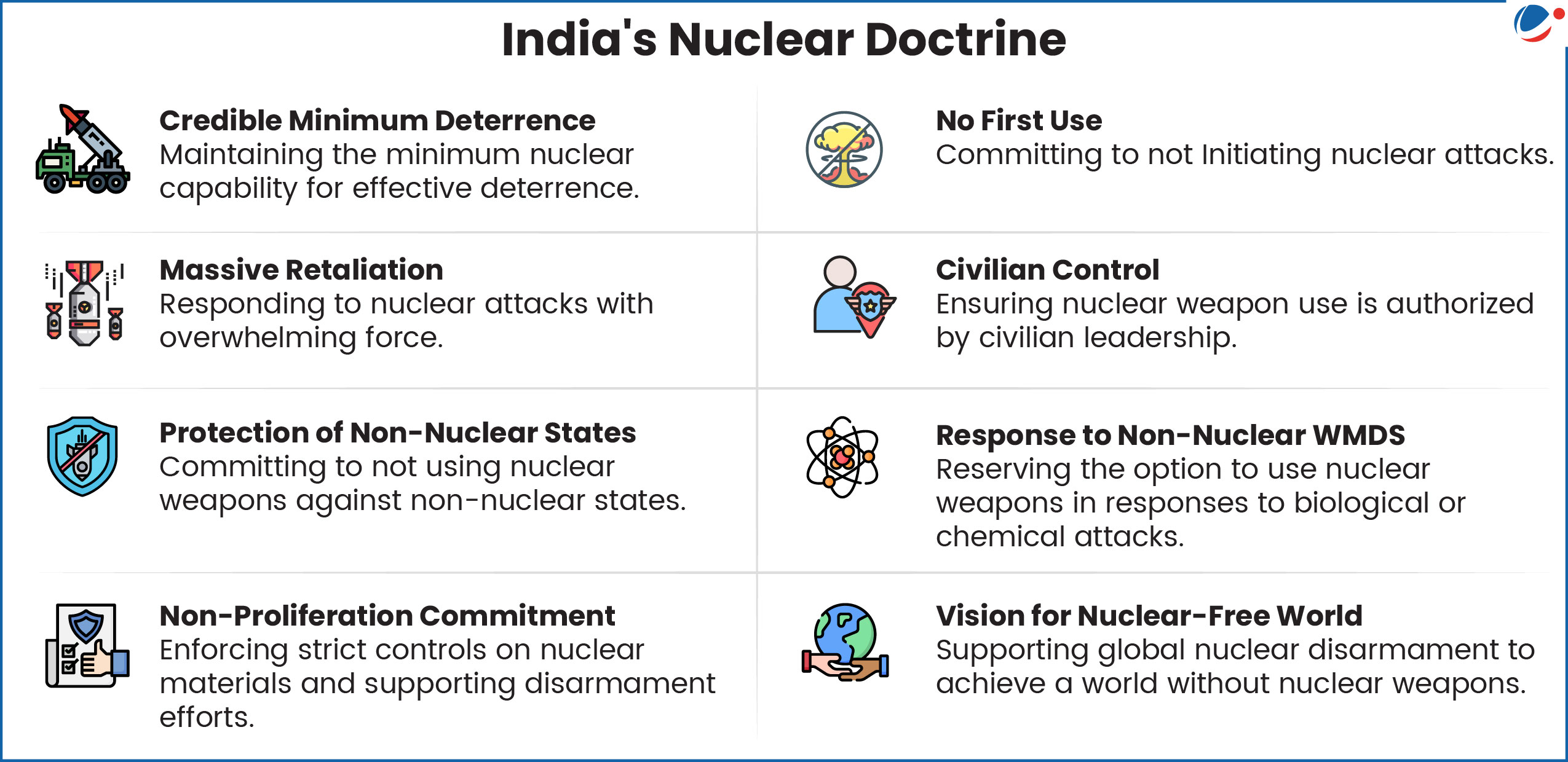
India's Stand on Nuclear Disarmament
- Core Principle: India supports global, non-discriminatory and verifiable nuclear disarmament that applies equally to all states.
- First to Call for Test Ban:India was the first country in 1954 to call for a worldwide ban on nuclear testing.
- Nuclear Ban Convention: India proposed a global convention in 1978 to prohibit the use or threat of nuclear weapons.
- Phased Disarmament Plan: India introduced a UNGA Action Plan in 1988 for eliminating nuclear weapons in three phases.
- Stand on Global Treaties
- NPT: Opposes because it recognizes nuclear weapons for only 5 countries.
- CTBT: Not signed due to lack of focus on nuclear disarmament and India's security concerns.
- TPNW: Not supported as it lacks new legal standards for disarmament.
- Multilateral Approach: India advocates negotiated universal agreements and supports a Nuclear Weapons Convention within the Conference on Disarmament, which it considers the main platform for a global nuclear ban treaty.
Conclusion
Mitigating nuclear risks will require rebuilding trust through renewed arms control, transparent doctrines, and inclusive multilateralism that keeps pace with emerging technologies. India's consistent advocacy for universal, non-discriminatory and verifiable disarmament, combined with restraint, risk-reduction measures and civilian oversight, offers a pragmatic pathway. Sustained dialogue, strengthened global institutions, and incremental confidence-building can together bridge the gap between deterrence realities and the shared objective of a nuclear-weapon-free world.


