


Why in the News?
NITI Aayog released the 4th edition of Export Preparedness Index (EPI) 2024.
What is Export Preparedness Index (EPI)?
- It is a comprehensive assessment of export readiness across India's States and Union Territories (UTs).
- The first edition of the EPI was published in 2020.
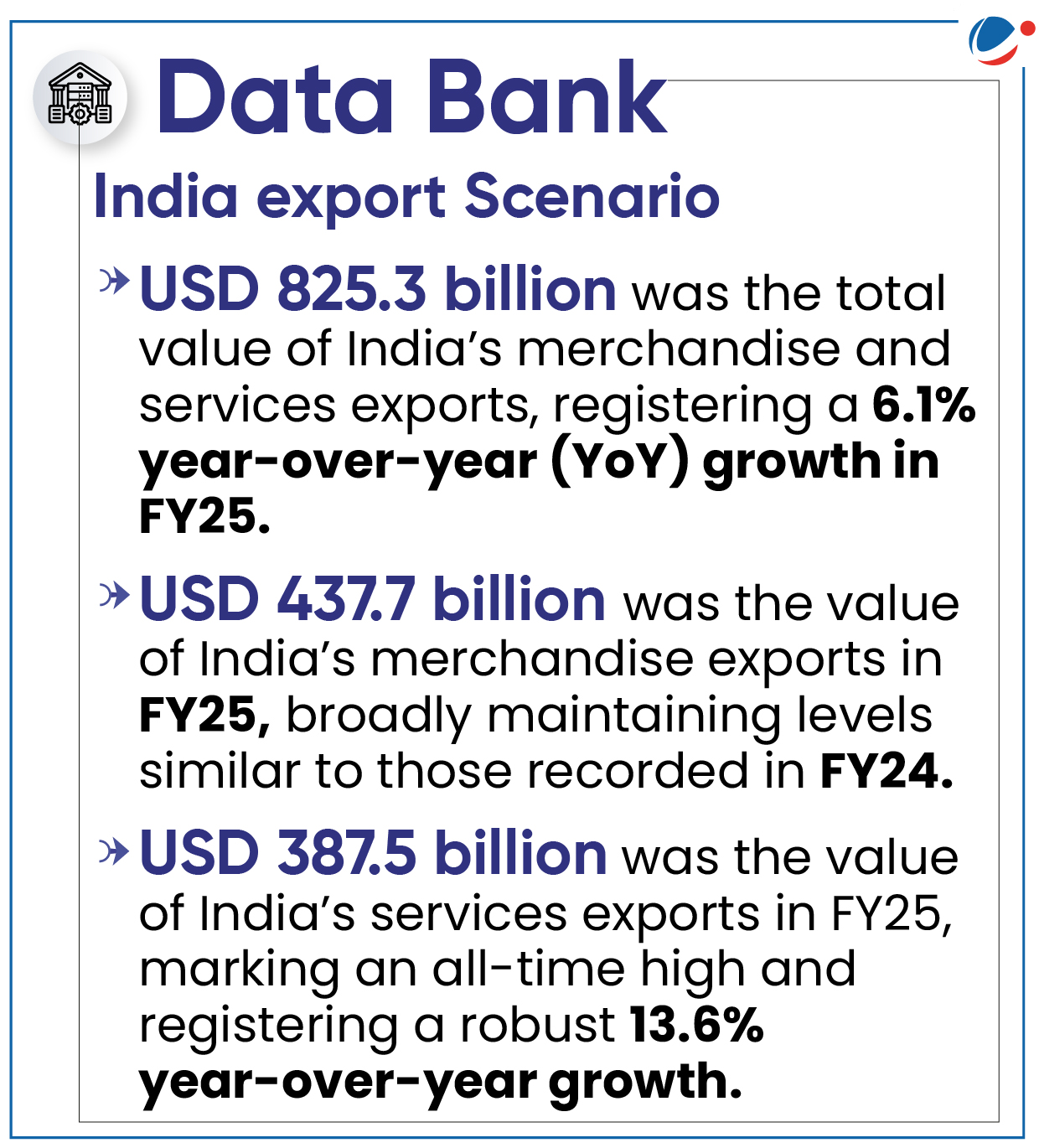
- It is aligned with India's objective of achieving USD 1 trillion in merchandise exports by 2030 and the vision of Viksit Bharat @2047.
- Enhancements to categorization of states in EPI 2024:
- Two major categories: Large States and Small States, North Eastern (NE) States & Union Territories (UTs) based on the aspects of land area, population and Gross State Domestic Product (GSDP).
- Within the categories, EPI 2024 classifies the states as:
- Aspirers: States in the early stages of developing their export potential.
- Challengers: States with emerging export potential that are enhancing foundational dimensions.
- Leaders: States that consistently demonstrate high export performance.
Key-findings of EPI 2024
- Leading Performers of EPI 2024
- Large States: Maharashtra, Tamil Nadu, Gujarat, Uttar Pradesh, Andhra Pradesh.
- Small States, North Eastern States & Union Territories: Uttarakhand, Jammu and Kashmir, Nagaland, Dadra and Nagar Haveli & Daman and Diu, Goa.
- Pillar-Wise weightage & performance
- Export Infrastructure (20%): It covers supply of power and water, ports, logistics network and last-mile connectivity that ensure timely delivery and reduced trade costs.
- E.g., Maharashtra hosts the Jawaharlal Nehru Port Trust (JNPT), India's largest container port, which handles over 50% of the country's containerized cargo.
- Business Ecosystem (40%): It evaluates the presence of industrial clusters, special economic zones (SEZs), and innovation hubs that enable businesses to scale efficiently.
- Export Infrastructure (20%): It covers supply of power and water, ports, logistics network and last-mile connectivity that ensure timely delivery and reduced trade costs.
- E.g., Gujarat's Industrial Policy 2020 and IT-ITES Policy 2022-27 focus on ease of doing business, research and development, and skill development.
- Policy & Governance (20%): It examines the policies that facilitate exports, the effectiveness of their implementation, and the role of state-level governance in supporting exporters.
- E.g., One District, One Product (ODOP) scheme in Uttar Pradesh has significantly boosted local industries and exports by promoting traditional crafts and goods.
- Export Performance (20%): It focuses on the tangible outcomes of a state's export efforts, such as the volume, value and diversification of exports.
- E.g., Karnataka's diverse and technologically advanced manufacturing base is a key driver of its strong export performance. The state excels in high-value sectors like aerospace, defence, electronics, auto components etc.
Challenges persist in Export sector of India
- Logistics and Connectivity: For e.g., Telangana landlocked geography and reliance on distant ports like Krishnapatnam and Visakhapatnam (600–700 km away) increase logistics costs and transit times, straining road and rail infrastructure.
- Price volatility: E.g., Gujarat's export profile is heavily skewed towards petroleum and petrochemical products, which make up over half of the state's total export value exposing it to global oil price volatility and environmental policy shifts.
- Competition: E.g., emerging competition from low-cost manufacturing hubs like Vietnam poses a challenge to Punjab's traditional export sectors such as textiles and agro-processing.
- Geopolitical tensions: E.g., Haryana's export resilience is challenged by overdependence on a limited set of markets primarily the U.S., UAE, and Europe, exposing it to external shocks from geopolitical tensions or trade policy change.
- Quality and Certification: E.g., Sparse network of National Accreditation Board for Testing and Calibration Laboratories (NABL) in Uttar Pradesh limiting its ability to meet global food safety standards.
- Cold Chain Deficits: E.g., In Dadra & Nagar Haveli and Daman & Diu the inadequate availability of cold storage and temperature-controlled logistics continues to limit the territory's ability to diversify into perishables, marine products, and pharmaceuticals requiring end-to-end cold chains.
Key Government Initiatives to Strengthen India's Export Landscape
- Export Promotion Mission (EPM): It is a flagship initiative announced in 2025 to strengthen India's export competitiveness, particularly for MSMEs, first-time exporters, and labour-intensive sectors.
- Establishment of Export Facilitation Centres (EFCs) across the country with an aim to provide requisite mentoring and handholding support to exporters especially MSMEs in exporting their products and services to foreign markets.
- Districts as Export Hubs (DEH) initiative was launched in 2019 to foster balanced regional development across all districts of the country to identify, brand, and promote products from each district, encouraging their sale in both domestic and international markets.
- National Logistics Policy (NLP) & PM Gati Shakti: Aim to reduce logistics costs and enhance multimodal connectivity through Geographic Information System (GIS)-based planning.
- Union Budget 2026-27 announced the complete removal of the Rs 10-lakh per-consignment value cap on courier exports, which will help small businesses, artisans and startups access global markets through e-commerce channels.
Conclusion
India must transition to a state-led, infrastructure-driven export strategy. Through targeted collaborations with regions such as the European Free Trade Association (EFTA) and the United Arab Emirates (UAE), India seeks to diversify its trade portfolio and strengthen resilient supply chains.





