


Why in the News?
The recent health crisis in Indore caused by contaminated municipal tap water have exposed the vulnerability of urban governance particularly, urban water systems.
More on the News
- National Human Rights Commission (NHRC) has taken suo motu cognizance of the incident in Indore.
- NHRC has noted that the main pipeline supplying drinking water to the area is found to be passing beneath a 'public toilet' thereby deteriorating the quality of the water.
- Contaminated tap water contained multiple harmful pathogens— including E coli, Salmonella and Vibrio cholerae bacteria, along with viruses, fungi and protozoa — that caused polymicrobial infections leading to multi-organ failure and sepsis among patients.
About Urban Water Governance
- Water supply is a state subject under Seventh Schedule.
- State Government/Urban Local Bodies is responsible to plan, design, fund, execute, operate and maintain the water supply systems.
- 74th Constitutional Amendment gave an expansive mandate to municipalities - from land regulation to water supply, sanitation, and environmental protection.
- At national level, Union Ministry of Housing and Urban Affairs oversees urban water infrastructure through programmes such as AMRUT and AMRUT 2.0.
- Bureau of Indian Standards (BIS) has specified drinking water quality standards (IS-10500-2012) in India.
- IS 10500 outlines the acceptable limit of various substances in drinking water, including heavy metals such as arsenic, and other parameters like pH value of water, its turbidity, total dissolved solids (TDS) in it, and colour and odour.
- As per BIS, water is defined as unfit for drinking if it is -
- bacteriologically contaminated (presence of indicator bacteria particularly E-coli, viruses etc.) or if
- chemical contamination exceeds maximum permissible limits (e.g., excess fluoride [>1.5mg/l], TDS [>2,000mg/l], iron [>0.3 mg/l], manganese [>0.3 mg/l], arsenic [>0.05mg/l], nitrates [>45mg/l] etc.).
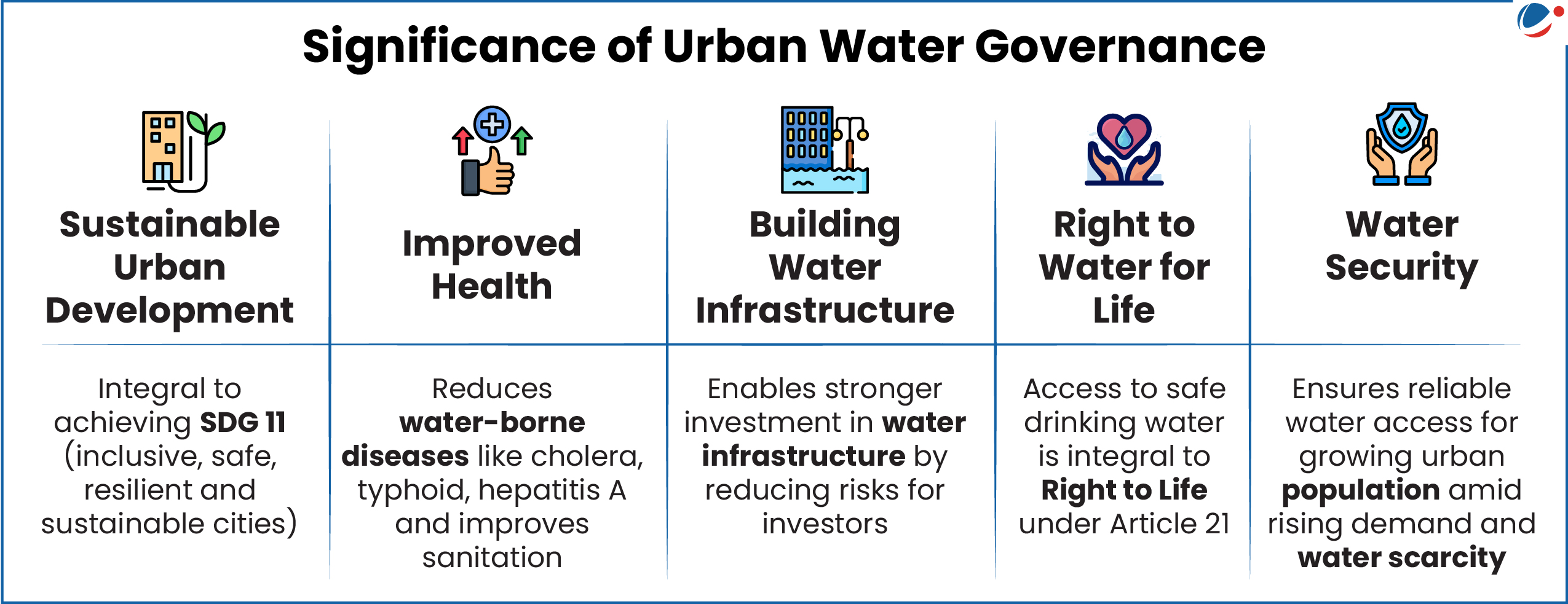
Challenges associated with Urban Water Governance
- Demand–Supply Gap: Rapid urbanisation and industrial growth are outpacing available water resources, leading to severe stress on urban water governance and sustainability.
- 21 major cities, including Delhi, Bengaluru and Chennai, were projected to run out of groundwater by 2020, potentially affecting around 100 million people. (NITI Aayog Composite Water Management Index, 2018)
- Fragmented Institutional Framework: Multiple agencies, overlapping jurisdictions and poor coordination hamper coherent urban water governance in cities.
- E.g., In Gurugram, PWD, Municipal Corporation, Gurugram Metropolitan Development Authority, etc. are responsible for service provisioning in different parts of the city depending on their respective jurisdictions.
- Inadequate Infrastructure: Ageing pipelines, leakages, and non-revenue water (often 30–50%) reduce effective supply and increase operational costs.
- It's estimated that around 38% of India's water supply is lost due to Non- Revenue Water (NRW).
- NRW refers to treated water that is fed into the distribution system but is lost before it reaches the consumer, either through physical losses (leaks and distribution losses) or apparent losses (theft, unmetered usage, or inaccurate billing).
- Climate Resilience: Urban water governance often fails to integrate climate impacts (like erratic rainfall and droughts), leading to fragile systems, flooding and unable to withstand stress especially during lean season.
- E.g. Chennai water crisis in 2019, where all four main reservoirs dried up, and Bengaluru water crisis in 2024.
- Wastewater Treatment: Most wastewater in urban India is not treated before discharge, increasing pollution loads and reducing availability of safe water. E.g. High level of pollutants in river Yamuna (New Delhi).
- Over-reliance on groundwater: Indian cities increasingly depend on over-extracted groundwater due to inadequate and intermittent piped water supply, leading to aquifer depletion and forcing households to rely on sources such as tankers and bore-wells, thereby deepening urban water insecurity and inequitable access.
Initiatives taken for management of Urban Water Resources
|
Way Forward
- Bridging Demand–Supply Gap: Adopt Integrated Urban Water Management by combining demand management (metering, rational pricing), and supply through rainwater harvesting, reuse of treated wastewater, rejuvenation of local water bodies to reduce pressure on limited freshwater sources.
- Institutional Framework: Create a single city-level water authority with clearly defined roles for supply, sewerage and storm-water management to improve coordination, accountability and integrated planning across jurisdictions.
- Upgrading Infrastructure: Modernise ageing pipelines, leak detection techno logies (pressure testing, acoustic leak detection, ground-penetrating radars) etc. and conduct regular water audits to reduce non-revenue water and improve efficiency and financial sustainability.
- Climate Resilience System: Integrate climate risks into urban water planning and promote nature-based solutions such as lake restoration, floodplain protection and decentralised storage to enhance resilience to droughts and floods.
- Wastewater Treatment and Reuse: Ensure full utilisation of sewage treatment capacity and mandate reuse of treated wastewater for non-potable purposes to augment urban water availability.
- Reducing Over-Reliance on Groundwater: Regulate groundwater extraction, promote recharge and storage, and ensure reliable piped water supply to reduce dependence on bore-wells and tankers.
- Strengthening 3Ps (Policy, People, Place) Framework: Urban water governance can be strengthened by aligning policies across sectors, encouraging active participation of people, and promoting cooperation across places (between cities and their surrounding water sources) to ensure sustainable and equitable water management.
Conclusion
Strengthening urban water governance is critical to ensuring public health, environmental sustainability and inclusive urban development. By aligning institutional reforms, infrastructure modernisation, and community participation, India can transform its urban water systems from fragile service providers into robust enablers of sustainable and equitable urban living.





