


Why in the News?
Ministry of Statistics & Programme Implementation (MoSPI) released the Consumer Price Index (CPI) with new base year 2024.
More on the News
- Key-findings of CPI for January 2026
- CPI General: Year-on-year inflation rate based on All India CPI with base year 2024 is 2.75%.
- Inflation rates for rural and urban are 2.73% and 2.77%, respectively.
- Food Inflation: Year-on-year inflation rate based on All India Consumer Food Price Index (CFPI) for the is 2.13%.
- Housing Inflation: Year-on-year Housing inflation rate is 2.05%.
Consumer Price Index (CPI)
- About: CPI is designed to measure the changes over time in general level of retail prices of selected goods and services that households purchase for the purpose of consumption.
- Each item in the CPI basket is assigned a specific weight, which reflects its relative share of total consumer spending.
- Genesis: CPI (Rural, urban and combined) has been started releasing by the MoSPI since January 2011 with base year 2010.
- CPI (Combined) which covers both rural and urban households is used as the headline inflation measure.
- The Base Year is a chosen year taken as a reference point (index = 100) to compare prices over time.
- It is important because it helps measure how much prices have increased or decreased and keeps inflation figures relevant and easy to understand.
- Formula: For compiling CPI, Laspeyre's Index Formula is used, which is based on three elements:
- Base Year Price: Average prices across all months of the base year.
- Base Year Weights: Weighting diagram prepared using the results of the Mixed Modified Reference Period (MMRP) data of Household Consumer Expenditure Survey (HCES).
- Under MMRP, different recall periods (7 days, 30 days, 365 days) are used for different categories of consumption expenditure.
- Current Month's Price: Collected monthly by MoSPI's Field Operations Division (FOD) for weighted items.
Need to update CPI base year:
- Structural Changes in Economy: Since 2012, shifts in consumption patterns, income levels, urbanisation and growth of the services sector demands updated weights.
- Technological & Market Evolution: Digital trade expansion (E.g., commerce) and fading rural–urban boundaries demand redesign of the inflation measurement framework.
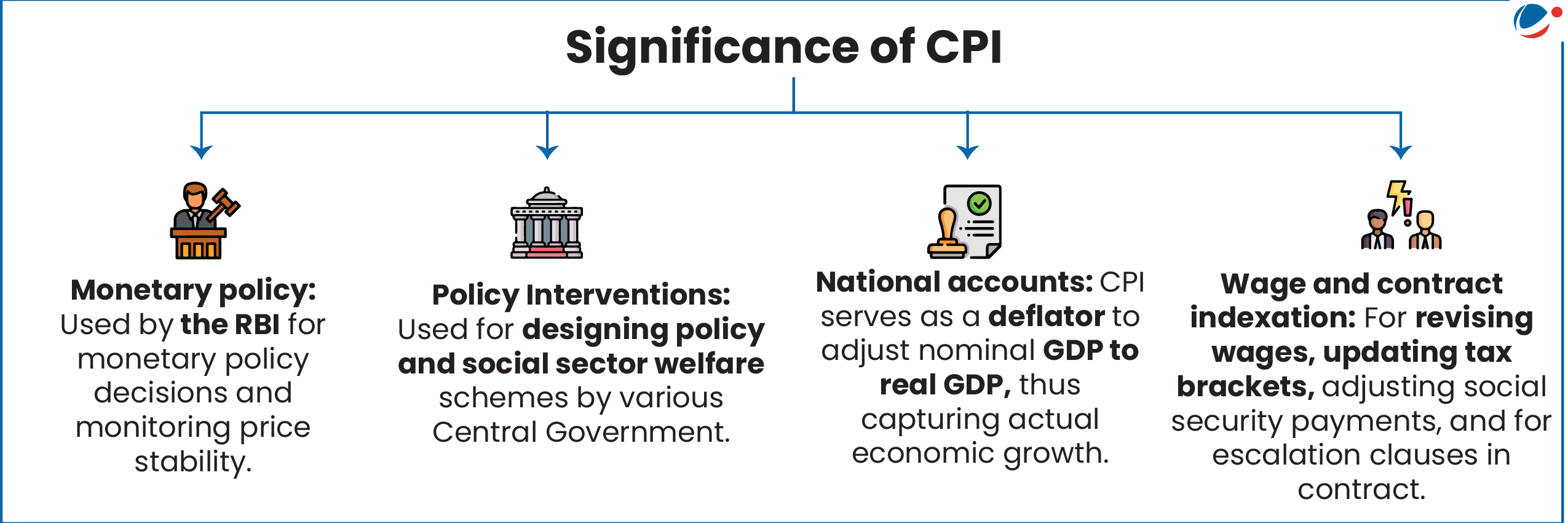
- Better Monetary Policy Transmission: As RBI relies on CPI (Combined) for inflation targeting (4% ± 2%), accurate weights ensure effective policy decisions.
- International Comparability: Aligning with global statistical standards improves credibility. Many countries revise CPI baskets every 3–5 years.
Key changes made in CPI 2024 in comparison to CPI 2012
Features | CPI 2024 | CPI 2012 |
Base Year | 2024 | 2012 |
Coverage of markets and items | Total number of weighted items in this basket will be 358 (goods will increase from 259 to 308 and services from 40 to 50 item). | At the All-India level, prices are collected for 299 items (number of items in rural are 288 in rural and 281 in urban). |
Changes in Items | New Additions: Rural housing, Online media service provider/Streaming services, Value added dairy products, Barley & its product, Pen-drive & External Hard disk, Attendant, Babysitter and Exercise equipment etc. Items Removed from 2012 CPI: VCR/VCD/DVD player and hiring charges, Radio, Tape recorder, Clothing second-hand, CD/DVD audio/video cassettes and Coir/rope. | |
Weight Reference | Household Consumption Expenditure Survey (HCES) 2023-24.
| Consumer Expenditure Survey (CES), 2011-12 |
Classification System | 12 Divisions based on Classification of Individual Consumption According to Purpose (COICOP 2018).
| 6 Groups based on COICOP 1999.
|
Data Collection Mode | CAPI (Computer Assisted Personal Interviewing) on tablets | Paper-based schedules |
Release of Housing index | All India, urban and rural (Rural rent included for the first time) | All India and urban. |
Weight of Food & Beverages (Highest weightage) | 36.75%. | 45.86%. |
Other important changes in CPI 2024
- Housing Index Compilation: In revised CPI, it is compiled using a weighted average of three constituent groups, namely "actual rental payments for housing", "maintenance, repair and security of the dwelling", and "water supply and other miscellaneous services" relating to the dwelling.
- Government and employer-provided accommodations will be excluded from the CPI housing index to avoid market distortion.
- Inclusion of alternative data sources: To reflect changing purchasing behavior, the CPI 2024 series supplement traditional collection with alternative data sources:
- E-commerce prices introduced as an additional market in 12 large towns (population exceeding 25 lakhs)
- Online sources for select services such as airfares and OTT subscriptions.
- Administrative data for standardized services such as rail fares, postal charges and fuel prices (Petrol, Diesel, LPG, CNG & PNG etc.)
- Linking Factor and Back Series: To facilitate continuity and ease of analysis on the basis of time series data, the linking factor is calculated to connect the two series over a common overlapping period.
- The overlapping period here is 2025, during which both CPI 2012 and CPI 2024 indices are available.
Conclusion
To maintain relevance, the MoSPI planning regular base revisions every 3 to 5 years based on Household Consumption Expenditure Survey data. A revised CPI will offer a more representative, transparent, and methodologically robust measure of retail inflation, aligned with global best practices and evolving consumption patterns.



