


Why in the News?
After signing Free Trade Agreement (FTA) with New Zealand India now has FTA with all Regional Comprehensive Economic Partnership (RCEP) countries, except China.
More on the News
- RCEP is a mega free trade agreement (FTA) involving the 11 ASEAN member states and their FTA partners: Australia, China, Japan, South Korea, and New Zealand.
- FTA is an agreement between the country(ies) or regional blocks to reduce or eliminate trade barriers, though mutual negotiations with a view to enhancing trade.
- It can however be comprehensive to include goods, services, investment, intellectual property, competition, government procurement and other areas.
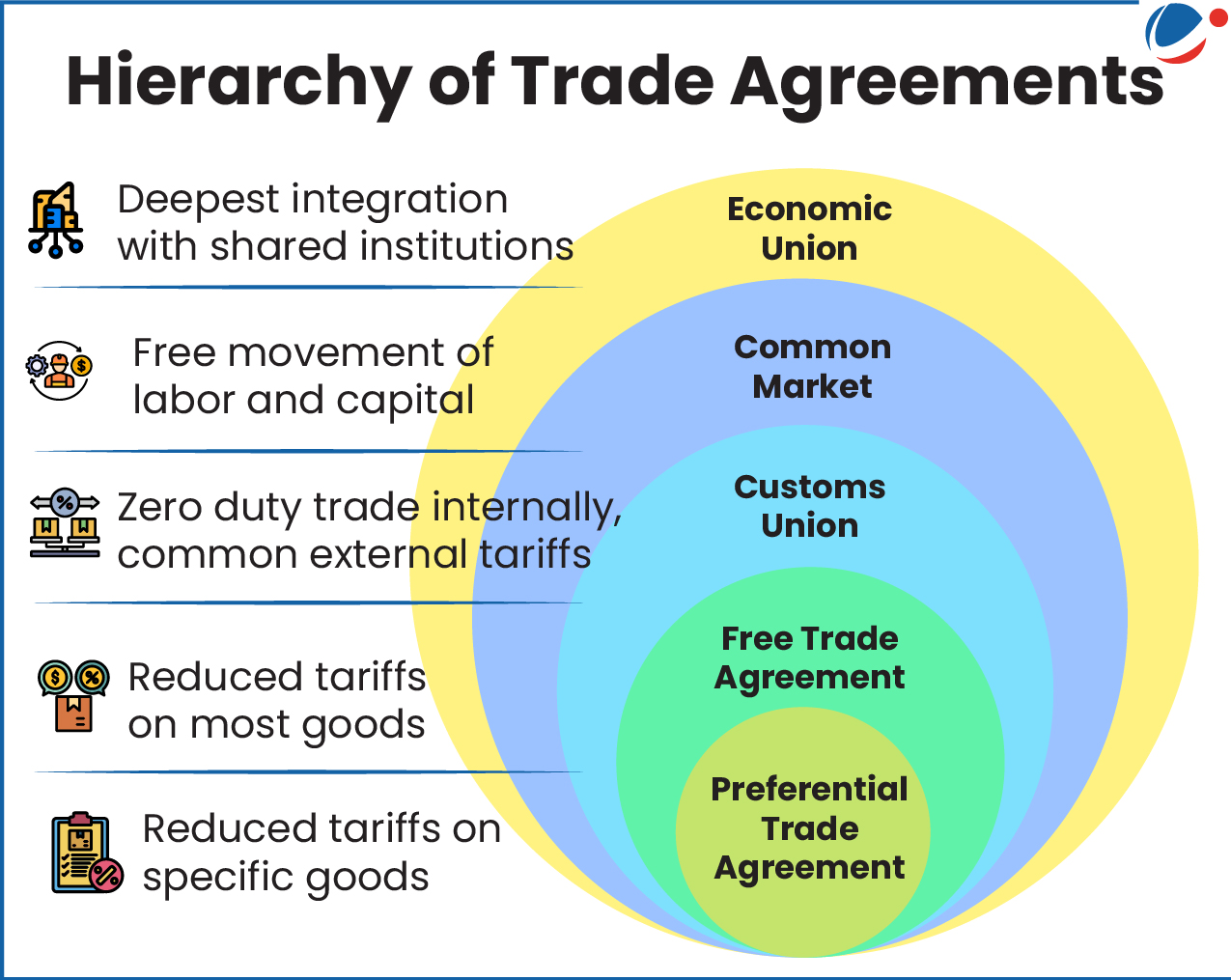
- Types of trade agreements: They can be categorized as per the level of economic integration (refer infographic).
FTAs signed by India in Recent Years
India has aggressively pursued bilateral agreements to integrate with the global economy while bypassing Chinese dominance. Key agreements and negotiations include:
- India-UAE CEPA: A comprehensive partnership agreement implemented in 2022 that covers goods, services, and digital trade.
- India-Australia ECTA: This agreement came into effect in December 2022, securing access to critical raw materials.
- India-EFTA TEPA: An agreement signed with the European Free Trade Association in March 2024.
- India-Oman CEPA: Signed in December 2025, this deal eliminates duties on over 99% of Indian exports to Oman.
- India-New Zealand FTA: Negotiations concluded in December 2025, completing India's strategy to have deals with all RCEP members except China.
- India-UK CETA: Signed in July 2025, this agreement grants duty-free access to 99% of Indian exports. It aims to double bilateral trade to $112 billion by 2030.
- India-EU FTA: Termed the "mother of all deals," this was signed in January 2026. It covers nearly 99% of India's export value to the bloc and opens access for Indian traditional medicine (AYUSH) practitioners.
Benefits of these FTAs
- Market Access: The India-EU deal is expected to remove duties on over 99% of India's export value to the region. Similarly, the Oman pact offers duty-free access to 98.08% of tariff lines.
- Boost to Labor-Intensive Sectors: Sectors such as textiles, leather, gems, jewelry, and footwear stand to gain significantly from duty elimination.
- Services and Mobility: New agreements focus heavily on services. The Oman deal allows for the long-term stay of Indian professionals and 100% FDI in key service sectors. The EU deal aids Indian traditional medicine (AYUSH) practitioners.
- Strategic Sourcing: Agreements with Australia and GCC nations secure energy sources and critical minerals necessary for India's growth.
- Investment Inflows: These partnerships aim to attract foreign investment. For example, the India-UK pact targets a bilateral trade of $100 billion by 2030.
- Integration of Micro, Small, and Medium Enterprises (MSMEs): Recent FTAs explicitly focus on MSMEs integration into the global economy as MSMEs contribute 50% of the country's exports.
- Mobility: Recent deals aggressively push for the movement of professionals.
- UK deal includes social security exemptions, and the New Zealand pact includes visa quotas for Indian workers.
- Geo-economics (Supply Chain Diversification): The "China Plus One" strategy drives India to forge ties with friendly nations to reduce economic dependence on a single supply chain.
- WTO's Decline: FTAs help overcome the decline of World Trade Organization (WTO) as trade negotiation platform for developing countries due to pressure from western nations, esp. USA.
- FTAs also allow countries to create rules for sectors the WTO has not successfully addressed, such as environmental protection and labor standards.
Legality of FTA under International Trade
|
Key concerns with India's FTAs
- Rising Trade Deficits: Historically, India has seen widening trade deficits with FTA partners like ASEAN, Japan, and South Korea after signing agreements.
- Low Utilization Rates: The utilization of FTAs by Indian exporters is low, ranging between 5% and 25%, due to complex compliance rules and lack of awareness.
- Non-Tariff Barriers (NTBs): Indian goods often face sanitary and phytosanitary (SPS) barriers in markets like Japan and the EU, limiting the benefit of tariff cuts.
- Carbon Taxes: The EU's Carbon Border Adjustment Mechanism (CBAM) poses a risk to Indian steel and manufacturing exports, though India has sought safeguards.
- Sensitive Sectors: Negotiations frequently stall over market access for automobiles, wines, and the protection of the dairy/agriculture sectors.
- India excluded dairy from the EU and New Zealand deals to protect domestic farmers' livelihoods.
- Low Awareness: MSMEs often lack adequate information about FTA benefits.
Key Recommendations by the High-Level Advisory Group chaired by Surjit Bhalla
- Strategic selection of partners and value chains: Combine trade intensification with traditional partners while exploring regions with low current linkages, such as Eurasia, Central Asia, Africa, and Latin America.
- India should launch a five-year program for the negotiation of FTAs identified based on complementarity and long-term sustainability.
- Integrated and deeper scope: Negotiations should adopt an integrated approach covering trade in goods, services, and investment. For services, India should move beyond just Mode 4 (movement of persons) to include Mode 3 (commercial presence), as Indian businesses are increasingly interested in investing abroad.
- India should identify and resolve non-tariff barriers that prevent exports to key partners and implement extensive technical regulations based on international standards to facilitate access to partner markets.
- Institutional and process reforms: An institutional mechanism should be established to seek inputs from stakeholders prior to finalizing an FTA to minimize adjustment costs for the industry.
- The "whole of government" approach is required, ensuring that different ministries and state governments are involved in decision-making.
- Government should create a database detailing the utilization of various FTAs and CEPAs.
- Advocacy and MSME support: A sustained medium-term advocacy program should be launched to spread awareness among the industry about potential opportunities and utilization of FTAs, with a specific focus on the MSME sector.
- Managing Trade deficit and Rules of Origin: Adequate provisions for trade remedies (like anti-dumping) should be available within FTAs and used based on scientific economic proof.
Conclusion
India's expanding FTA network marks a strategic shift toward proactive trade diplomacy. By aligning domestic reforms with external commitments, strengthening negotiation expertise, and empowering MSMEs and services sectors, India can transform FTAs from mere market-access instruments into engines of sustainable growth, supply-chain resilience, and long-term global competitiveness.


