
‘Board of Peace’ for Gaza | Current Affairs | Vision IAS

Upgrade to Premium Today

Start Now
MENU
Home
Quick Links

High-quality MCQs and Mains Answer Writing to sharpen skills and reinforce learning every day.

Watch explainer and thematic concept-building videos under initiatives like Deep Dive, Master Classes, etc., on important UPSC topics.

A short, intensive, and exam-focused programme, insights from the Economic Survey, Union Budget, and UPSC current affairs.

ESC

‘Board of Peace’ for Gaza

01 Mar 2026
2 min

In Summary

  • India attended the inaugural Board of Peace meeting in Washington D.C. as an observer.
  • The Board of Peace, part of the US Gaza Peace Plan endorsed by UNSC Resolution 2803, aims to resolve global conflicts beyond Gaza.
  • Arguments for the Board of Peace cite efficiency and diverse stakeholder inclusion, while concerns include undermining international law, sovereignty, and potentially excluding the Global South.

In Summary

Why in the News?

Important of Board of Peace

India attended the Board of Peace inaugural meeting held in Washington D.C. as an observer. 

About Board of Peace

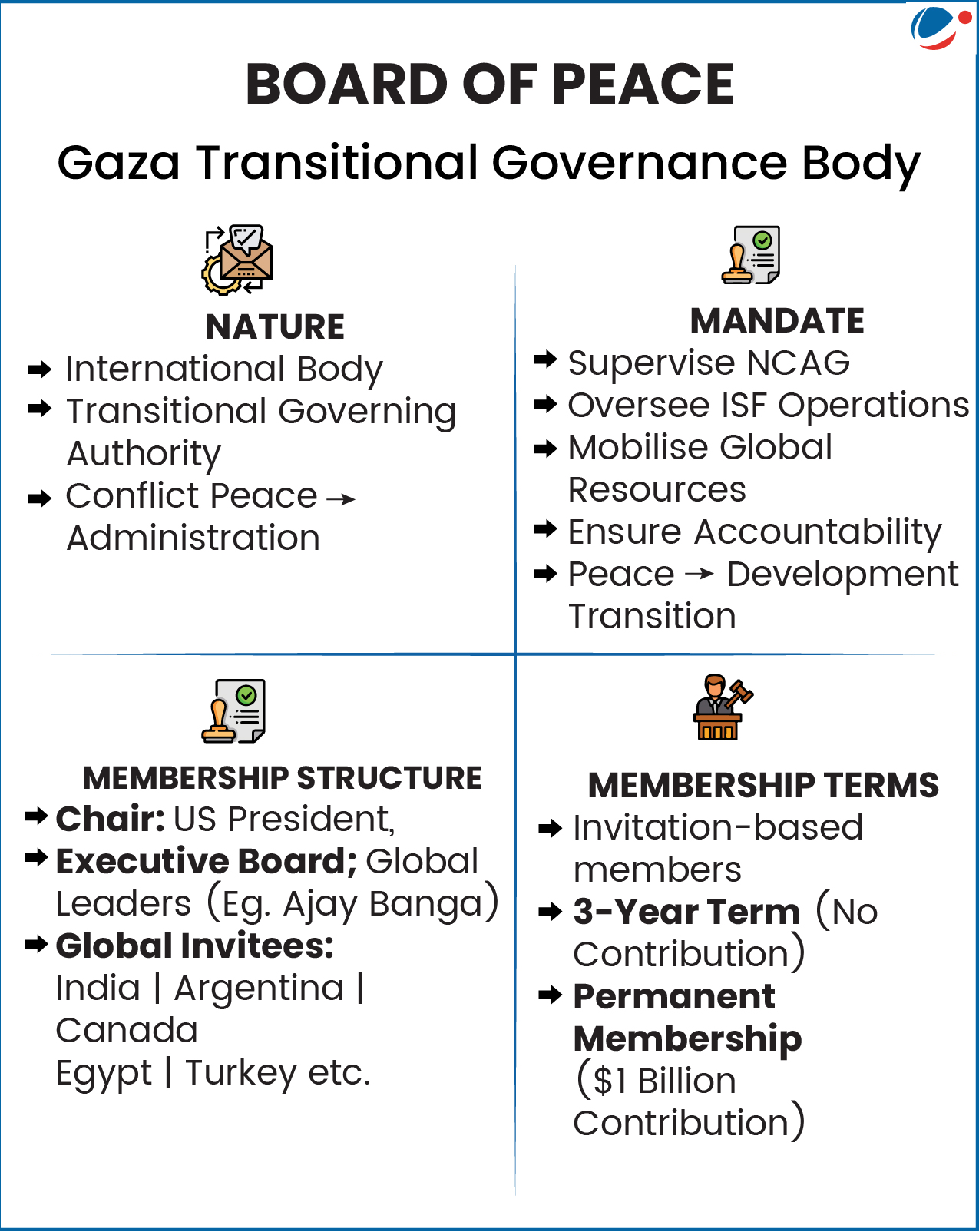
  • Board of Peace is a core element of the US 20-point Gaza Peace Plan (Comprehensive Plan to End the Gaza Conflict), which was endorsed by the UN Security Council Resolution 2803 (2025).
    • The formation of the National Committee for the Administration of Gaza (NCAG) and the International Stabilization Force (ISF) was also initiated.

The Board of Peace is being seen as a new approach to resolving Global Conflict, beyond its role in Gaza and the Middle East. It can be seen as a shift toward minilateral, leader-centric institutions over universal multilateralism.

Can the Board of Peace be an alternative to the United Nations (UN)?

Arguments in Favour

Arguments Against

  • Efficiency and Outcomes: Due to its structure, the Board can be more result-oriented compared to the UN consensus model which practically delays or hinders action-oriented outcomes.
  • Diverse Stakeholder approach: Inclusion of private sector experts along with world leaders makes it multi-faceted in ensuring sustainable outcomes.
  • Potentially undermines international law and democratic representation. E.g. lacks checks and balances of the UN General Assembly
  • Sovereignty Concerns: Potentially favours external trusteeship instead of local democratic voice.
  • Exclusionary nature: Possible limited and paid membership  may hinder balanced global order by marginalizing the "Global South."

Explore Related Content

Discover more articles, videos, and terms related to this topic

RELATED VIDEOS

1
Role of Indian Diaspora in Making India Self-Reliant

Role of Indian Diaspora in Making India Self-Reliant

YouTube HD

RELATED TERMS

3

Global South

A term used to refer to countries in the world generally considered to be less economically developed, often comprising countries in Africa, Latin America, and Asia.

Multilateralism

A foreign policy approach characterized by cooperation and agreement among multiple countries, often through international organizations and treaties. This contrasts with unilateralism or bilateralism.

Minilateralism

A form of international cooperation involving a small group of countries, distinct from broader multilateralism, which is being presented as a new approach to conflict resolution with institutions like the Board of Peace.

Title is required. Maximum 500 characters.

Search Notes

Filter Notes

Loading your notes...
Searching your notes...
Loading more notes...
You've reached the end of your notes

No notes yet

Create your first note to get started.

No notes found

Try adjusting your search criteria or clear the search.

Saving...
Saved

Please select a subject.

Referenced Articles

linked

No references added yet
